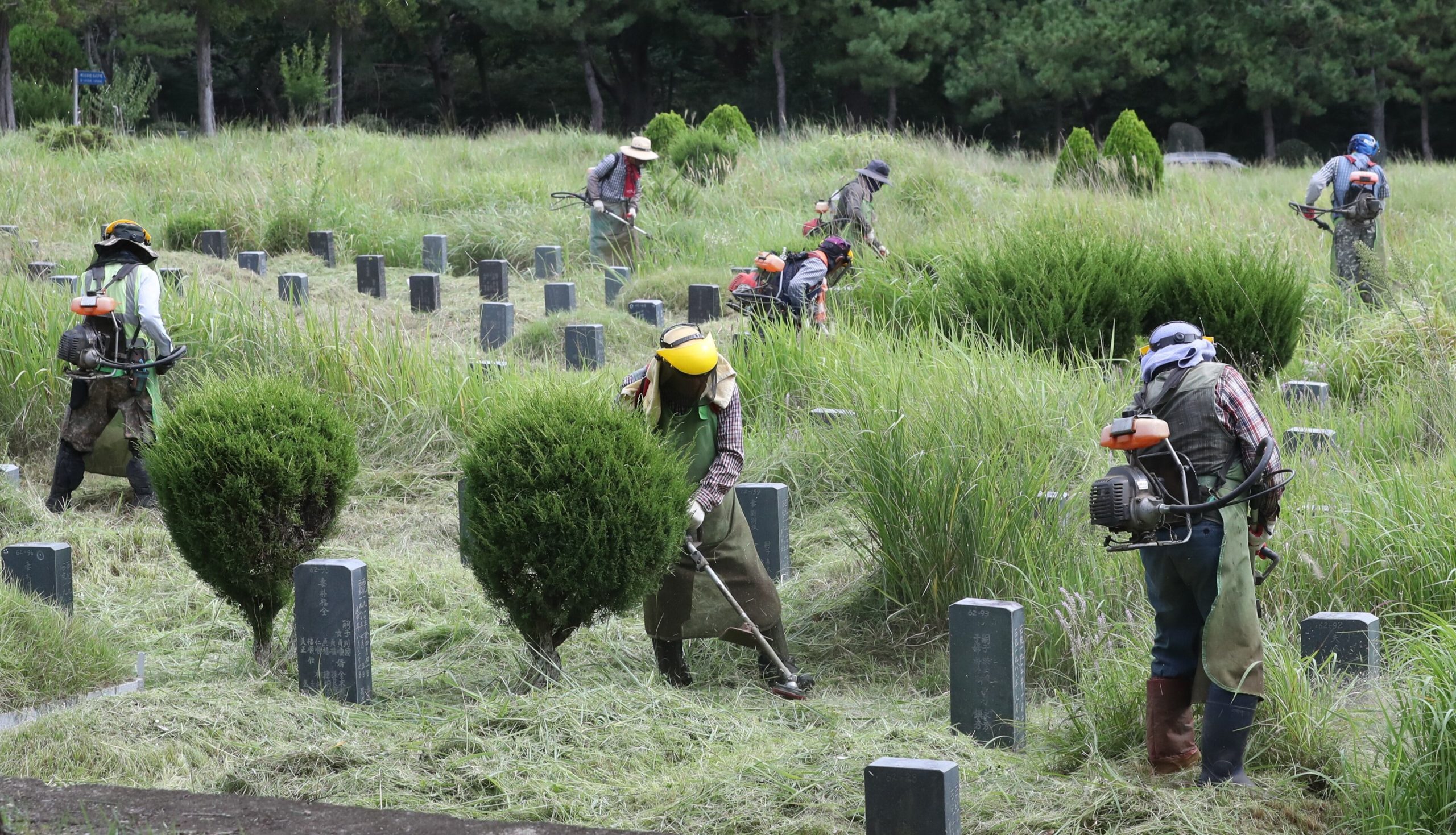
Lee, 66 years old, who lives in Cheongju, North Chungcheong Province, visited his hometown of Ulsan on September 5 to trim grass around his family graves. For him, who has accompanied his father and uncles to grave sites since childhood, climbing mountains with a brush cutter, sickle, and rake is a familiar routine. He still performs grave maintenance two to three times a year. It took five hours to tidy up seven graves of his parents and grandparents that day. Lee said, “It’s true that my age makes it physically demanding,” but added, “I plan to continue as long as I can.” However, he has no intention of passing the responsibility to his children. “We do it because we’ve always done it, but I don’t want to force it on the kids,” he said. He also has no plans to leave a grave for himself.
Many people in their 50s and 60s, like Lee, care for ancestral graves but do not intend to pass the duty to the next generation. Between generations that view grave maintenance as a family obligation and those that do not, the 50–60 age group is effectively becoming the “last generation” to perform the ritual.
◇ Grave Maintenance Bridging Families, Also a Seed of Conflict
Grave maintenance was long considered a natural duty of descendants. The late Joseon-era agrarian calendar *Nongga Wolryeongga* lists “clearing ancestral graves” as a task for the seventh lunar month. Until about 30 years ago, burial was the dominant funeral practice in South Korea. In 1993, 8 out of 10 deceased individuals were buried. Descendants would visit graves ahead of Chuseok (Korean Thanksgiving) to cut overgrown grass and tidy the area. In Jeju, where grave maintenance culture was particularly strong, schools even had a “grave maintenance vacation” around the first day of the eighth lunar month until the 2000s. Airlines operated special flights for people returning to their hometowns during this period.
Grave maintenance was not just about managing burial sites. It was an act of filial piety and a communal ritual where dispersed relatives gathered. Children learned family history while accompanying adults to the mountains, and after maintenance, they shared meals and caught up. This naturally strengthened bonds among relatives. Lee, 59, from Jeollanam-do Gwangju City, said, “Since relatives live scattered, it’s hard to see each other even a few times a year, but meeting during grave maintenance and sharing stories is good. Even though cutting grass is tiring, it feels rewarding afterward.”
However, grave maintenance can also sow conflict. Disagreements over participation often strain family relationships. Kim, 25, a university student, received a call from his uncle last week: “Clear your schedule for Sunday; we’re going to trim the graves.” Kim said, “I felt resistant because they didn’t consider my busy schedule after the semester started and assumed I should attend.” Social media is filled with posts about such conflicts during the grave maintenance season. On the eighth, a thread described how a father-in-law told his son-in-law, who cited health issues to avoid grave maintenance, to bring his 5–6-year-old children by 8 a.m. The writer said, “When I said we couldn’t go, my father-in-law remarked, ‘What’s so important about dead ancestors?’ I don’t understand why only our family is pressured when my brother-in-law doesn’t attend.”
◇ 70% of 50–60 Age Group: “No Burden on Children”
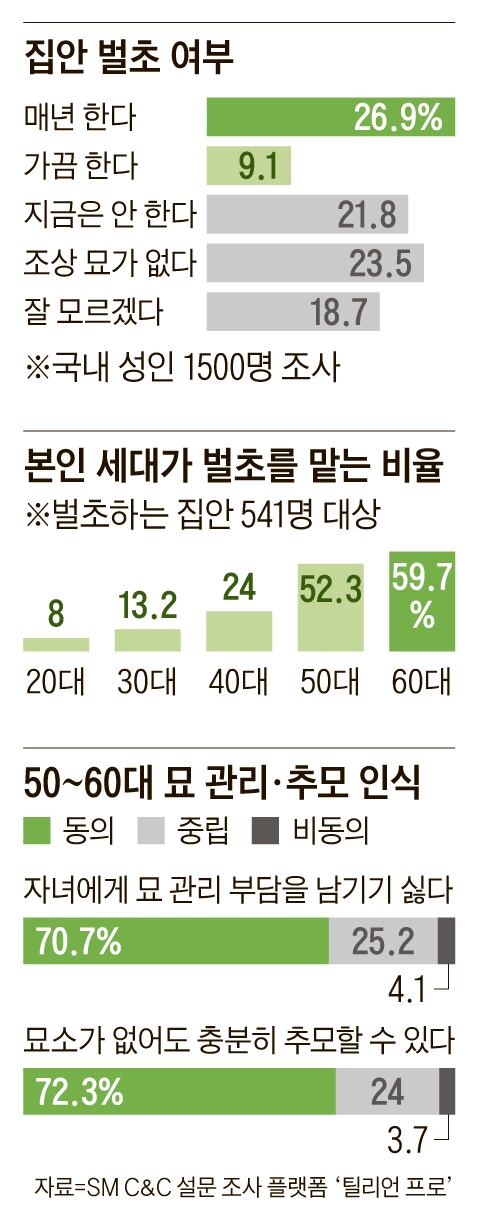
The question surrounding grave maintenance has shifted from “Who will do it this year?” to “Will it be passed to the next generation?” In a survey of 1,500 people aged 20–60 nationwide commissioned by *Anyhow, Weekend* via SM C&C’s survey platform *Tillion Pro*, 36% responded that their families perform grave maintenance annually or occasionally. Among them, only 8% of respondents in their 20s, 13.2% in their 30s, and 24% in their 40s said their generation primarily handles the task. In contrast, 52.3% of those in their 50s and 59.7% in their 60s—over half—said they are responsible. However, few in their 50s–60s wanted their children to continue the practice. Only 7% of current grave-maintaining 50–60-year-olds wished for their children or the next generation to “definitely continue,” while 42% said they “do not want to pass it on.” A total of 70.7% of all 50–60-year-old respondents agreed that they “do not want to leave the burden of grave management to their children.”
Nam, 65, from Busan, plans to trim his family graves in Uljin, North Gyeongsang Province, on the 12th. As the youngest of six siblings (two brothers and four sisters), he has accompanied his father since adulthood. After his father’s death, he did it with his eldest brother, and after the brother’s passing, with his youngest sister. However, for the past three years, he has stopped maintaining graves of ancestors beyond his great-grandparents. When he last visited, he said, “It will be difficult for descendants to come for grave maintenance.” He still personally cares for his parents’ and grandparents’ graves but plans to exhume and cremate them or say a final farewell if he can no longer maintain them. He also has no intention of leaving a grave for himself. Nam said, “Even if we build a grave, there will be no one to maintain it. I hope my children will do what they prefer.”
The younger generation is already distancing itself from grave maintenance. Kim, 39, a office worker, left a group chat where relatives shared grave maintenance schedules last year. Kim said, “The chat notified us of duties and fees, and it was stressful during the grave maintenance season. After a ‘silent exit’ feature was added, which lets users leave without notification, my cousins in their 20s–30s and I all left.” He added, “It’s hard to accept that we must care for graves of ancestors we’ve never met, even several generations back.”
According to a 2010 report by the Korea Institute for Health and Social Affairs on grave management projections, the core age group for grave maintenance at the time was those born between 1955 and 1970 (then aged 40–55). Now aged 56–71, most of this group has either exceeded or is nearing 65, the age at which physical burden excludes them from practical grave management. The study assumed all deaths were buried and male descendants managed graves, projecting per-person grave management burdens. It found that while the 1955–1970 generation managed 0.67 graves per person, the burden would rise to 3.15 for their children, 8.11 for grandchildren, and 15.92 for great-grandchildren. The study assumed a total fertility rate of 1.22 for the third and fourth generations, but the actual rate dropped to 0.8 last year. Graves accumulate while descendants dwindle, increasing the burden per person in younger generations. Low birthrates, nuclear families, and weakened kinship bonds have turned grave maintenance succession into a structural family issue. The question is no longer “Who will do it?” but “Can these graves be maintained at all?”
◇ “Less Labor-Intensive and Sustainable Methods”
An increasing number of people pay for grave maintenance services provided by forestry cooperatives, agricultural cooperatives, and private companies. This year, 140 member cooperatives nationwide participate in the forestry cooperative’s grave maintenance helper program. The average fee is 114,014 Korean won per grave, varying by mound count, grave area, and travel distance. The forestry cooperative’s grave maintenance service revenue increased by over 40% from 4.7219 billion Korean won in 2021 to 6.6702 billion Korean won last year. A grave maintenance service provider said, “Most customers are in their 50s–60s and have no intention of burdening their children. Recently, we’ve introduced a ‘subscription service’ where customers pay a little extra for three non-peak-season maintenances along with one peak-season service during Chuseok.” In the survey, 42.5% of respondents whose families currently perform grave maintenance said they would hire a service if the current maintainer could no longer do it. This proportion reached 50.6% among those in their 60s.
However, outsourcing only cuts grass—it doesn’t eliminate the need for grave management. Some are now considering relocating or closing existing graves. Demand peaks during leap months due to the superstition that “unlucky tasks done during leap months bring no misfortune.” In 2004, a leap year, 53,866 cases of exhumation and cremation occurred. In 2023, another leap year, this number rose to 119,463. Fewer people are also choosing burial. In 2024, the cremation rate reached 94%. In last year’s Ministry of Data and Statistics social survey, only 6.8% preferred burial for their own funerals. Responses favoring cremation followed by enshrinement in a memorial facility were 36.5%, natural burial 32.2%, and scattering ashes in mountains, rivers, or the sea 23.8%. Since last year, “sanbunjang” (scattering ashes in designated areas) has been legally recognized as a funeral method. In the survey, 72.3% of respondents in their 50s–60s agreed that “ancestors can be sufficiently memorialized without graves.”
Professor Lee Jeong-seon from the Department of Funeral Guidance at Eulji University said, “Funeral practices are shifting from burial to cremation, from enshrinement to natural burial or scattering—toward less labor-intensive and sustainable methods. In the future, memorial practices that honor the deceased without physical graves will likely increase.”
- 월 5900원 멤버십, 신문 독자에게는 2900원, 조선멤버십
- 55000원 상당의 신문-잡지 8종 마음껏 보기, 조선멤버십
- 현금처럼 쓸 7000포인트 받아 알뜰한 쇼핑, 조선멤버십

Related posts:
Artists protest National Theater for Young Audiences’ non-specialist appointment

Booker-winning translator Deepa Bhasthi on why she has ‘nothing kind to say about AI’
Beijing signals support for rebuilding flood-ravaged Rasuwagadhi route

Infrastructure Minister Sunil Lamsal on rebuilding after the Bhotekoshi floods
Why Nepal’s climate crisis is also a public-health emergency