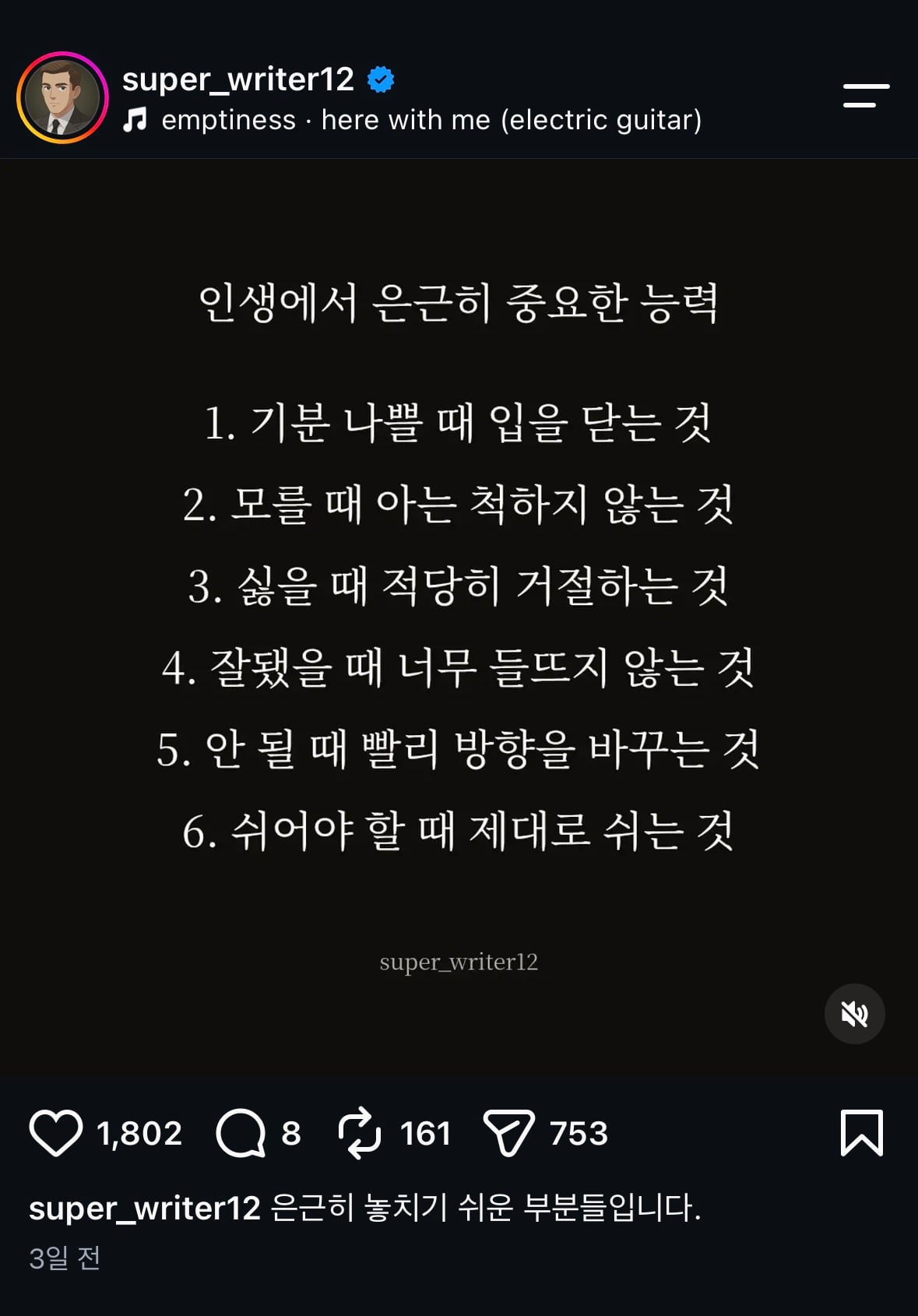
Haruki Murakami runs 10 kilometers every day. It’s to build the endurance and physical strength needed for writing. No matter what you do, physical strength must underpin it. Those who don’t exercise cannot last long.
A 44-year-old office worker Kim, who lives in Seoul, starts his day by reading such “advice” on an SNS account he follows. Kim said, “Last year, short pieces of advice began appearing frequently on my algorithm. At first, I ignored them because I didn’t know the source or who posted them, but after seeing them repeatedly, I found many relatable stories. So this year, I started following the account.” As of early this month, the number of followers of this advice account has surpassed 130,000 people.
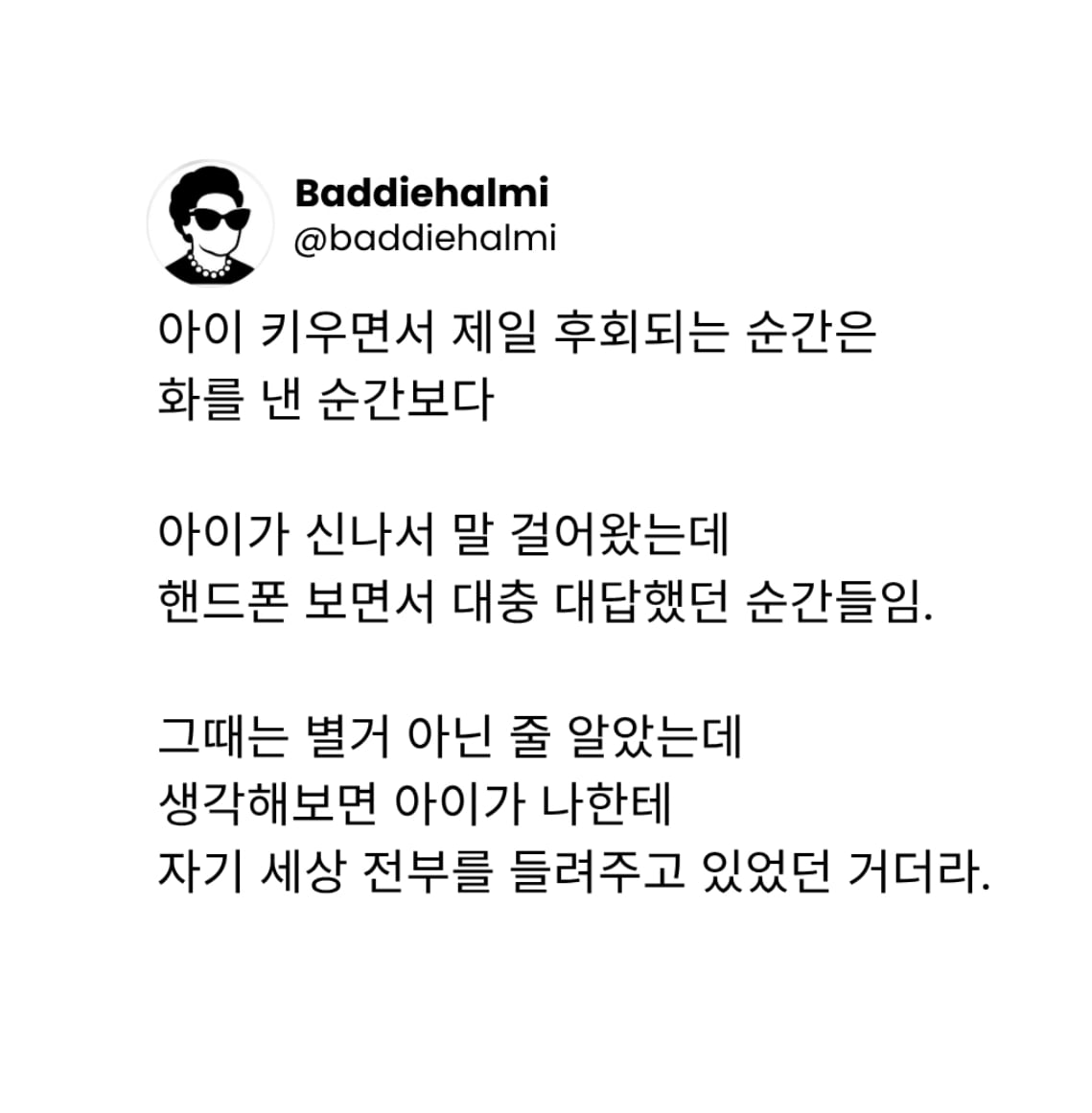
The “saved posts” of Han, a 38-year-old working mom raising a five-year-old, are also filled with such advice. One she recently saved reads: “A mother’s privilege that only exists now and will disappear in 10 years. My child’s lovely voice, which always calls only for me, no matter how many people are around. The most harmless gaze in the world, coming to the bed to ask for a story….” Most of the advice on this account, which has about 340,000 followers, relates to child-rearing. Han said, “Rushing between home and work from morning to night, I often feel a reality check—‘Is this really how life should be?’ When I’m too exhausted to even open a book, a simple line on SNS helps me appreciate daily life and regain my composure.”
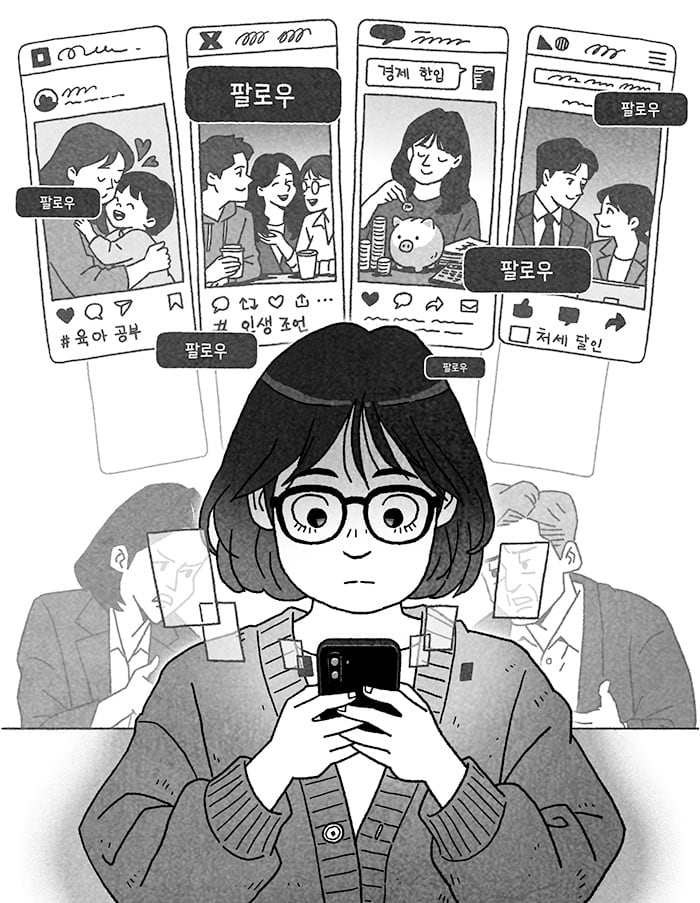
Advice has always been necessary. What’s changed is how people seek it. In an era where “Back in my day…” is both a comedy catchphrase and a target of satire, hasty advice and admonitions are easily dismissed as old-fashioned nagging. SNS now fills the void left by traditional advisors. These so-called “advice-only” accounts don’t flaunt high academic credentials or flashy resumes. Some don’t even reveal their names. Instead, they consistently post one- or two-sentence advice on various life issues—human relationships, work, health, parenting. Followers range from a few thousand to hundreds of thousands. From teenagers preparing for college entrance exams to 20-somethings starting their first jobs, 30-something working moms, and 60-somethings planning their second act—everyone needs advice to endure harsh realities and sometimes even change their life’s direction.
◇Strangers Make the Best Advisors
In the past, advice came mainly from teachers, bosses, seniors, or parents—people closely connected and experienced. Most SNS advice accounts have no vested interest in the reader. Kim, the office worker, said, “Since they’re unrelated to me, it’s easier to focus purely on the advice. If a senior says, ‘Exercise over studying,’ or a boss says, ‘You don’t need to be too loyal to the company,’ I might nod but think, ‘What about you?’ On SNS, the same advice feels unbiased because there’s no preconception about the person behind it.” The messenger disappears, making the message clearer.
Han, the working mom, added, “I’ve heard senior moms give advice on English kindergartens or academies, and if I didn’t follow it, they’d distance themselves, saying, ‘You’re just taking the information.’ With SNS advice, there’s no obligation to act on it or explain the results later.”
Unwanted advice can be easily rejected—just swipe the screen. The effort to seek advice has also decreased. You don’t need to meet someone in person; a 10-second scroll during your commute suffices. It’s more convenient than reading a self-help book or attending a lecture.
◇The Era of Vanishing Mentors
This shift reflects changing social perceptions of advice and admonition. A department head in his late 40s at a large corporation said, “These days, saying something like, ‘You should marry early’ or ‘You should have kids’ at a team dinner can cause trouble. Even if you genuinely want to help, you end up biting your tongue.” There’s a joke that isn’t a joke: “The best way to show you care is to avoid starting sentences with, ‘I’m saying this for your own good.’” The rise of political correctness has also raised the bar for giving advice.
Life conditions—employment, housing prices, wealth accumulation—have diverged so much between generations that past experiences no longer hold the same weight. B, 29, who works at a mid-sized company, said, “It’s not that I’m deliberately dismissing older generations, but their ‘back then’ success formulas no longer apply. Housing prices, job markets, and social mobility have completely changed. It’s hard to accept past stories as universal truths.”
A “mentor craze” swept through broadcasts after 2010, but it didn’t last. Some mentors’ words didn’t align with their lives, causing backlash. A prime example is Buddhist monk Haemin, whose book *When You Stop, Things Finally Become Visible* topped bestseller lists for years. He advocated for a life detached from desire and competition, but in 2020, controversy erupted after a TV show revealed his real estate holdings.

In the SNS era, mentors face stricter scrutiny. Unlike the past, when only their books or lectures were judged, every aspect—homes, spending habits, relationships, past statements—is exposed.
◇Only the Advice You Want to Hear Surfaces
Even as mentors fade, demand for advice remains. SNS algorithms, which recommend content based on user interests, create an ideal environment for advice consumption. Someone pondering a job change sees advice on “signs it’s time to leave your company,” while someone tired of relationships encounters “how to spot narcissists around you.” The algorithm ensures relatable stories keep appearing as advice. B, the office worker, said, “I find more cathartic, straightforward advice on SNS than from real-life acquaintances. It comforts me mentally and reinforces my values.”

However, there’s a risk of being exposed to one-sided or oversimplified advice. Unlike real-life counsel, which often begins with, “It depends on the situation,” SNS advice tends to reduce complex issues to a single answer.
A study by the University of British Columbia analyzed 1,000 popular mental health-related SNS (TikTok) videos. Of 319 advice or information videos, 33% contained content likely to cause misunderstandings, such as presenting personal experiences as general facts or oversimplifying mental health issues. Yet, these misleading videos received more views, likes, comments, and shares than accurate ones. Short, definitive advice gains traction easily on SNS.
- 월 5900원 멤버십, 신문 독자에게는 2900원, 조선멤버십
- 55000원 상당의 신문-잡지 8종 마음껏 보기, 조선멤버십
- 현금처럼 쓸 7000포인트 받아 알뜰한 쇼핑, 조선멤버십

Related posts:

Artists protest National Theater for Young Audiences’ non-specialist appointment

Booker-winning translator Deepa Bhasthi on why she has ‘nothing kind to say about AI’

Beijing signals support for rebuilding flood-ravaged Rasuwagadhi route

Infrastructure Minister Sunil Lamsal on rebuilding after the Bhotekoshi floods

Why Nepal’s climate crisis is also a public-health emergency