

Having and raising a child is the ultimate happiness in life. It is a return to the primordial self I cannot remember, growing anew. It is guiding a child along a path I never walked. Finally, it is watching from afar as they enter a future I will never live to see.
However, for many, childbirth and parenting have become arduous, fearful, and something to postpone or abandon. In this country, where the population is vanishing faster than anywhere else, the pursuit of that profound happiness has been overshadowed by meager childcare subsidies and politicians’ clichéd rhetoric. Low birth rates have become a tiresome dilemma and a subject of mockery.
“If we continue like this, we’re in big trouble. If we miss the golden window of the next 3–4 years, South Korea will have no future. We must make the population issue not a grand discourse but everyone’s ‘personal problem,’” said Kim Jong-hoon (77), chairman of HanmiGlobal, with a worried expression. He founded HanmiGlobal, a global leader in construction project management (PM) and pre-construction (precon) services, in 1996 and has grown it over 30 years.
Precon is a technology that reduces costs for clients by preemptively managing inefficiencies and risks across the entire construction process—design, procurement, construction, and maintenance. As a construction engineer, he first introduced this technology to South Korea, overseeing thousands of projects, including Seoul’s Sangam World Cup Stadium, Lotte World Tower, semiconductor factories, nuclear power plants, and Saudi Arabia’s Neom City.
Yet, it was in the early 2000s that Chairman Kim, seemingly unrelated to his core business, plunged into the low-birthrate crisis. He wrote newspaper columns and led a “have four children” campaign—before low birth rates became a national issue.
In 2022, he launched the Korean Peninsula Population Institute for Future, the country’s only population-focused think tank. That year, the total fertility rate (the average number of children a woman is expected to have in her lifetime) plummeted to around 0.7 people, and Seoul’s rate dropped to around 0.5 people, shocking the world.
As chairman, he personally gathered domestic and international experts and persuaded companies to fund the initiative. His appeal was: “Don’t leave it to the government—let the private sector save the nation.” He was awarded the Order of Civil Merit, Moran Medal, on July 11, World Population Day.
Beware of the Illusion of a ‘Birth Rate Rebound’
-How severe is the population crisis?
“Last year, the Korean Peninsula Population Institute for Future conducted a 100-year population projection. If the current fertility rate continues, South Korea’s population will shrink to 7.53 million people by 2125—just 15% of today’s population. That’s fewer than Seoul’s current population (9.28 million people). The working-age population will plummet from 35.02 million to 2.91 million. Does that make sense? Can such a nation even exist?”
-World population scholars call it ‘Black Death-level decline’ and ‘demographic suicide.’
“Yes, the nation is disappearing. Low birth rates are the greatest crisis threatening South Korea’s survival. Yet, because it’s become a ‘familiar story,’ interest is waning, and fatigue is setting in.”
-Recently, the total fertility rate rebounded.

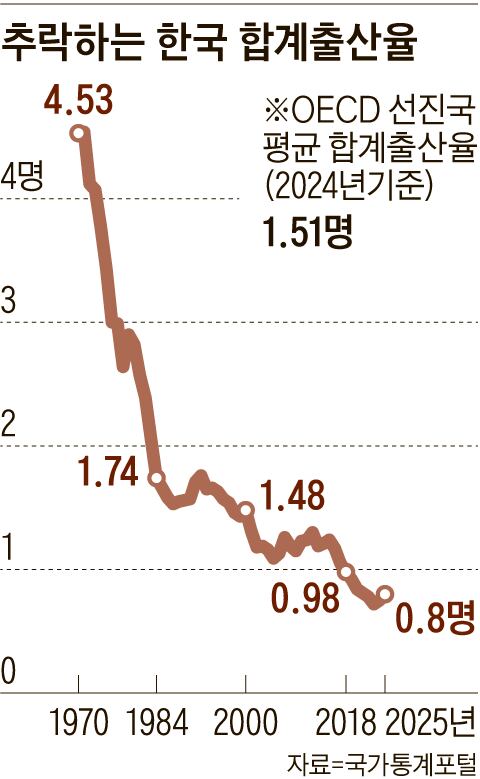
“It fell to 0.72 people in 2023 but rose to 0.8 people in 2025. Some expect around 0.9 people this year. This may be due to concentrated government and corporate policies over recent years. However, the main reason is that the 1990s-born echo boom generation (children of the baby boomers) has entered marriage and childbearing age, and delayed births from the COVID-19 pandemic have surged. This is a temporary rebound, not structural improvement. It’s frustrating to see awareness of the crisis diluted.”
-It’s not a time to relax.
“In advanced countries, the replacement fertility rate—needed to sustain the population—is 2.1 people. South Korea has made it extremely difficult to reverse the trend. Even if the fertility rate rises slightly, the absolute number of births remains low because the female population of childbearing age is shrinking. Last year, births were around 250,000, still a historic low. What difference does it make if the fertility rate goes from 0.8 to 0.9 people in this context?”
-What fertility rate would make you feel relieved?
“At least 1.5 people. Only then can we say, ‘The pace of population decline has slowed’ or ‘We can hope for the next phase.’ Japan, with a fertility rate of 1.14 people, has set clear policy goals: ‘Raise it to 1.4 people’ and ‘Defend a population of 100 million people.’ South Korea must quickly establish official targets.”
-Does the government have any official targets for fertility rates or population?
“No.”
-(After checking) You’re right. I didn’t know.
“Without clear goals, direction becomes blurred.”
Is AI the Solution to a Shrinking Population?

The 70-year-old chairman, father of two and grandfather of four, effortlessly cited population statistics. His modest office was piled with materials on low-birthrate countermeasures. A plaque in the hallway read, “Companies lead the way in overcoming the population crisis.” He laughed, saying, “I know I’ll be criticized for acting like an NGO, but I can’t help it.”
-Is population still important in the AI era?
“People often ask, ‘Since AI will replace human labor, won’t the low-birthrate crisis resolve itself?’ Some scholars argue, ‘South Korea is already doomed; adapt to the AI era.’ These are ‘population extinction adaptation theorists.’ While AI’s production capabilities are expandable, technology can’t fully replace humans’ intrinsic value. Can AI sustain national systems like pensions, welfare, healthcare, agriculture, or defense? Population remains a core variable of national competitiveness, even in the AI era.”
-Does the adaptation theory make no sense?

“Adaptation means replacing a shrinking workforce—say, from 100 to 70–80 people—with physical AI or robots. But what adaptation is possible when the population collapses from 100 to 7–8 million?”
-Is the construction sector heavily affected by low birth rates?
“There’s a severe shortage of workers on-site. I’ve felt this for a long time. R&D talent is also scarce. As the young population shrinks, tough industries are avoided. Even with foreign workers, communication with supervisors is challenging, leading to poor construction and major accidents. I founded a leading construction management company after the collapse of the Seongsu Bridge and Sampoong Department Store, and now we face another national crisis…”
-Is this urgency why you entered the low-birthrate issue?
“It’s not just construction—every essential sector faces the same problem. This isn’t a campaign to save one industry. When the population vanishes, labor and consumer markets shrink, and essential national functions halt. What business can have a vision in that scenario? Every company is a stakeholder in the low-birthrate crisis.”
Low Birth Rates Are Proof of ‘Unhappiness’
-What do you see as the biggest reason people avoid having children?
“Childbirth is deeply personal. Structural low birth rates mean South Korea is an unhappy country.”
-Why is it unhappy?
“Because of the hyper-competitive society and future anxieties faced by the younger generation. Housing instability, heavy private education costs, and endless competition have solidified the belief, ‘I can barely survive alone, let alone raise children.’ Women face additional barriers: career interruptions and missed promotions. Marriage and childbirth, once domains of love and happiness, have become high-risk endeavors and threats to survival. Instead of ‘high-risk happiness,’ people immerse themselves in ‘small joys’ like hobbies, travel, and social media.”
The Korean Peninsula Population Institute for Future analyzed 50,000 posts on the online community Blind related to marriage, childbirth, and parenting last year. For marriage, negative emotions like ‘sadness’ (32%) and ‘fear’ (25%) dominated. For childbirth, ‘disgust’ (24%) and ‘fear’ (21%) were primary.

-I was surprised that ‘disgust’ topped the list for childbirth.
“This reflects hostile perceptions that devalue parenting, regardless of institutions. Exclusionary cultures like ‘mom-chung’ (a derogatory term for mothers) and ‘no-kids zones,’ combined with workplace fatigue, have manifested as extreme ‘parenting disgust.’”
-Haven’t parental leave and flexible work systems taken root?
“According to our 2026 evaluation of companies responding to the population crisis, 35% of firms with flexible work systems had zero users. Policies without cultural support are useless. Even though parental leave is legally guaranteed, it’s still difficult in small and medium-sized enterprises. Taking it often leads to disadvantages.”
-Only possible in public offices and large corporations?
“A ‘class polarization’ of childbirth is emerging. Ultimately, the solution is providing all workers with a stable future. Changing daily work practices and ensuring predictability—like the ability to return to work after childcare—is far more important than one-time subsidies. That’s why companies can solve the low-birthrate crisis.”
Mothers as ‘National Childbirth Heroes’
-I heard your company’s employees have many children.
“It’s been a policy since the company’s founding. Initially, applicants, their spouses, and even their parents had to pledge to ‘have four children’ to be hired. We stopped the pledge after some backlash… (laughs).”
-What benefits do you offer?
“We provide unlimited infertility treatment support until employees conceive. For each child, we give a ‘National Childbirth Hero’ gold medal worth one don. Having three children leads to a special promotion regardless of tenure or performance reviews. Four children earn a childcare assistant. We allow remote work for two years after parental leave and cover college tuition for all children. The same applies to non-marital births and adoptions.”
-National Childbirth Heroes?
“In a sinking nation, women who give birth are heroes.”
-Don’t companies see childcare employees as less productive?

“Productivity may dip temporarily. But discussing productivity in saving the nation is inappropriate. A company’s mission isn’t just profit—it’s to make employees happy and contribute to societal and national prosperity.”
According to the Korean Peninsula Population Institute for Future, companies with strong childbirth and parenting policies have 2.7 times higher average sales per employee than those without. HanmiGlobal expanded bold childbirth welfare over 30 years, growing its assets 400-fold and sales nearly 100-fold.
Chairman Kim said, “Considering South Korea’s unique industrial ecosystem, large corporations can establish work-life balance cultures and spread these practices to partners and industries.”
-What societal traits have worsened low birth rates?
“I blame Confucian and patriarchal family cultures. South Korea, Japan, and Singapore—Confucian cultures—have the world’s lowest fertility rates. They still view childbirth and parenting as women’s roles. Both parents must work and share family care. Prejudice against non-marital births is another barrier. Countries with higher non-marital birth rates have higher fertility rates. Lowering marriage barriers makes childbirth easier.”
We Can Still Change
South Korea’s ultra-low birth rate is the result of decades of government misjudgments and poor policies. After aggressive birth control from 1962, the fertility rate fell below 2.1 people in 1983, officially becoming a low-birthrate country. Yet slogans like “One child is enough to fill the land” and penalties for multiple children continued for another decade.
In 1996, when the fertility rate dropped to around 1.5 people, birth control policies were scrapped, but the government neglected population strategies for another 10 years. Since the Presidential Committee on Ageing Society and Population Policy was formed in 2005, the government has spent 390 trillion Korean won over 20 years.
-Despite astronomical spending, we faced a 2024 population emergency.
“While countless policies mention ‘low birth rate,’ only 20 trillion Korean won was directly spent on childbirth and childcare. That’s 1.5% of GDP, below the OECD average (2.29%). We didn’t spend enough. Also, a 2021 audit found over 3,000 government low-birthrate policies. Many policies mean nothing gets done.”
-How about recently?

“We proposed low-birthrate policy pledges to political parties and candidates during the 2024 general election and 2025 presidential election. These included establishing a dedicated population ministry, creating a special budget, and providing radical housing support to youth and newlyweds. But there was little interest. In June’s local elections, we analyzed 620 candidates’ pledges with the Chosun Ilbo. While candidates acknowledged the severity of population decline and aging, 60% had no related pledges. Surprisingly, vanishing regions had fewer pledges.”
-Why don’t politicians address low birth rates properly?
“Population policies take at least a generation to show results, but political decisions are tied to 4–5-year election cycles. Instead of structural reforms in labor, welfare, and education—which face resistance—policies focus on immediate cash benefits for political gain.”
-What should governments and municipalities never do?
“Zero-sum competitions to ‘steal’ populations from neighboring cities. Such policies don’t increase the national population by one person.”
-What population goals would you propose to the government?
“We held a population vision declaration last year, proposing to ‘maintain 30 million people by 2100 and restore a fertility rate of 2.1 people.’ To achieve this, we suggested raising youth employment from 46% to 90%, female employment from 55% to 80%, and male parental leave usage from 33% to 100%. We aimed to gather 33 people, like the 33 national representatives who led the independence movement, but ended up with 54.”
-Is a fertility rate of 2.1 people possible?
“Currently, it’s distant. But rather than lowering targets prematurely, we need to set challenging goals with the urgency of ‘changing direction.’ South Korea has a history of exceeding seemingly impossible targets, like the Five-Year Economic Development Plans. If the government, businesses, and people unite, it’s not an impossible goal.”
- 월 5900원 멤버십, 신문 독자에게는 2900원, 조선멤버십
- 55000원 상당의 신문-잡지 8종 마음껏 보기, 조선멤버십
- 현금처럼 쓸 7000포인트 받아 알뜰한 쇼핑, 조선멤버십

Related posts:

Artists protest National Theater for Young Audiences’ non-specialist appointment

Booker-winning translator Deepa Bhasthi on why she has ‘nothing kind to say about AI’

Beijing signals support for rebuilding flood-ravaged Rasuwagadhi route

Infrastructure Minister Sunil Lamsal on rebuilding after the Bhotekoshi floods

Why Nepal’s climate crisis is also a public-health emergency