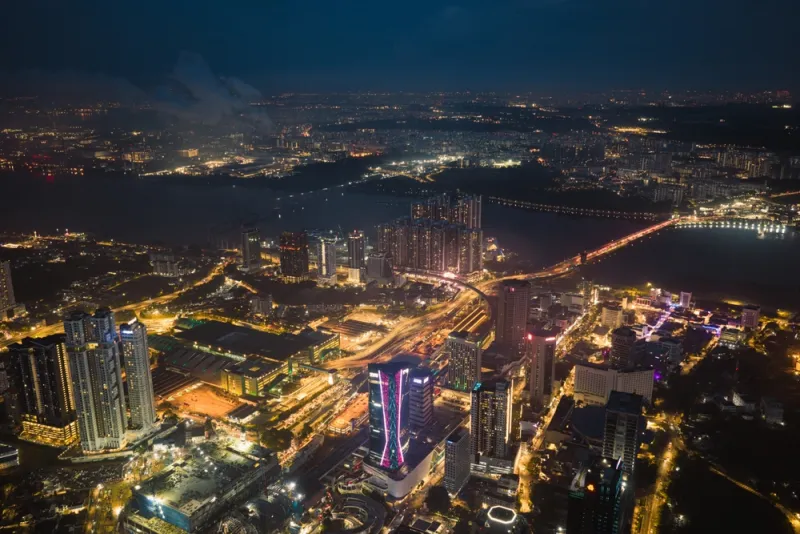
Consumers could spend $1.05b more a year in Johor Bahru.
Singapore grocers and food and beverage (F&B) businesses could lose more consumer spending to Johor Bahru once the Rapid Transit System (RTS) Link opens, with groceries expected to face the greatest pressure as cross-border travel becomes easier.
“All Singapore businesses will be impacted, but F&B and retailers will face it most acutely, particularly in cost-sensitive categories like groceries, dining, pharmacies, and personal care,” Musa Fazal, chief policy and operating officer at the Singapore Business Federation (SBF), told Retail Asia.
Singapore consumers could spend $1.05b more a year in Johor Bahru after the rail link starts operating, whilst Singapore businesses could gain $756m in additional annual spending from Johor Bahru visitors, a July 2026 study by SBF, Restaurant Association of Singapore and Singapore Retailers Association showed.
The difference amounts to about $290m in additional annual spending flowing out of Singapore, equivalent to 0.4% of the city-state’s total retail and F&B sales in 2025.
Groceries are expected to account for the biggest share of additional spending by Singapore consumers in Johor Bahru, followed by pharmacies, dining, and beauty services, Fazal said.
Singapore consumers are likely to visit Johor Bahru more frequently in search of “better value, wider variety, and service offerings,” he added.
David Zhang, regional market insight manager for services, channels, consumers, and economies at Euromonitor International Ltd., said the RTS Link could draw some consumer spending away from Singapore but also bring more Malaysian shoppers into the city-state.
Trips from Singapore to Johor Bahru could increase by more than 50% after the RTS Link starts operating, whilst trips in the opposite direction could rise by about 30%, Zhang said.
“There will be more leakage, but also opportunities to drive the acquisition from Malaysia,” he said in a video call.
Singapore businesses would struggle to compete with Johor Bahru on price because of differences in operating costs between the two markets, Fazal said.
Retailers should instead compete through service quality, products that are distinctive to Singapore and customer experience, whilst linking shopping more closely with dining, attractions, cultural activities,and major events, he added.
Zhang said retailers could also focus on convenience, Singapore-exclusive products, loyalty rewards, and services that consumers could not easily replace by shopping across the border.
The effects are unlikely to be evenly distributed across Singapore or across retail and F&B categories, Fazal said.
Alan Cheong, executive director of research and consultancy at Savills Plc, expects the overall effect on Singapore’s retail market to be limited, although some businesses could face greater pressure.
The impact would depend on RTS fares, accessibility, and whether passengers encounter bottlenecks travelling between Singapore and Johor Bahru, he said.
Restaurants and businesses selling consumable goods could be more exposed if fares are affordable and travel becomes quicker and easier than existing transport options.
RTS passengers would also have less capacity to carry purchases than consumers who cross into Malaysia by car or motorcycle, Cheong said. “I don’t think it would add any greater, much significant impact with the competition from RTS,” he said via Zoom.
Singaporeans already travel to Malaysia to shop and dine, meaning the RTS Link would not necessarily cause a dramatic shift in consumer spending, Cheong said. Rising costs were already reducing consumer spending in Singapore, he pointed out
No need to take action
Cheong said businesses should avoid making major changes before there is evidence showing how consumers respond to the rail link.
“At the moment, I don’t think they should do anything,” he said, adding that retailers and mall operators should instead be ready to respond quickly if particular sectors or locations are affected.
“It’s better to let empirical evidence flow through before they take action,” he said. “But to take action, they must take it fast.”
Fazal said businesses should prepare for a more integrated Singapore-Johor Bahru consumer market.
“This means investing in what makes Singapore distinctive—service quality, locally distinctive offerings, and the unique, trusted customer experience Singapore has spent decades building,” he said.
Zhang cited Charles & Keith Pte. Ltd. stores carrying the brand’s fullest product range in Singapore and Singapore-exclusive Disney Cruise Line merchandise as examples of how businesses could differentiate their products.
Singapore could also seek to encourage Johor Bahru visitors to stay longer and spend more through retail, entertainment, events, and night-time activities, Fazal said.
Businesses, industry groups, and the government need to support local spending in sectors and locations that are more exposed to consumers shifting purchases across the border, he added.
Retail and F&B businesses also need help adapting to a more integrated Singapore-Johor Bahru market, particularly in managing cost pressures and developing different operating and business models.
Singapore and Johor Bahru could also be marketed as complementary destinations under a broader “Twin-Cities, One Destination” concept, with cross-border loyalty programmes, coordinated promotions, and bundled experiences, Fazal said.
“This would give Singapore businesses more opportunities to participate in a larger visitor journey, rather than viewing Johor Bahru simply as a source of competition,” he added.
Cheong said exchange rates could ultimately matter more for cross-border spending than the RTS Link. He said a stronger Singapore dollar against the Malaysian ringgit could have a greater impact on cross-border spending than the RTS Link itself.
Retailers are likely to be cautious immediately after the RTS Link opens as they assess which businesses and locations are affected before changing their expansion plans, Cheong said.