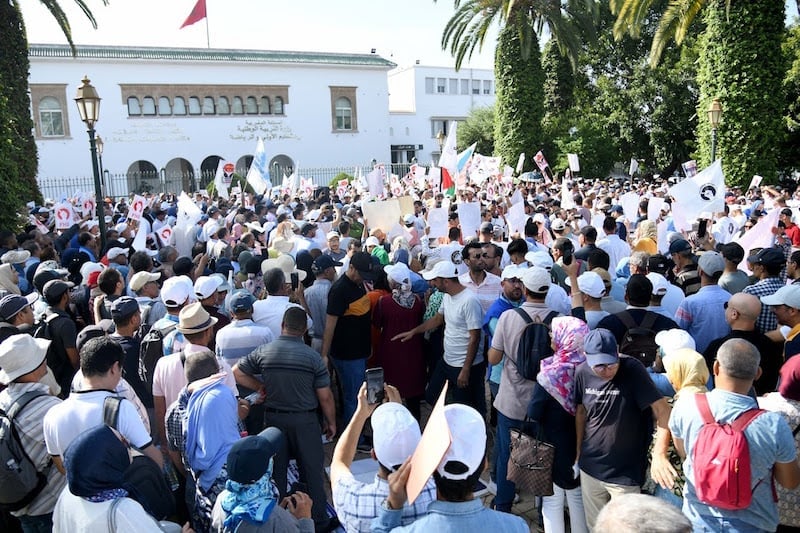
Teachers and Administrators in Morocco Protest Nationwide Over Unfulfilled Promises
Across Morocco, teachers and education administrators are engaged in a nationwide strike, demanding that the government honor long-standing commitments. The protests involve three main groups: primary and secondary school teachers, agregé teachers, and education administrators. Each group has distinct grievances, but they all point to a system that they believe is failing them.
Agregé Teachers Face Unfair Working Conditions
Agregé teachers, who hold a high-level teaching qualification, have joined the strikes, expressing frustration over their treatment in high schools. Represented by a coalition of five unions, they claim that the government has not implemented a new employment framework agreed upon on December 26, 2023. This framework was meant to provide clearer working conditions and better benefits for agregé teachers.
Shahrazad Saraj, an agregé French teacher in the Beni Mellal region, highlighted the disparities between her role and that of other teachers. She explained that while agregé teachers in preparatory classes (CPGE), technical training centers (BTS), and training institutions (CRMEF) work 14 hours per week, those in high schools work up to 21 hours. “It’s like being buried alive,” she said, emphasizing that the difference in workload is not justified by the type of school.
Saraj also pointed out pay gaps and unfair benefits. “An agregé teacher in CPGE gets more benefits than me, even though we have the same title,” she said. She added that transfers to higher-tier institutions are nearly impossible, with priority given to teachers in CRMEF and BTS. “We’re left with zero chance unless a miracle happens,” she said.
The promised regulatory framework was supposed to be released two years ago, but it remains unimplemented. Saraj expressed disappointment with the union’s lack of action, stating that strikes often serve as a show rather than a real effort to bring about change. “We feel like pawns in their game,” she said.
Primary School Teachers Demand Better Pay and Working Conditions
Primary school teachers, represented by the National Education Federation – Democratic Current (FNE), are also striking. They claim the government has ignored agreements signed on December 10 and 26, 2023, which were meant to improve working conditions and salaries. Their demands include an immediate reduction in teaching hours, activation of extra compensation, and a fixed financial allowance for teachers in rural and remote areas.
The union is urging the Ministry of National Education to stop requiring teachers to supervise students inside schools. They also want the ministry to regularize the status of contract or transferred teachers, centralize their payroll, and correctly calculate seniority. Additionally, they are calling for the immediate payment of correction, supervision, and support allowances, while resolving administrative delays and publishing a clear schedule for pending payments.
Teachers are also pushing for the implementation of previous agreements, including promoting teachers who have completed 14 years in the second grade, with full recognition of seniority and associated financial and administrative effects. They argue that years of service should count for all categories, including temporary and gap-filling teachers, ensuring they are included in seniority, promotions, and social benefits.
Education Administrators Boycott Key Programs
Education administrators, including directors and regional managers, are also participating in the strikes. The National Secretariat of Education Administrators and Shared Staff under FNE claims the Ministry of Education has “frozen dialogue” with them. They are angry over the exclusion from negotiations with other unions, despite discussions that began under the former minister.
Kamal Ben Omar, head of the administrators’ union, described the situation as a setback in communication. “We had submitted a detailed list of demands, and it was supposed to be discussed. Instead, the ministry shut the door on us,” he said. In response, administrators have launched boycotts of key school programs, including the integrated school project, school insurance collection, sports associations, and paperwork related to “pioneering schools.”
They are also freezing involvement in school support associations and any extra duties outside their official roles. The union is demanding a special regulatory framework recognizing them as the backbone of the education system, an idea backed by the Higher Council of Education. They also call for urgent measures such as fairer transfer opportunities for principals and supervisors, proper travel compensation, and payment for extra institutional support hours.
Administrators accuse the ministry of ignoring repeated letters, the latest sent in July 2025, and of mishandling transfers, which they say lacked transparency. They also demand long-delayed payments, including training allowances for graduates of the National School of Administration, and merit-based promotions stalled since 2024.
“We will keep escalating if nothing changes,” said Ben Omar, adding that the strike is not just about money but also about recognition and respect for their role.


