Understanding the Party System of Government
A popular English adage says: “If you cannot beat them, join them.” This saying can be applied to the political world, where various forms of political parties exist. These include ideological, mass, democratic, mission, personality, and broker parties, as well as one-party, two-party, and multi-party systems. Each political party must have an emblem for identification and a manifesto or programme of action. From their manifestos, some parties lean towards either socialism or capitalism. While this article will not examine all these parties in detail, it will briefly explore the advantages and disadvantages of the party system of government.
The Roles of Political Parties
Political parties usually make public their objectives for seeking political offices. They provide platforms for the electorate to choose the right people to represent them in offices. Parties try to unite their members and supporters, regardless of their own ethnic tribes and religions. Day in day out, the party members campaign in order to get people to join their folds. Party members intermittently meet to discuss the successes and failures of their parties, with a view to making amendments.
Political communication improves greatly, especially during campaigns. Music, songs, and dances are usually the highlights at such meetings. Partisan members embrace each other when they meet. But sometimes, quick blows are exchanged when tempers become hot. Parties often organise debates and discuss political issues publicly. Debates are usually very useful and educative. Sufficient number of political parties offers the electorate a great opportunity to change parties easily. This is the reason why many Nigerian politicians do change parties continually and with impunity.
The Party Systems
Societies or countries can be classified according to the number of parties operating within them. In some countries, there are few or no parties to compete with one another. Why is it so? Perhaps, the parties have been emasculated by the government in power and authority. Government could harm the opposition members in a variety of ways. In some countries, there are few or no opposition parties. Now, let me take a careful, brief look at each and every party system, its advantages and disadvantages.
The Zero Political Party System
In a country where there is not a single political party, representatives of the people are usually selected based on their personal achievements and good manners. In such a situation, the government would certainly be unstable at least for some time. A government would work better if there are opposition parties and educated elites around it.
The One Political Party System
A one-party system of government means that in a country, there is only one recognised registered political party. The other parties are not registered for one reason or another. They are not allowed to function and seek members. Perhaps, the party in government is afraid of being overthrown. In such a situation, radical and revolutionary indigenes are often arrested and sentenced to long terms of imprisonment. Some are even sentenced to death.
The single party system was the creation of the defunct Soviet Union. The communist philosophy leaves no room for any ideology that is inconsistent with Maxims. Some theorists argued that the system could not be democratic since parties develop to give organised expression and leadership. This system of leadership existed in Senegal, Ivory Coast, Kenya, Tanzania, Zambia, Malawi, Cameroon, Zaire, Ethiopia, Egypt, Algeria, China, Russia and most of the Eastern European countries.
Merits of the One-Party System
The merits are: The system allows for a strong leadership, either in one person or a group of leadership; it has a strong doctrine or ideology to pursue. It is a programmed party; pursues its programme to conclusion; usually represents the majority of the people in a given state; tends to bring about the stability of government and makes it remain unique. It allows mass participation. It is to unite all the citizens of the country.
It is most relevant for the purpose of nation building, rapid economic and social development. It eliminates the forces of disunity, that is political wrangling and domination; tries to avoid tribalism and sectionalism; becomes a forum for political socialisation and apprenticeship of would-be leaders; enhances self-discipline, patriotism, enterprise, productivity, economic development and even development; guarantees the elimination of foreign incursions, which the existence of factions could make possible.
It is in line with the African system of government, whilst others are alien, divisive and sectional.
Demerits of the One-Party System
It brings all citizens together under one organisation so that government does not have to worry about challenges from the opposition. Decision can be reached quickly within the party with the conviction that it will be implemented as all are presumably committed to the objectives of the single party. It is a contradiction or negation of the principle of democracy particularly the fundamental freedom of association. It forces the option of the ruling elite on all citizens. Usually, citizens of the ruling group are not welcomed so that opposition or critics are driven underground. The system is usually maintained through coercion and has totalitarian tendencies.
The Two-Party System
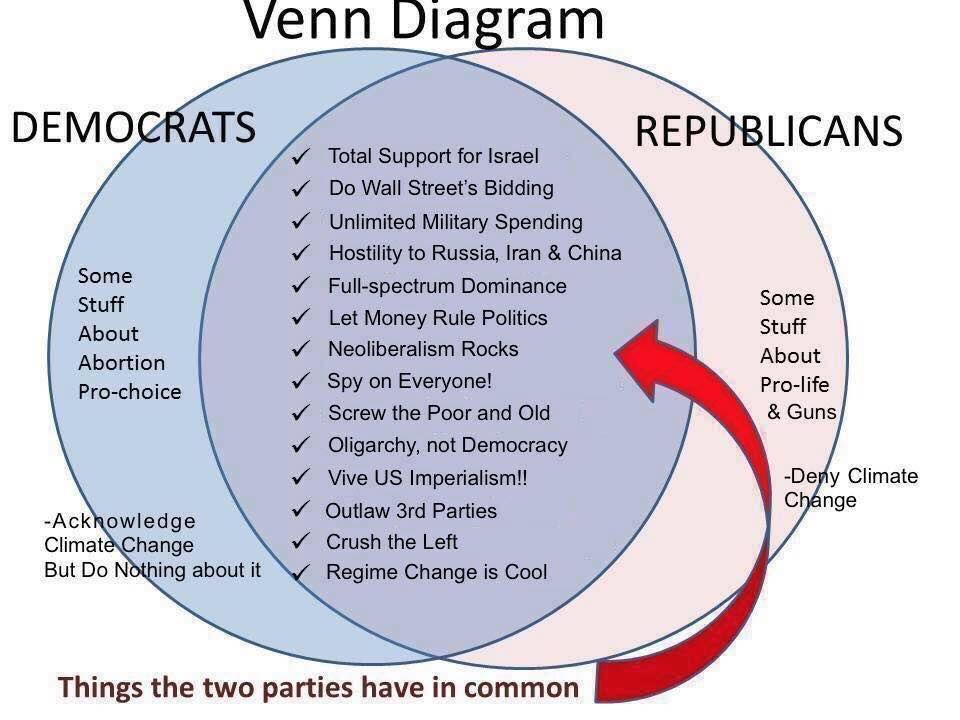
The two-party political system contains many political parties, but only the two strong ones form governments alternately. In Britain, the Labour Party and the Conservative Party have been exchanging governments since 1911. In the United States, there have been Democrats and Republicans since 1854. Five registered political parties may perhaps be good enough for Nigeria and Nigerians. Austin Kanne says, “A two-party system is one in which only two parties regularly win substantial portions of the votes and public offices, and in which the majority parties to some degree alternate in having majority of both.”
This means that at every election in a two-party system of government, one party can have a substantial lead over and above the other party by having more candidates elected than the other. From the above definition, the system does not necessarily mean only two parties do exist in a state. There could be minor parties which hardly win any reasonable fraction of the votes cast.
The English speaking democracies: Britain, the United States, Canada, Australia and New Zealand are among the countries where the two-party system of government exists more prominently. France too has a two-party system of government. In this type of system, the party in power must have won the largest number of the seats of the legislature, whilst the other party forms the opposition. The opposition party is always the watch-dog and critic of the government’s proposed policies presented to the parliament.
Demerits of the Two-Party System
It often degenerates into a single-party system; tends to divide a society into two: north and south, east and west, or Muslim and Christian, rich and poor, or traders and workers etc; one faction opposing the other, thereby tilting towards disunity and instability.
It may also degenerate into a multi-party system, whereby three or several parties regularly share substantial portions of the seats and in which a single party rarely, if ever, gets a majority of seats. An example of this was the 1959 Nigerian election after, which a coalition government was formed by three parties: NPC, CNC and NEPU. A particular ideology is usually difficult to follow in a coalition government because each party has its own different ideology. Really, a coalition government hardly has any unity of purpose. The government’s machinery could be used by the party in power to ban the minority opposition and totally emasculate the opposition. In the third world countries essentially, the system often brings about quarrelling, fighting, looting, arson, maiming, imprisonment and even killing of the members of the rival party or parties.
The Multi-Party System
This system offers the populace a sufficient number of political parties, out of which one could choose from. A multi-party or group system consists of three or more parties that regularly share substantial portions of the votes and public offices. It is a system in which a single party, if ever wins a clear majority of either votes or offices.
Merits
It is more democratic than the two-party system. And no party has a clear dominance of the political arena; permits more shades of opinion to be represented in the legislature; hence issues are usually debated thoroughly before reaching a decision; reflects more accurately the manner in which the popular opinions are properly debated; dismembers a country into smaller units.
Demerits
The multi-party system emphasises differences amongst the populace rather than what unites them. It confuses the electorate and makes it difficult to hold parties accountable for their behaviour in parliament. It creates political instability. Numerous parties confuse voters. It makes it difficult for any political party to win a clear majority; and therefore, weakens the government. It encourages bribery and corruption, tribalism, nepotism and greed.


