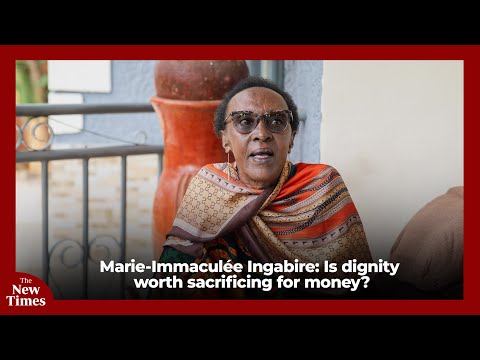
A Legacy of Courage and Clarity
In a 2009 interview titled “Intellectual Hooliganism,” the Congolese poet, philosopher, and theologian Kä Mana criticized what he saw as the noise of minds that shout without enlightening—intellectuals who wound rather than elevate their nations. He was particularly critical of the ongoing conflict in eastern DR Congo, where he felt the voices of intellectuals were either absent or ineffective.
Kä Mana also expressed disappointment with the silence of Rwandan intellectuals. He believed that African thinkers should offer courage rather than comfort, using their voices to engage with the tumult of history. It was within this context that he recalled his encounter with Immaculée Ingabire, a Rwandan woman whose quiet strength and clarity left a lasting impression on him.
During a journey to Rome for a conference on the conflict in eastern DR Congo, Kä Mana met Immaculée Ingabire. She was described as a quiet, composed figure with a deep and resonant voice. Her analysis of complex problems was marked by great clarity, and her presence at the conference stood out amidst the turbulence of the debate.
The conference was dominated by anger and accusation, with participants shouting accusations of lying, treason, corruption, and assassination. Amidst this uproar, Immaculée Ingabire managed to speak about the tragedy of women across the Great Lakes region, from the genocide against the Tutsi to the conflicts in eastern Congo. However, her efforts were met with hostility, as a group of Congolese attendees stormed the stage, hurling insults at the moderator, other speakers, and even Immaculée herself.
The next day, Kä Mana and Immaculée Ingabire spoke quietly. She pointed out the weakness of the Congolese, noting that they often shouted and fought without purpose. In contrast, she highlighted the resilience of Rwanda, where people had learned not to shout or fight but to know precisely what they wanted.
Their final evening in Rome was marked by a dinner with a Rwandan couple. As they entered their host’s car, Kä Mana realized that Rwanda’s strength over Congo lay in the people’s trust in their leaders. This trust, he noted, was a form of power. In Congo, there was neither trust nor power. Immaculée smiled, her eyes shining with calm strength, and said, “You are not far from the truth.”
Encounters Remembered
My own encounters with Immaculée Ingabire were not numerous, yet each was profoundly meaningful. Every moment carried weight; every word—spoken in that low, resonant voice—was filled with depth. When I brought my U.S. students to Rwanda for a study-abroad program on the 1994 Genocide against the Tutsi and the country’s reconstruction, she was among the voices I most wished them to meet. Her testimony was both intellectual and human, analytical yet deeply compassionate.
A mutual friend, Aloys Mahwa, the Director of the Living Peace Institute, remembers her vividly: “I shared with her intense intellectual moments—participating in conferences, summer programmes, and debates on peace and security in the Great Lakes region. Being with Miki was like being in a classroom where one learns truth, equality, and patriotism all at once. We often discussed Rwanda, Africa, and current events.”
Beyond her intellectual life, Immaculée was a profoundly generous human being. As Mahwa recalls, her kindness shaped not only his professional world but also his family’s daily life:
“We owe much of our family’s harmony to Miki’s constant and benevolent presence. She had a natural generosity and an instinct to give abundantly.”
Immaculée – For Yet Two Eternities and a Thousand Years
Aloys Mahwa adds, with emotion: “When I think of Miki, I also think of all those who contributed to building Rwanda and who, I hope, now meet again in heaven: Professor Paul Rutayisire, Professor Nkusi, Professor José Kagabo, Madame Aloysia Inyumba, Servilien Manzi Sebasoni (SMS), and many others who taught us patriotism and self-sacrifice.”
This reunion also includes Kä Mana himself, who passed away four years ago. One may say that their encounter did not end in Rome. One can almost hear their conversation continuing somewhere beyond this world—especially since the realities Kä Mana described in 2009 still echo painfully in our region today.
I would borrow Kä Mana’s own words, taken from an exchange he once had with a friend after the eruption of the volcano in Goma, and imagine him now speaking with Immaculée Ingabire:
She: “Are you already dead?”
He: “I am alive, and proud to be so.”
She: “For how long still?”
He: “Two eternities and a thousand years.”
And I see them both laugh—a laughter full of peace, not only of that evening in Rome, but of the Greater Region itself—a laughter for two eternities and a thousand years.
From these fragments—Kä Mana’s testimony, Aloys Mahwa’s memories, and the recollections of friends—emerges the portrait of a rare woman: honest, intelligent, lucid, serene, and generous. In the noise of conflict, she embodied the dignity of silence; in the confusion of ideas, she restored the precision of thought. Her courage was quiet but unwavering, her intellect sharp yet never cruel.
To remember Immaculée Ingabire is to remember what is best in the human spirit: the ability to listen deeply, to speak with integrity, and to give without counting. Her legacy endures—in the clarity and integrity she brought to words, in the peace she inspired in others, and in the light she left behind in every mind she touched—for yet two eternities and a thousand years.


