A Journey of Resilience and Ambition
Nepal, Oct. 18 — Binod Chaudhary’s story is a testament to entrepreneurial perseverance. From being a small textile merchant in Indrachowk to becoming Nepal’s sole Forbes-listed billionaire, his journey is a blend of business acumen, political challenges, and regulatory hurdles. His life, marked by humility and determination, offers a compelling narrative that spans generations.
The book begins with an earthquake in Santiago, Chile, in March 2010, when Chaudhary and his wife experience a terrifying event. This incident serves as the starting point for a chronologically structured narrative that traces his early childhood, family background, and eventual rise to prominence. The story is told in the first person, beginning with the migration of his grandfather to Nepal, invited by the Rana rulers to set up a trading business. Interestingly, his grandfather is never named and is simply referred to as “Grandfather.”
By the time Chaudhary was born on April 14, 1955, his father had already opened a shop on Juddha Sadak. The narrative includes family anecdotes, his passion for cars and films, the death of his mother, and how his father’s illness thrust him into the world of business at an early age. While this part of the story can feel monotonous, it transitions into more engaging chapters about the creation of Wai Wai noodles, the growth of the CG conglomerate, and his interactions with political figures such as Narendra Modi, Bangladesh’s Hussain Muhammad Ershad, and Sri Lankan statesmen.
Professional Battles and Business Triumphs
The chapters detailing Chaudhary’s professional battles, his involvement with FNCCI, and the birth of a multinational corporation are particularly captivating. The narrative highlights his efforts to navigate Nepal’s restrictive regulations, the acquisition of NABIL Bank, and conflicts over acquiring Butwal Power Company and the Modi Khola project. Additionally, the controversy surrounding his blacklisting by the credit bureau adds depth to his story.
Chaudhary’s career began with selling sarees, and he recounts his journey with candor that reflects his humility. His story is one of unmatched aspiration, struggles, and triumphs, culminating in his billionaire status. However, despite the powerful plot, the book falls short due to its writing style, which often lacks literary flair and fails to sustain reader engagement. The narrative relies heavily on factual recounting rather than vivid storytelling that could have made the events more impactful.
Reflections and Limitations
Autobiographies are expected to inspire and reflect, not just present a sequence of facts. With sharper editing, the narrative could have been more evocative and inspirational, leaving a lasting impression on readers. The conclusion, where Chaudhary reflects on his life mantras, feels cliched and fails to meet the expectations of a billionaire’s memoir.
The book cleverly mirrors its beginning and end, opening with the earthquake in Chile and closing with the devastating earthquake in Nepal on April 25, 2015. This circular structure underscores the transitory nature of life and provides a thoughtful note for readers to carry home.
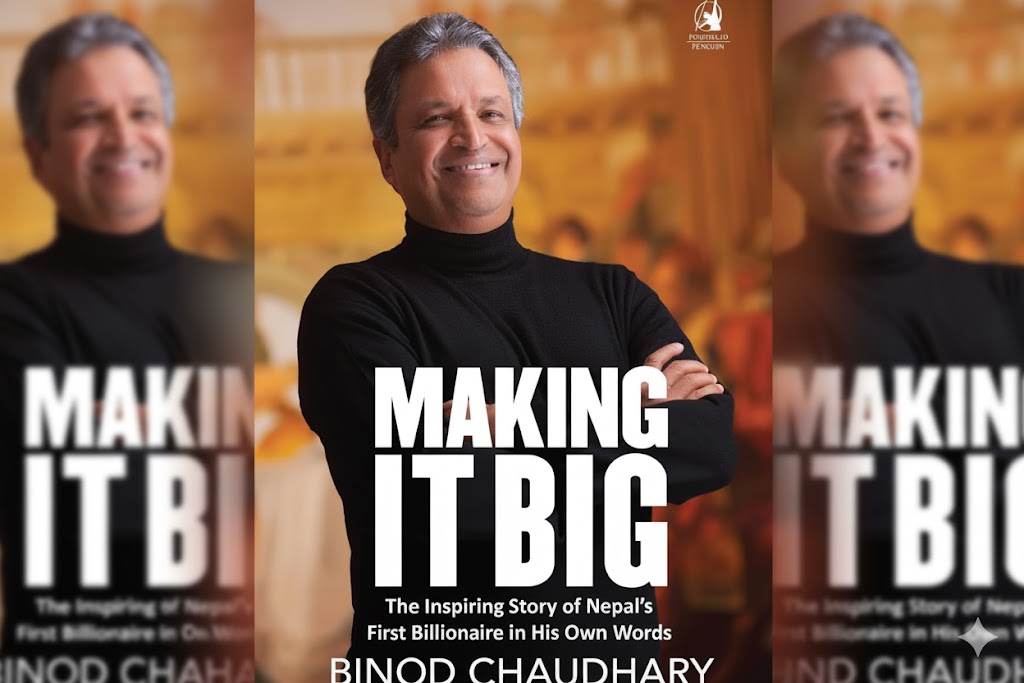
First published in Nepali as ‘Atmakatha’ in 2013, the English version, ‘Making it Big,’ was later released by Penguin for the South Asian market. While the autobiography of Nepal’s first Forbes-listed billionaire is bound to attract Nepali audiences, it may feel less like an autobiography and more like a journal to international readers.
Literary Flaws and Technical Errors
Chaudhary’s declarations, such as “I have faced hurdles created by the system of politicians and bureaucrats. I will continue to fight the system,” are earnest but veer towards familiar platitudes. Similarly, occasional attempts at figurative language feel unimaginative. His insights, though thoughtful, are presented in a matter-of-fact tone that undercuts their potential impact.
The book also suffers from spelling errors and technical lapses, raising questions about the editorial process. For instance, an article he supposedly wrote titled ‘A mourner’s letter to the Prime Minister’ is dated 17 May 1999, while his mother passed away on 9 May 2000—an impossible chronology. These issues weaken the narrative and leave readers confused.
A Mixed Reception
Despite these shortcomings, the book holds interest for Nepali readers through familiar characters, events, and settings that evoke nostalgia. However, international audiences may find it unrelatable and uncontextual. The absence of precise dating and the poor design details further detract from the reading experience.
The memoir does not shy away from glorifying Chaudhary, which is understandable. However, the lack of literary flair and craft makes it difficult to overlook. Ultimately, as Samuel Johnson observed, “the only end of writing is to enable the readers better to enjoy life or better to endure it.”
Final Thoughts
Chaudhary’s journey unquestionably embodies resilience and ambition, but the book’s prose does not always capture that spirit with the depth it deserves. With stronger narrative craft, his extraordinary life story might have done more than inform—it would have truly inspired readers to enjoy or endure their journeys.
Around 2020, while traveling to Delhi, I sat in the same row as Chaudhary on an aeroplane. I found him remarkably down-to-earth, kind, and soft-spoken, showing no hint of arrogance. I wondered then whether this demeanor was genuine or a facade. After reading his autobiography, I am convinced his humility was authentic. Such humbleness can only be natural for someone who rose from modest beginnings and self-taught the art of wealth. Probably his book falls short of this extraordinary life, but my admiration for Binod Chaudhary remains undiminished.


