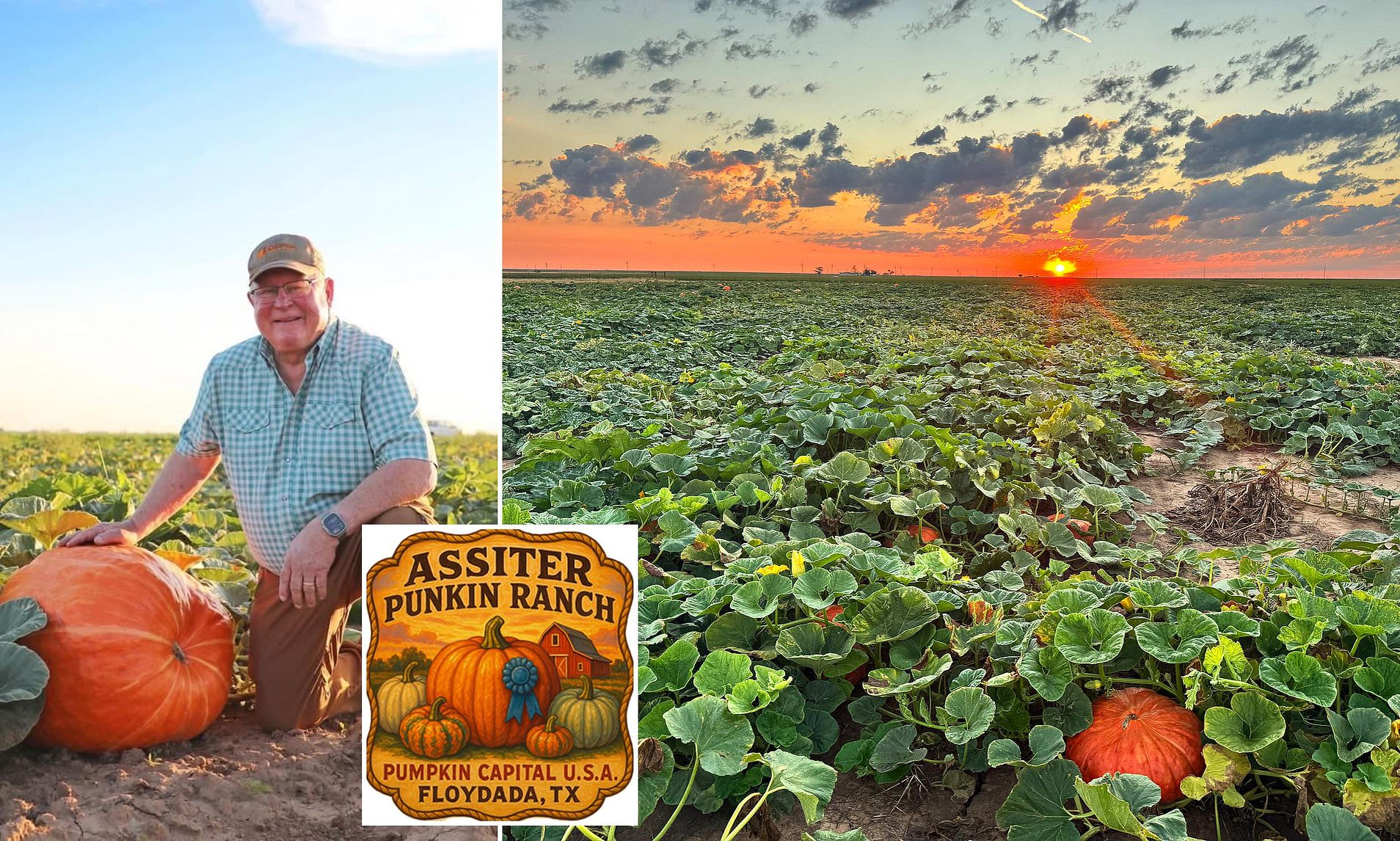
A Legacy of Pumpkins in Floydada, Texas
Tim Assiter was around 10 years old when his father began growing pumpkins on their farm in Floydada, Texas. This initiative was inspired by a local legend who had started cultivating pumpkins a decade earlier. Over the years, the family has maintained this tradition, becoming one of the oldest pumpkin farms in the area.
Assiter, now 72, recalls that when they first started raising pumpkins, they would load semi-trucks with loose pumpkins and sell them to metropolitan areas. “We’ve continuously grown pumpkins since then, making us maybe the oldest pumpkin farm in Floydada,” he shared.
Floydada, a small town with a population of 2,500 residents, has been known as the Pumpkin Capital of America since 1987. This title was given by the town’s Chamber of Commerce due to the millions of pumpkins grown there. At its peak, the town had 35 growers across thousands of acres, but this number has dwindled to just three, including Assiter.
“I think we raise about almost as many pumpkins due to improved irrigation and technology as we did in the mid-1990s,” Assiter said. Although he doesn’t have an exact number, he estimates the total to be between 2.5 million and 3 million pumpkins.
The 72-year-old grows more than 200 varieties of pumpkins across 40 acres, from Jack-o’-Lanterns to those that can weigh hundreds of pounds. 


“We are recognized as the face of the pumpkin in the Pumpkin Capital of America,” Assiter said. “We take a lot of pride in it.” What makes him happiest is seeing kids leave with a pumpkin and a big grin. “We have built a tradition for 25 years.”
In 2000, the family built a red barn on the grounds of the farm and began inviting people to visit and “experience a pumpkin patch.” Since then, they’ve joined in on the Punkin Day festival, which happens annually in fall, allowing families and residents to enjoy the 40 acres of pumpkins for free.
His grandchildren, four and seven, of Dallas, also help out on the farm during pumpkin season. Pumpkins, squashes, and gourds are the only vegetables Assiter grows on the 750-acre farm. The fields not used for the orange October staple are leased to other farmers, he said.
He has pink pumpkins and green ones, white and red, and even those with warts on them. They begin planting in May, so the first harvest will be ready by late August to early September, so the “nervous housewives” eager for fall can decorate their porches with them, Assiter told The Daily Mail. 

And although visitors to the farm are excited for all things Halloween, Assiter himself passes on the holiday. “I’ve been on my farm for four weeks, seven days a week. I haven’t come in from the barn before 8.30pm or 9pm. If you loaded these pumpkin trucks seven days a week, by the time we get to Halloween, we are pretty tired of it,” he told the Daily Mail. “It’s so labor-intensive.”
But don’t think the 72-year-old will be retiring anytime soon. “I probably need to [retire], I can’t do what I used to,” he admitted. “But can you quit? No, it’s in your blood. It’s like rodeo or golf or skydiving or flying or whatever, it gets in your blood and you want to stay with it, that tradition is there. It’s a very satisfying, yet taxing and demanding tradition.”
His daughter, 53, also has a porch concierge service, where she takes Assiter’s homegrown goods straight to families’ doors to decorate. His grandson also delivers the pumpkins to HOAs and other places in Dallas. 

The farm is on his fifth generation, but it only got started after BA “Uncle Slim” Robertson, who also was known as the Pumpkin Man, suggested to Assiter’s father to start growing the gourds in the 1960s. Robertson had started growing a five-acre patch in the 1950s and set up a roadside stand to sell them, quickly becoming a popular hit.
“He wasn’t kin to us, but he was like a mentor to my father,” Assiter said. Robertson and Assiter’s father became close after the latter’s father died when he was 16.
The farm’s pumpkins are now shipped across Texas, Oklahoma, Arkansas, and Louisiana. Despite housing the so-called Pumpkin Capital of America, Texas is not the biggest producer of the gourd in the US. That belongs to Illinois, which harvests more than twice as many pumpkins as the other top states.
Morton, Illinois, is considered the Pumpkin Capital of the World, as 85 percent of the world’s canned pumpkin comes from there. Illinois has 15,400 acres of pumpkins, followed by Indiana, Pennsylvania, California, Michigan, and Washington. Texas is, however, among the top 10 states in pumpkin production. 

Assiter believes both places deserve their moniker for different reasons. “We do not can anything,” he said of Floydada’s pumpkins. “But our pumpkins have a reputation.” He thinks both places have the right to be a pumpkin capital. “Our pumpkins have a reputation that is well known across the United States, but mostly in New Mexico to Louisiana. It’s a tongue-in-cheek argument.”
The existence of the pumpkin in Floyd County, where Floydada is located, dates back to the 1540s when Spanish explorer, Francisco Vázquez de Coronado, and his crew were exploring the area. His starving expedition was fed roasted pumpkin by Native Americans near Blanco Canyon, which is not far from one of Assiter’s farms.
Last weekend the town had a grand show of pumpkins on Punkin Day, as plentiful rainfall yielded a good harvest, Ryan Crowe, executive director of the Floydada Economic Development Corporation, told the Lubbock Avalanche-Journal. Twenty million pounds of pumpkins were seen at the festival, which included a chucking contest, where festival-goers threw the gourd as far as they could.
Texas generates around $2.4 million in commercial pumpkin production, according to the United States Department of Agriculture.


