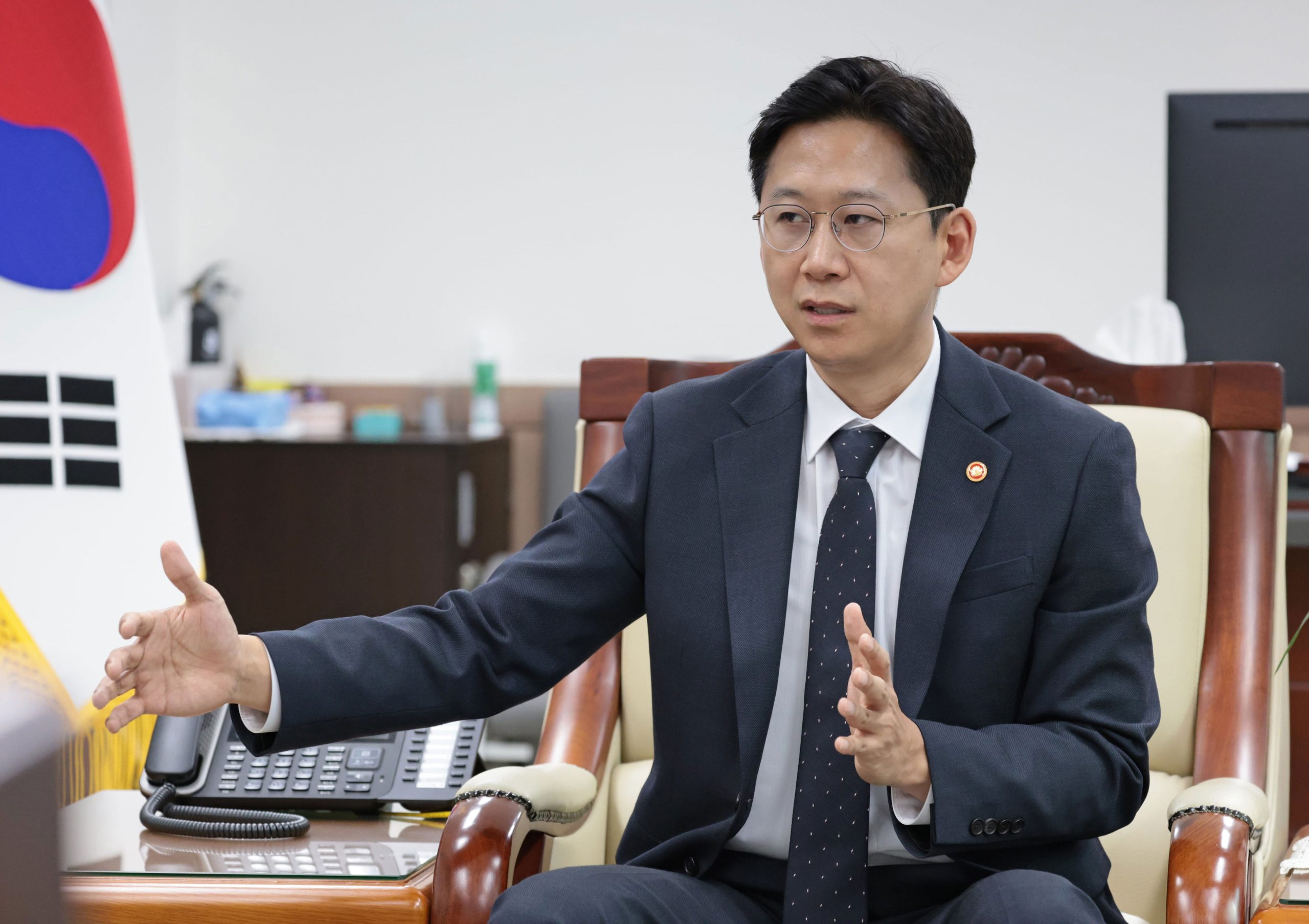
Introduction to the Korean-Style Academician System
Deputy Prime Minister and Minister of Science and ICT Bae Kyung-hoon, in his first media interview since taking office in July, announced plans to introduce a “Korean-style academician system (tentative name)” to prevent the overseas exodus of domestic scholars. The system, benchmarked against the academician system granted to top scientists by the Chinese government, aims to support senior scientists with outstanding achievements to continue their research.
Bae, who will mark his 100th day in office on the 24th, stated during the interview at the Deputy Prime Minister’s Office in the Government Complex Seoul on the 17th, “We will soon present a package system to prevent the outflow of talent.”
Emphasizing Negative Regulation for AI Advancement
He also emphasized the need to adopt a “negative regulation” principle—allowing everything except what is prohibited—to advance AI and science and communication technologies across society. This contrasts with the “positive regulation” system, where only government-approved activities are permitted. The plan is to shift science and technology regulations to a system that fully permits all activities except those threatening national security or public safety.
Bae said, “President Lee Jae-myung stated, ‘Nations that value science and technology have thrived, while those that do not have perished.’ With the resolve that South Korea could fall behind advanced nations if it fails to achieve a major transformation through concentrated investment in science and technology, I am working with that sense of urgency.”

Q&A with Deputy Prime Minister Bae
The Ministry of Science and ICT was upgraded to a deputy prime minister-level agency last month, 17 years after the abolition of the science and technology deputy prime minister position during the 2008 integration of the Ministry of Education, Science, and Technology.
“The President said during a Cabinet meeting, ‘Nations that valued science and technology have thrived, while those that did not have perished.’ I believe this reflects a sense of crisis that if we fail to achieve results in science and technology or AI within 5–6 years, we could fall behind advanced nations, and a determination to revitalize the economy through scientific innovation. Elevating the Ministry of Science and ICT to a deputy prime minister-level agency is a call for greater responsibility. The ministry must act as a special task force to revive the national economy.” His face flushed as he spoke with emphasis.
Transition from Corporate Sector to Government Role
“You were appointed as the head of the LG AI Research Center and led the development of the large-scale AI model ‘Exaone’ before being nominated for the ministerial position in June.”
“At first, I found it difficult to accept. I was someone deeply immersed in AI research and development in the corporate sector, and I had never imagined working on government policies or anything outside that realm. However, I always believed South Korea could create world-class AI models and dreamed of globalizing and expanding them. To achieve this, I thought fundamental competitiveness required government-level investments in data and GPU procurement. In that sense, I believed I could contribute to surpassing existing technological developments by integrating the capabilities of South Korean companies and academia and completing the AI industry ecosystem, which is why I accepted the position.”

Ambitions for South Korea as a Top AI Power
– At a press briefing 50 days into your term, you expressed the ambition to make South Korea one of the top three AI powers by 2030.
“I do not believe this is an impossible dream. If the government, companies, and academia collaborate on a scale comparable to the U.S. and China, becoming a global leader is only a matter of time. We have not reached that level of achievement simply because we have never been given ‘that much’ support. Even during my time in the corporate sector, I found these limitations frustrating and once told the Ministry of Science and ICT during a meeting, ‘I can create a proper inference model in a month, so please invest properly at the government level.’ The reason OpenAI in the U.S. can lead is because CEO Sam Altman actively secured investments. If we make a similar bet, we can create unprecedented success stories.”
Increased AI Budget and Investment Needs
– The pan-government AI budget for next year increased from 3.3 trillion Korean won to 10.1 trillion Korean won.
“While the budget has increased, it is still insufficient. Continuous investment is crucial. In the field of science and technology R&D, I will ensure that phrases like ‘We cannot do it’ or ‘Why invest so much?’ never arise at the government level.”
Regulatory Barriers and Power Issues
– Lowering regulatory barriers is essential to achieve AI innovation in fields like shipbuilding, defense, energy, and bio.
“At a recent ‘Regulatory Rationalization TF’ meeting, the President proposed introducing the ‘negative regulation’ principle for AI transformation and scientific advancement. This means deregulating everything except a few areas threatening national security or public safety. Unlike ‘positive regulation,’ where only government-approved activities are permitted, this approach will drastically relax regulations in AI data utilization, cloud adoption, and bio research.”
– Power issues cannot be overlooked in achieving AI transformation.
“Power is a significant concern. To become an ‘AI infrastructure hub’ in the Asia-Pacific region, resolving power issues is essential. Stable power supply through renewable energy is critical. The Ministry of Science and ICT is currently promoting the development of non-light water reactor small modular reactors (SMRs). Accelerating this development timeline is also a priority.”

Addressing Talent Exodus and International Competitiveness
– Urgent measures are needed to prevent the overseas exodus of science and technology talent and scholars.
“We plan to introduce a ‘scholar support system’ benchmarked against China’s academician system. The government will select senior scholars who have reached retirement age at research institutes or universities and support their continued research. We are also designing stable research funding support for young researchers, including non-tenured faculty, and will announce the plan in early November.”
– Japan produced two Nobel laureates in physiology or medicine and chemistry this year.
“The secret to accelerating Nobel Prize achievements can be found through AI innovation. AI can drastically improve speed and quality. If the government rapidly establishes an AI-X (AI convergence) foundation and continues investing in basic science, I believe we can narrow the gap with Japan.”
Cybersecurity and Future Goals
– There have been consecutive hacking incidents at telecom companies recently.
“We are improving systems to allow government field investigations without corporate reports if hacking traces are confirmed and considering actively utilizing AI technology for hacking prevention and response. We will establish fundamental countermeasures by discussing with private platform operators and telecom companies.”
– What is one thing you want to achieve during your term?
“I will create an environment where confidence and possibilities in science and technology and AI are secured, and where government and private investments continue without pause. In the future, in the fields of science and technology and AI, I will ensure that phrases like ‘It cannot be done’ or ‘We cannot do it’ never arise. I want to create an atmosphere where those who say such things are seen as traitors (laughs). Like the K-culture wave, I will swiftly break through to ensure ‘Made in Korea’ achieves global competitiveness in science and technology and AI. I will create success stories within this administration.”
Additional Information
Academician (院士)
Top-tier academic members elected by the Chinese Academy of Sciences and the Chinese Academy of Engineering in science and engineering. It is the most prestigious honorary title in the Chinese science and technology community, with substantial influence in advising on national major projects and setting academic directions. It is known to include over 2,000 members, both Chinese and non-Chinese.
Bae Kyung-hoon
Born in Seoul in 1976. After completing a bachelor’s, master’s, and doctoral degree in electronic engineering at Kwangwoon University, he earned an MBA from Columbia Southern University in the U.S. A leading domestic AI expert, he served as head of the Future Technology Institute at SK Telecom and held roles including head of AI platforms at LG Uplus. In 2020, he became head of the LG AI Research Center and led the development of the Korean large language model (LLM) ‘Exaone.’ In 2023, he received the Silver Tower Order of Industrial Service Merit from the Ministry of Science and ICT. He served as a private member of the Presidential Advisory Council on Artificial Intelligence in 2024 and as a deliberation member of the National Science and Technology Council in 2025.

Related posts:

Fiction park: He was the best in class. He still wasn’t good enough
Gagan Thapa takes oath as Congress president, vows to regain public trust

Inside knowledge that has locals gripped by fear after gran’s body found decomposing in cattle dip

New property purchase disclosure rule in Japan sparks fears it may curb foreign investment
Dino-mite treasures: inside Singapore’s Fort Knox storing playthings of ultra-rich