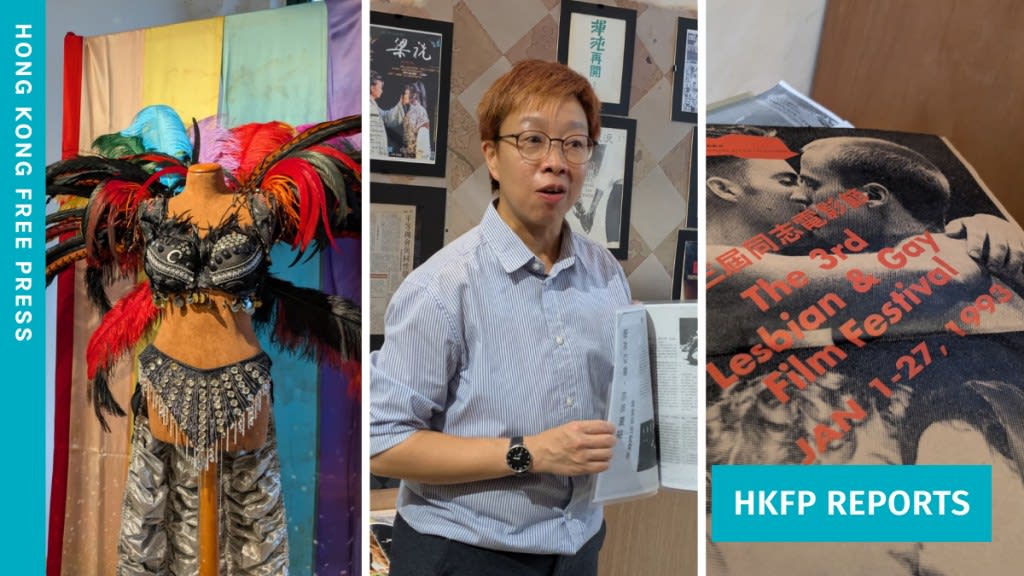
Waltzing Matilda, which opened in the late 1950s in Tsim Sha Tsui, is considered to be Hong Kong’s first gay bar. However, this was never the original intention of its founders. The bar was initially established by an Australian couple with the goal of introducing Australian cuisine, such as fish and chips, to the city. Over time, it gained popularity among sailors who visited Hong Kong, a major port of call at the time, seeking connections with other men.
The story of Waltzing Matilda is one of many that are highlighted in an exhibition showcasing the history of Hong Kong’s LGBTQ community during the colonial era. Connie Chan, a researcher who has studied the city’s LGBTQ scene in the 1980s and 1990s, shared insights from her conversations with the daughter of the bar’s founders. Her exhibition, held in a walk-up building in Sham Shui Po, is open for two weeks until November 2.

During the 1990s, Hong Kong saw a proliferation of LGBTQ businesses, including bars, bookstores, and saunas, following the decriminalization of homosexuality by the British colonial government in 1991. This period also reflected the community’s need for spaces where they could gather and connect. “The internet was beginning to take off then, but not everyone had access,” Chan explained. “People relied on in-person interactions to build friendships.”
According to Chan’s research, there were approximately 60 LGBTQ-related businesses in the 1990s, with most being bars and saunas frequented primarily by men. She created a map highlighting these venues, which also included three public toilets and bathhouses that served as informal meeting places for the community.

Another way the LGBTQ community connected was through matchmaking profiles in magazines. One example is a quarterly publication founded by Lui Tung Yuen, a lesbian group co-founded by Chan in 1996. Readers could pay HK$20 to publish an advertisement featuring their name, age, and interests. To maintain privacy, addresses were not listed, and interested parties would contact the publication via a letter, which was then forwarded to the individual.

“This column became very popular,” Chan said. “We started with just one page, and it eventually expanded to three pages.” These advertisements played a crucial role in helping members of the LGBTQ community find potential partners and build connections.
Decriminalization of Homosexuality
The exhibition is organized chronologically, beginning with the MacLennan incident in 1980. John MacLennan, a Scottish inspector with the Royal Hong Kong Police Force, took his own life hours before he was due to be arrested for engaging in homosexual acts. At the time, the law banning homosexuality applied only to men, not women, and was rarely enforced. However, MacLennan, who was 29, was reportedly targeted in a “high-powered police frame-up” as part of an investigation into gay officials, including senior police officers.

A government inquiry involving 110 witnesses, including pimps and prostitutes, found that some police officers had acted improperly in their pursuit of MacLennan. This incident sparked public debate about revising laws related to homosexual conduct. In 1990, the Legislative Council voted to decriminalize homosexual conduct, with 31 votes in favor and 13 against.
“The measures proposed today will ease pressures, including blackmail, on those who exercise their sexual preference with other consenting adults in private,” said Elsie Tu, a lawmaker who supported MacLennan, during a July 1990 Legislative Council meeting.
After decriminalization, Hong Kong witnessed the growth of civil society groups advocating for LGBTQ rights. Some organizations, like the HK 10% Club, had already existed for several years before the law changed. Founded in 1986 by activist Alan Li, the club became the first registered LGBTQ-friendly society in 1992.

Chan noted that the rush to register societies was driven by fears that after Hong Kong’s Handover to China in 1997, authorities might not allow LGBTQ groups to exist. Activists cited reports of oppression of LGBTQ communities across the border.
“People were worried about what would happen after 1997 if there was no longer freedom of assembly or speech,” she added.
Progress, and Lack Thereof
Compared to the 1990s, society today is more accepting of the LGBTQ community, according to Chan. People are more open about their sexual orientations within families and workplaces, she said.

However, progress is not uniform. For instance, the Legislative Council recently rejected a bill recognizing same-sex marriages registered overseas. Most lawmakers cited Christian and traditional Chinese values, arguing that the bill would threaten the heterosexual marriage system.
Chan compared the speeches made by lawmakers regarding the same-sex partnership bill this year with those during the 1990s debate on decriminalizing homosexuality. She noted that the earlier speeches were more substantive, addressing societal and economic impacts, while the recent ones were emotional and lacked depth.

The bill to recognize same-sex marriages was a result of a 2023 Court of Final Appeal ruling requiring the government to establish a legal framework for this purpose. The court gave the government two years, with the deadline approaching next week.
After the bill failed, Chief Executive John Lee stated that the government would explore administrative measures to protect same-sex couples’ rights, though no further details have been provided.

Chan believes that Hong Kong’s LGBTQ advocacy reached its peak in the 2000s, marked by events such as the Pride Parade and IDAHOBIT marches. While LGBTQ groups may have been less visible in the 1990s, their efforts in creating safe spaces and fostering community were equally significant.

“What set the stage for the vibrant LGBTQ movement in the 2000s? We want to show that in the 1980s and 1990s, there were groups working hard to get here,” she said.


