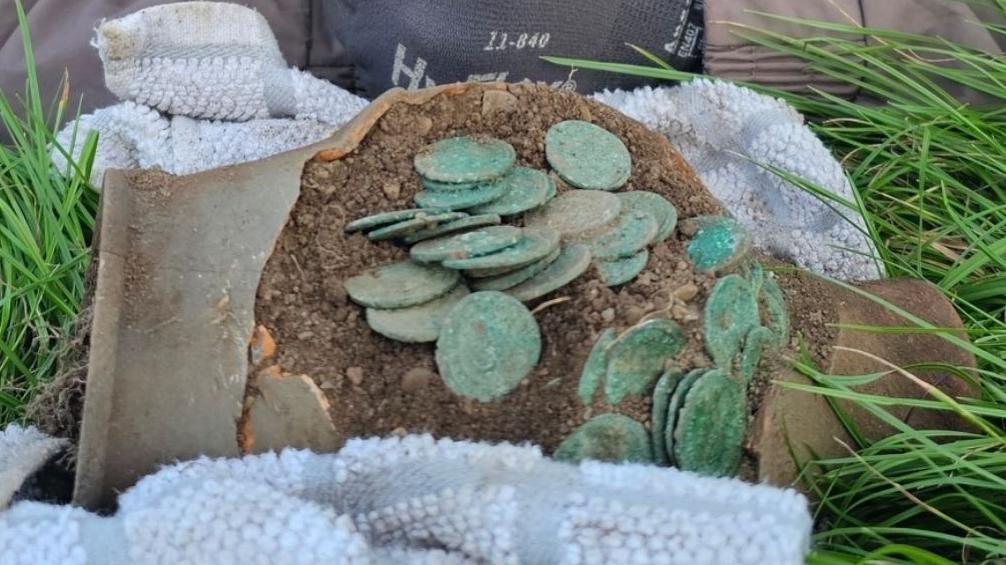
A metal detectorist has made an extraordinary discovery of up to 15,000 Roman coins, potentially the largest hoard ever found in Wales. The find was made by David Moss, a 36-year-old from Cheshire, who was left stunned after unearthing two clay pots in north Wales.
The discovery left David in awe, and he described the moment as one that gave him “goosebumps.” However, the excitement quickly turned into concern about the safety of the coins. To ensure their protection, he slept with them in his car for three days before taking them to experts.
The coins are now being carefully analyzed at the National Museum Cardiff. Experts believe this could be the most significant Roman coin discovery in Wales. While David did not reveal the exact location of the find, he described the area as “virtually untouched” and rich in historical significance, spanning from the time of the druids and Vikings through to the Romans.
David’s fascination with the area is evident, and he expressed that it will remain a place of interest for him for the rest of his life.
Throughout history, there have been several instances of coin hoards discovered, often buried during times of turmoil or as offerings to the gods. In 2010, over 50,000 Roman coins were found in Somerset, England, valued at £320,250. In Wales, a similar discovery occurred in 2008 when nearly 6,000 coins were found in Sully, Vale of Glamorgan. The largest hoard previously known to the National Museum Cardiff was 10,000 coins found near Chepstow in the 1990s.

David has been involved in metal detecting for almost a decade, having uncovered approximately 2,700 Roman coins so far. He believes the two clay pots he discovered in August, alongside his friend Ian Nicholson, contain between 10,000 and 15,000 coins.
He recalled that a rainbow appeared just minutes before he detected the signal, which he found hard to believe. The pair spent six and a half hours excavating the site.

After finding the coins, David notified the landowner, who provided a plastic box to store them. He then drove back to his home in Cheshire and decided to sleep with the coins in his car to ensure their safety.
“I just didn’t want to leave it out of my sight,” he said. After a few restless nights, he made the four-hour drive to Cardiff, where he handed the coins over to museum experts.

Anthony Halse, chairman of the South Wales and Monmouthshire Numismatic Society, believes this discovery could be the largest in Wales. He suggests the hoard may have belonged to a member or members of the Roman army, who buried the coins for safekeeping.
“If it was a person’s wealth, it could have been part of the army,” he said. Anthony also mentioned that the museum in Cardiff will determine the age of the coins. They will be cleaned, and since it’s such a large hoard, the museum will apply to the British Museum to see if they can keep them. A decision on the reward will then be made, with the finder receiving half the money and the landowner the other half.
A spokesperson for the museum stated that the assessment should be completed next year.

If you discover treasure, it is important to know the legal requirements. Treasure includes any object at least 300 years old with metallic content, or at least two coins that meet these criteria. In Wales, if you find treasure, you must report it to a Finds Liaison Officer within 14 days.
There are strict rules in place, with penalties for failing to report. Different regulations apply in Scotland and Northern Ireland.
Once reported, you will be contacted by a Finds Liaison Officer or museum curator. They will discuss how and where the find was made and provide a receipt. A report will be written, and museums may express interest if the item is considered treasure.
A coroner will hold an inquest, and you may be invited to participate along with the site occupier and landowner. You will have the opportunity to ask questions and provide input.
Experts will assess whether the find meets the legal definition of “treasure” under the Treasure Act 1996. If a museum wants the treasure, the Treasure Valuation Committee will determine its value and recommend a reward distribution.
You may be eligible for a share of the reward if you are the finder, the landowner, or a tenant. However, if you act in bad faith, such as by trespassing or hiding the find, you may receive a reduced share or none at all.
Archaeologists and volunteers are not eligible for rewards. If you find ancient coins, avoid cleaning them, as this could damage them. Record the location, date, and method of discovery.
It may be the pinnacle for any metal detectorist to find treasure, but it does not automatically belong to them. This was the case for Layton Davies, who concealed a £3m Viking coin find and was fined and jailed for not reporting it.
Bronze Age burial site found under park
Largest Iron Age gold coin hoard ‘one of a kind’
Hoard of Roman coins found during building work
More top stories
E-scooter rider died after being hit by car at 70mph in dark
Sir Paul McCartney’s gift that made ‘pivotal’ Gavin & Stacey scene
Three wrongly accused over child abuse images after BT gets ‘wires crossed’


