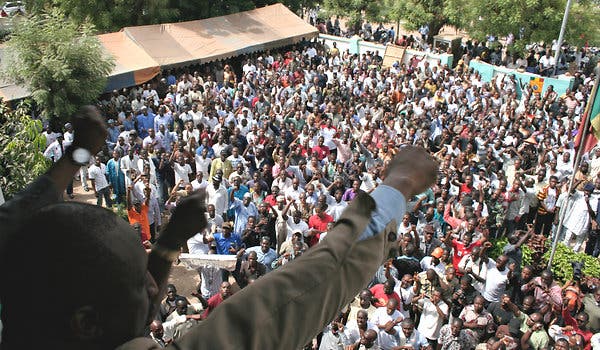
The Role of the Military in African Democracy
Professor Toyin Falola, a renowned historian and distinguished scholar, has called for the demilitarisation of politics as a crucial step toward securing Africa’s democratic future. He emphasized that integrating the military into constitutional governance and empowering civil society are essential to ending the continent’s recurring cycles of coups and dictatorial rule.
Falola made this call during the maiden lecture of the Hassan Sunmonu Centre for Leadership and Governance at Yaba College of Technology, Lagos. The lecture, titled “Democracy and the Dynamics of Development in Africa,” explored the intersections of youth activism, identity politics, religion, and the military in shaping the continent’s democratic and developmental experiences. As the Jacob and Frances Sanger Mossiker Chair in the Humanities and University Distinguished Teaching Professor at the University of Texas at Austin, his insights carry significant weight.
In his wide-ranging lecture, Falola underscored the military’s complex role in Africa’s political transitions, describing it as both “a liberating and a repressive force” that has shaped the continent’s postcolonial political institutions. According to him, “The military plays a central role in debates of democracy and development in Africa. It has functioned as a liberating and a repressive force on the continent by shaping political institutions and outcomes in ways that reflect the complexities of Africa’s postcolonial experience.”
He noted that while armed interventions are often justified as corrective measures against civilian failures, they tend to entrench authoritarian cultures and obstruct democratic consolidation. “The continuity of militarised politics leaves a tricky question about how much democratic consolidation can take place where the military remains very central to politics,” he warned.
Falola argued that authoritarian regimes often obstruct transitions to democracy, adding that military interventions are usually rationalised through accusations of corruption, ethnic fragmentation, or governance failure. Yet, he maintained, “These interventions often entrench cultures of dictatorship within the state, thereby saddling the state with legacies of distrust and weakened institutions.”
He described this contradiction as “the dilemmas of military disengagement,” where armed forces find it difficult to withdraw from governance even during democratisation. Tracing the problem to Africa’s colonial history, Falola observed that coercion was central to colonial rule and has since been inherited in the ethos of postcolonial armies.
“The persistence of the military in political transitions reflects more profound historical continuities beyond institutional manipulation,” he stated. “Colonial African societies were established through coercion that has now been inherited in the structure and ethos of force as a core instrument of governance by postcolonial armies.”
According to him, this historical inheritance has led the military to perceive itself as the legitimate arbiter of political disputes, while elite competition within civilian politics often creates opportunities for military actors to pose as “saviours.” Nonetheless, Falola acknowledged that the military has not always been an obstacle to democratisation.
“In South Africa, the reform of the army during the democratic transition was essential in stabilising the country and building an institution that could maintain rather than undermine civilian rule,” he said. “Rawlings’ transition in Ghana, although controversial, eventually paved the way for constitutional reforms and competitive politics.”
Falola cited Afrobarometer’s 2023 report, which shows growing public concern about the military’s political influence across Africa, adding that such fears echo Achille Mbembe’s reflections on the postcolony, where “power is always exercised through violence” and authoritarian norms persist.
He noted that genuine democratisation is impossible when development excludes the people: “Militarised politics often excludes citizens from meaningful engagements in governance. Democratisation is impossible when development is pursued without the active participation of the people.”
To change this trajectory, Falola emphasised the need for vibrant civil society and accountable leadership. “Civil society and leadership are key factors in reshaping this dynamic; they have the role of pushing back against military dominance and advocating democratic reforms,” he said.
He argued that democracy must extend beyond elections to include transparency, accountability, and professionalization of the armed forces. “Civilian control of the military becomes the cornerstone for consolidating democracy, as it ensures that the army operates within its constitutional boundaries and not as an autonomous political actor.”
Falola called for structural reforms: “The reform of the security sector and accountability mechanisms becomes essential for the demilitarisation of politics and to enable the military to serve as protectors of constitutional order instead of competitors for power.” He added that institutional strengthening, empowering civil society, and anchoring the military within democratic governance structures are the way forward.
“This is when Africa can overcome the cycles of coups and dictatorial relapse for sustainable democracy and development,” he affirmed.
Youth Activism and Democratic Transformation
Turning to the role of the youth, Falola hailed youth-led movements as “one of the most dynamic forces shaping the trajectory of democracy and development in Africa.” He said: “African youths over the last two decades have risen from being passive receptors of political change to active agents of political transformation. They have carried out activism through physical protests, social media campaigns, and cultural expressions that challenge state authority, expose failures in governance, and restructure democratic participation.”
Falola cited the #FeesMustFall movement in South Africa and #EndSARS in Nigeria as examples of how youth mobilisation, especially through digital platforms, has bypassed traditional party politics to create “people-centered democracies.” He added that these movements often confront entrenched power structures and redefine the meaning of freedom and justice in postcolonial states.
“Youth-led movements in African civil societies are a key factor in the interplay between democracy and development. They challenge dictatorial tendencies, serve as catalysts for civic engagement, and agitate for development measured by expanded freedom, social justice, and equal access to opportunities.”
Ethno-Regional Politics and Religious Influence
On the persistence of ethno-regional politics, Falola described it as “a double-edged feature of African democracies” that simultaneously enables representation and undermines accountability. “Ethno-regional politics is another persistent feature of African democratic societies that shapes electoral competition, governance, and the prospects for development,” he said.
He traced its origins to the colonial era, when administrative boundaries institutionalized ethnic divisions. “The manipulation of ethnic and regional identities in the postcolonial era by political elites has sustained their relevance in democratic politics,” Falola explained. While ethno-regional politics can hinder governance by encouraging identity-based voting, Falola noted that it can also promote inclusion when properly managed.
“Institutional designs that promote cross-cutting identities—like proportional representation and multi-ethnic political parties—can help transform ethno-regional politics from a force of division to one of unity and national integration.”
On religion’s role in African democracies, Falola observed that faith remains a critical factor in shaping legitimacy, morality, and political participation. “Religion is a deciding factor in the shaping of political legitimacy and development all over Africa. Religious institutions, leaders, and values all serve as channels of morality that influence voter behavior, political stability, and civic engagement,” he noted.
However, he warned that religion could also foster intolerance and sectarianism. “Religion can be mobilized to reinforce peace and civic culture, but it can also stifle democratic ideologies by engendering intolerance or legitimizing dictatorship,” he said.
Drawing on examples from Nigeria and Ghana, Falola analyzed how Shari’a politics in Kano and Pentecostalism in West Africa have both united and polarized societies. “Religion can often act as a clog in the democratic machinery, obstructing national unity and fueling intolerance. Yet, it can also motivate participation in politics and civic life,” he concluded.
Falola emphasized the need to harness religion’s moral authority for good governance. “African societies face the challenge of harnessing the positive force of religion while mitigating its opposing force. Africa’s democracy must be grounded in the realities of African social life, of which religion is one of the most powerful realities.”

Related posts:
Fiction park: He was the best in class. He still wasn’t good enough
Gagan Thapa takes oath as Congress president, vows to regain public trust

Inside knowledge that has locals gripped by fear after gran’s body found decomposing in cattle dip

New property purchase disclosure rule in Japan sparks fears it may curb foreign investment

Dino-mite treasures: inside Singapore’s Fort Knox storing playthings of ultra-rich