The European Union’s Urgent Efforts to Support Ukraine
The European Union is under increasing pressure to find ways to support Ukraine’s finances as the ongoing war shows no signs of ending and the costs continue to mount. This urgency has been heightened by the Trump administration’s stance, which suggests that Europe must bear the financial burden for the continent’s security. With the United States stepping back, European leaders are now considering an ambitious plan to use Russia’s immobilized assets to issue a €140 billion reparations loan to Ukraine. This could help cover the country’s financial and military needs for 2026 and 2027.
However, the plan faces several obstacles. Belgium, which hosts the assets, has raised concerns during an EU summit this week, citing legal implications and the potential threat of retaliation from Russia. Despite these challenges, Europeans are determined not to bear the cost of the destruction caused by Russia, leaving little alternative but to pursue this plan.
They agree on the “what” – now they need a “how.”
How Did We Get Here?
In the first week of Russia’s full-scale invasion of Ukraine in early 2022, the EU, along with its G7 allies, imposed unprecedented sanctions on the Kremlin. Among these was a sweeping decision to immobilize the assets of the Russian Central Bank held in the West to prevent Moscow from financing the war. For the EU, this represented €210 billion in economic and political leverage over Russia, as the bulk of the assets are held at Euroclear, a central securities depository in Brussels.
The assets at Euroclear generate annual windfall profits of €2.5 billion to €3 billion for the Belgian government, which houses Euroclear, and it is now at the center of discussions. Last year, after months of internal debate, the EU began using the extraordinary revenues to support Ukraine’s financial and military needs. This effort eventually coalesced into a larger G7 loan of €45 billion, to be repaid entirely from the windfall profits.
With Russia showing no willingness to engage in meaningful peace talks, Europeans have realized that the G7 line of credit will soon prove insufficient. Something bigger needs to be done.
What Exactly Is the Reparations Loan?
The urgency to find a solution prompted the European Commission to take a closer look at Euroclear. The assets, initially held as bonds, have matured into a cash pool worth about €175 billion, with an additional €10 billion expected in the near future. Under the tentative plan, Euroclear would transfer the cash to the Commission, which would then issue a €140 billion loan to Ukraine on behalf of the union. The remaining €45 billion would cover the G7 credit, as the windfall profits would no longer apply.
The €140 billion loan would then be disbursed in gradual tranches to Kyiv and be subject to certain conditions. For instance, a Made-in-Europe target for purchased weapons. Ukraine would be asked to repay the loan only after Russia ends its war of aggression and agrees to compensate for the damages caused. Hence, the name “reparations loan.” After that, the Commission would repay Euroclear, and Euroclear would repay Russia, completing the circle. The Commission insists this is not confiscation.
Politically, the loan is useful too, as it would provide a reliable, steady line of support to Kyiv while sparing cash-strapped member states from paying out of pocket.

Why Is Belgium the Main Obstacle?
The plan, which is still in early stages, has pushed Belgium to the forefront of the political debate as the home of Euroclear, where the assets are held. Belgium has a long-standing investment treaty with Russia that provides for arbitration in the event of any dispute between the parties. Belgium fears that, the very moment the cash leaves Euroclear, Moscow will launch aggressive retaliation to recover the €140 billion and demand hefty compensation, leading to international litigation.
Another critical concern is that EU sanctions, which require unanimity, might be lifted before Moscow pays reparations and therefore unwind the entire loan. This is why Belgian Prime Minister Bart De Wever has insisted on the need to secure the “full mutualisation” of risks and bulletproof guarantees from all member states.
In theory, each member state would back a share of the €140 billion in proportion to its size. The EU budget could be mobilized later as an additional layer of support. “If you take the money from my country, if it goes wrong, I am not, and certainly not willing, in a week’s time to pay €140 billion,” De Wever said after an EU summit on Thursday that concluded without a firm agreement on the idea.
“So I would imagine that everybody who is really for this decision, really wants to make this happen, is also ready, willing and able to make a guarantee so that I can sleep quietly at night knowing that if it goes wrong or sour that the solidarity will make (sure) that the money is actually there,” he added.
“This question was not answered with a tsunami of enthusiasm around the table.”
What About the ECB?
The reparations loan has also cast a light on the European Central Bank, the chief guarantor of financial and monetary stability in the eurozone. Its president, Christine Lagarde, had previously criticized any move that could be seen as outright confiscation of a country’s sovereign assets, which is illegal under international law and could damage the international reputation of the euro jurisdiction. In its current format, the loan falls short of outright confiscation because Russia would be able to recover the assets if it agreed to pay reparations, which is virtually impossible.
According to diplomats and officials familiar with the discussions, Lagarde did not oppose the plan and suggested the idea of a reparations loan is feasible, but further technical work is needed. Lagarde recommended the EU should not move forward alone with the unprecedented project and instead bring in other G7 allies, like the UK, Canada, and Japan, all of which hold smaller portions of Russian sovereign assets.
De Wever has demanded total transparency to locate all the assets around Europe. “The fattest chicken is in Belgium, but there are other chickens around. In the eurozone, there are other countries with immobilized assets: there are six,” he said.

What Are the Other Countries Saying?
Publicly, EU member states have expressed understanding and sympathy for Belgium. “I would use the same argument if the assets were in Germany. Today we took a step forward that should not be taken for granted,” German Chancellor Friedrich Merz said at the end of the summit. “We will do what we can to move forward.”
Dutch Prime Minister Dick Schoof said that all member states “must bear a shared risk, not just Belgium on its own”. (Hungary has already said it would not participate.)
Privately, diplomats say there is a limit to how much Belgium can expect. The idea of compensating Belgian companies that still operate in Russia if the Kremlin decided to retaliate by seizing their assets in return is considered a no-go.
Austria’s recent attempt to offset Raiffeisen Bank International (RBI), which runs a successful subsidiary in Russia, for a €2.1 billion legal defeat proved controversial and failed to gather support from the rest of the member states.
There is also the politics of it, too. De Wever is stuck in fraught budget talks, and his multi-party coalition is facing a delicate balancing act. This has raised the question of whether the prime minister may not be as concerned as he makes it seem to the press, but is looking to capitalize on playing tough to earn domestic points.
After all, in Brussels, each leader speaks to two audiences: his European counterparts and his voters. For a breakthrough to happen, it has to look difficult.
Are There Any Alternatives?
Leaders have instructed the European Commission to explore “options” to address Kyiv’s ballooning financial and military needs over the next two to three years. That language leaves the door open to alternatives.
One avenue is for member states to go to the markets and raise the funds themselves without touching the Russian assets. This was done in 2023 when the Ukraine Facility was set up, assuring €50 billion to Kyiv in grants and loans.
Although the Belgian premier did not rule out that possibility when asked by reporters, it would be difficult for other heavily indebted European countries to go down that path. If the underwriting is done based on size, nations like France and Italy would be on the line. This poses a problem for President Emmanuel Macron, who is dealing with complicated budget talks, but also for Giorgia Meloni, given her country’s debt pile.
Related
Belgian resistance holds up €140 billion loan for Ukraine at EU summit
EU and US impose new sanctions on Russia to force ceasefire in Ukraine
“Tonight’s discussion did not bury the proposal made by the Commission. It simply provided an opportunity to raise technical issues that need to be resolved. And we are aware of these technical issues,” Macron said.
The ball is now in the Commission’s court. The executive, which came under fire for the way it presented the file without much consultation, is expected to intensify bilateral contacts with Belgium and placate all outstanding concerns.
“There are points to be clarified and have a deep dive,” said Commission President Ursula von der Leyen, signaling a determination to march ahead.
“In other words, we agreed on the what, that is, the Reparations Loan, and we have to work on the how, how we make it possible (and) what’s the best option to move forward.”
An updated proposal should be presented before the next summit in December, which is now seen by diplomats as crunch time for a decision to be made before the new year.
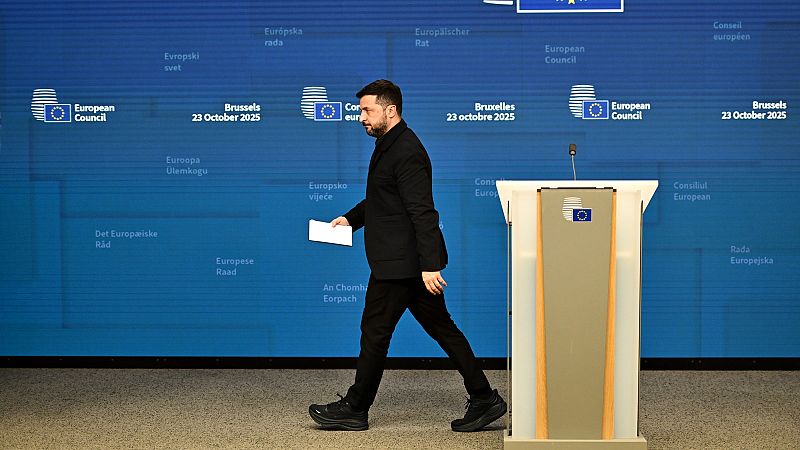
President Volodymyr Zelenskyy told European leaders that Ukraine would need the cash in 2026, preferably at the “very beginning of the year”.
“I don’t know if it’s possible,” he admitted. “Not everything depends on us. It’s a political decision.”


