The MoMo Lesson: A Beep That Changed the Class
What if the money in your MoMo wallet, the balance that makes you feel rich, isn’t real at all, but just a digital promise backed by cash sleeping silently in a bank you’ll never see?
It was a quiet Wednesday morning at the University of Ghana Business School. Mr. Boateng’s Financial Markets and Institutions’ lecture was in full swing. The topic for the day: “Financial Systems and Market Infrastructure.” Students scribbled notes as he walked across the front of the class, his voice steady, explaining how funds move through banks, payment systems, and financial intermediaries. The air was thick with concentration until a single, unmistakable sound shattered it.
Beep!
A text alert. Loud. Clear. Unmistakable.
Heads turned. Mr. Boateng froze mid-sentence. He didn’t need to ask whose phone had made the noise. He was standing right beside Michael. “Out,” he said calmly, his eyes not leaving the student’s face.
The class chuckled nervously, everyone knew the lecturer’s zero-tolerance rule for phone disruptions. But Michael, known for his mischievous wit, raised his hand and smiled. “Sir, before I leave, won’t you at least ask what the alert was for?”
The class erupted in laughter. Mr. Boateng folded his arms, already sensing a trick. “Humor me then,” he said, smiling faintly. “What was it for?” “It was a mobile money alert, Sir. And I think it perfectly relates to the topic you’re teaching, Financial Systems and Market Infrastructure.” The class went silent.
Mr. Boateng arched an eyebrow. “Is that so? Then explain, Mr. Michael. If you can show me how that MoMo alert ties to today’s topic, you may return to your seat. Fail—and you’ll miss my next lecture too.” And so began what became known as The MoMo Lesson.
Behind the Beep: The Hidden Financial System
Michael cleared his throat and began. “Sir, that single beep isn’t just a text. It’s the sound of an entire financial system at work—one that connects millions of Ghanaians every day. It begins with a user like me and travels through four invisible stages: the user, the agent, the mobile network operator (MNO), and finally, the banking and settlement system.”
He paused as a few heads lifted from notebooks. “When I received that alert, somewhere in the background, data systems, trust accounts and payment switches were already in motion, moving electronic value as real as the cedi in your wallet. What looks like a simple SMS is actually the heartbeat of Ghana’s digital financial ecosystem.”
The World Beneath the Screen
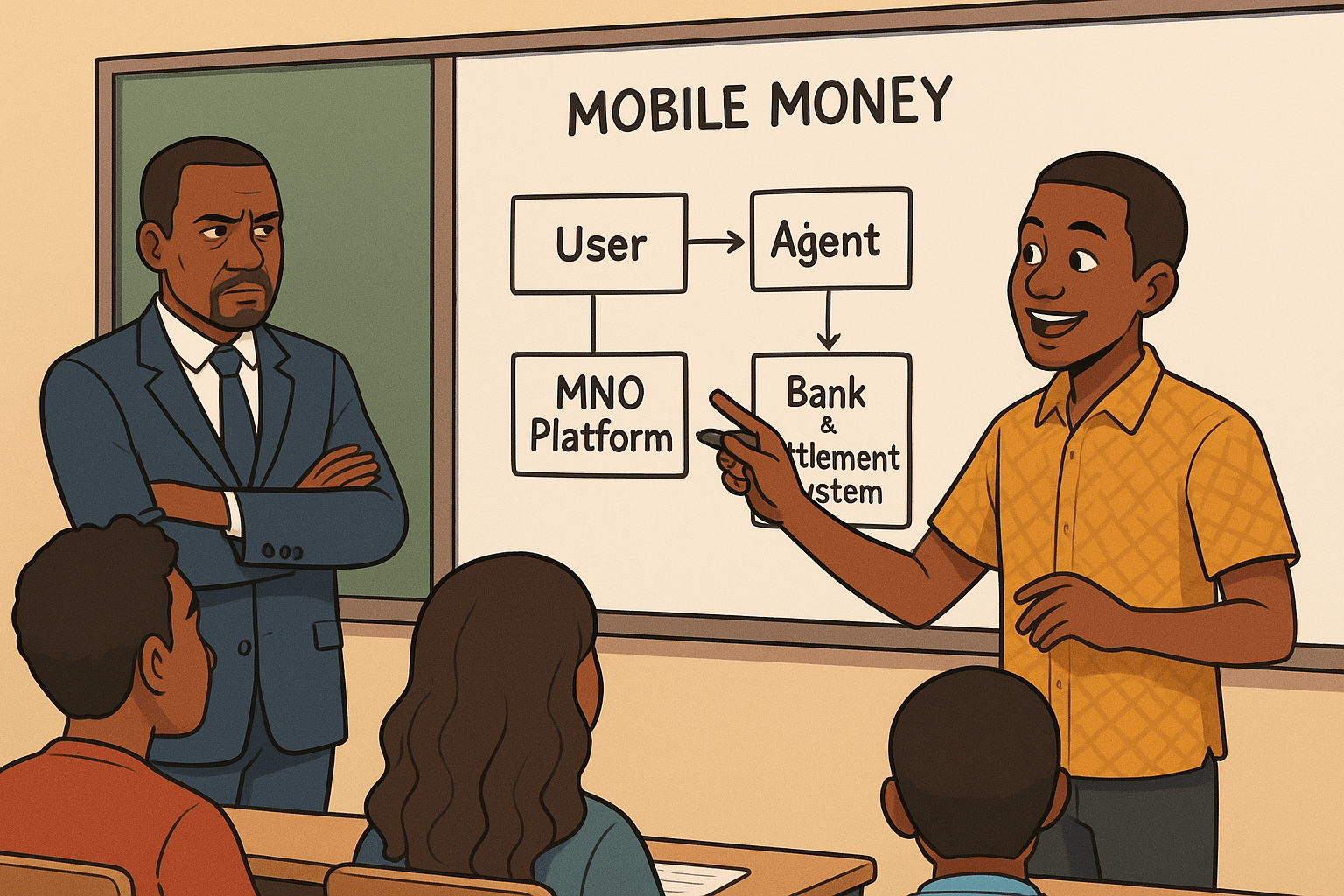
“Most people think mobile money is just dialing *170# or using an app,” Michael continued. “But beneath that simple interface lies a layered structure.” He drew four quick boxes on the whiteboard:
User → Agent → MNO Platform → Bank & Settlement System.
“That’s the chain.”
The user: front-end layer
He pointed to the first. “The user interacts through USSD or an app designed for simplicity, even without internet. That’s why you can send money from a cocoa farm in Ahafo or a fishing beach in Elmina.”
The agent: human link between cash and digital money
Then he moved to the second box. “The agent is Ghana’s real bank branch. Every time someone deposits cash, the agent converts it into e-money from their float. When someone withdraws, the agent reverses it. They’re the bridge between the physical and digital economy.”
The mobile network operator: engine room
He turned to the third. “Inside the mobile operator’s system, say, MTN, Telecel, or AirtelTigo, the real engine runs,” he explained. “It’s a complex ecosystem built for speed, trust and compliance. At its heart is the Wallet Management System (WMS), which keeps a real-time ledger of every customer’s e-money balance, applying daily limits, transaction caps and KYC verification rules. It ensures that each cedi in the system is accounted for, whether it’s stored in a user’s phone wallet or an agent’s float account. Alongside it, the Transaction Processing System (TPS) acts as the nerve center handling millions of instant ‘send,’ ‘receive,’ and ‘pay’ commands with sub-second accuracy. Every button tap from a market woman transferring cash to her supplier to a student paying school fees travels through this lightning-fast system. Supporting these engines,” he continued, “is the Agent Management System, which connects the human network behind mobile money, the thousands of MoMo agents spread across Ghana. It monitors their liquidity, commissions and cash availability in real time, ensuring money can move smoothly at every corner. The Fraud and AML Engine runs quietly in the background, scanning for suspicious behavior, preventing identity theft and meeting Bank of Ghana’s compliance standards. Finally, the Integration Middleware binds everything together, enabling seamless interaction with banks, fintechs and regulators. It’s this invisible coordination that keeps Ghana’s digital financial ecosystem running reliably, 24/7.”
Bank & settlement system: where the real money sleeps
Then finally, he tapped the fourth box. “But where is the real money?” he asked, pausing long enough for curiosity to rise. “It’s asleep in the banks,” he said. “Every cedi of e-money that people see on their phones is fully backed one-to-one by real cash held in trust accounts at commercial banks, under the watchful eyes of the Bank of Ghana. These accounts act as the anchor of confidence in the entire mobile money system. So if MTN has GHS 5 billion showing across all customer wallets, that same GHS 5 billion lies quietly in its partner banks. The e-money simply mirrors it; a digital reflection of actual funds. That’s why, even in a cashless world, the heartbeat of mobile money still pulses through the banking halls.”
Finance Lens
From a financial systems perspective, mobile money represents one of Ghana’s most transformative innovations in monetary intermediation. It has effectively merged the roles of banks, telecoms and fintechs into a unified payment ecosystem that facilitates liquidity flow, deposit mobilization and digital inclusion.
The Wallet Management System acts as the digital ledger—mirroring the core banking system—whiles the Transaction Processing System ensures instant payment execution, enhancing velocity and transactional trust.
The Agent Network expands the reach of financial services beyond traditional branches, making cash-in and cash-out possible across informal markets. Meanwhile, the Fraud & AML Engine safeguards system integrity, ensuring compliance with the Bank of Ghana’s prudential regulations. Together, these elements create a financial infrastructure that democratizes access to money, turning every mobile phone into a mini bank.
The Invisible Handshake Between Telecoms And Banks
He smiled slightly, warming to his theme. “When someone sends money across networks, say, MTN to Telecel, the transaction travels through the Ghana Interbank Payment and Settlement Systems (GhIPSS). The Mobile Money Interoperability (MMI) switch checks, confirms and routes the funds. On the surface, the money moves in seconds, but behind the scenes, banks settle later that night. That’s the ‘market infrastructure’ part; the pipes and rails that keep the system running smoothly.” Mr. Boateng leaned against his desk, arms folded. He didn’t want to interrupt.
Keeping the System Honest
Michael continued. “Security and regulation keep it all together. Every MoMo transaction passes through PIN authentication, encryption and anti-money laundering checks. The Bank of Ghana demands daily reconciliation reports from operators to ensure that electronic money equals cash reserves. It’s a self-balancing, tightly monitored ecosystem.” He paused, then added, “That’s how trust is maintained because even in a digital economy, trust is the real currency.”
The Cedi’s New Journey
“Think about it,” he said, gesturing toward the class. “From the market woman in Kejetia to the banker in Ridge, from the trotro driver to the cocoa farmer, the same system serves them all. Mobile money has become Ghana’s financial bloodstream carrying value, wages, and hope through digital veins. What started as a telecom service is now the very foundation of our financial market infrastructure.” He smiled again. “So that MoMo alert, Sir, it wasn’t a distraction; it was a live demonstration of today’s topic.”
The Class That Never Forgot
Mr. Boateng chuckled. “Well, Mr. Michael, I must admit, you’ve turned an interruption into an excellent case study.” The class erupted in laughter. He nodded thoughtfully. “You may keep your seat… and your phone, for today.” As laughter filled the room, the point lingered clearer than any slide could have made it: Every ‘MoMo Alert’ is proof of Ghana’s evolving financial system; one where telecom towers, banking halls and digital codes now speak the same financial language.
And that day, a simple phone beep became the perfect lesson on how modern finance truly works.
Moment of Clarity
In that quiet lecture hall, the sound of a mobile money alert did more than interrupt a class; it illuminated how finance now transcends walls and teller counters. What once required physical cash, lengthy queues and manual reconciliation now happens invisibly within seconds.
The moment crystallized a simple truth: Ghana’s financial ecosystem has evolved from analog to digital rails, where telecom signals now carry monetary value as securely as banknotes. For Mr. Boateng’s students, that “beep” became more than a sound; it became a metaphor for modern finance: fast, interconnected and built on trust between code, capital and compliance.
Discussion Questions
- In what ways has mobile money redefined the structure of Ghana’s financial system, and does its growing dominance pose a competitive threat or a complement to traditional banks?
- The article describes e-money as “a digital promise backed by cash sleeping in a bank.” What does this reveal about the nature of money, liquidity and trust in a digital economy?
- How do the core systems—Wallet Management, Transaction Processing, Agent Management, Fraud & AML Engine and Integration Middleware—mirror or differ from the functions of traditional banking infrastructure?
- Mobile money agents are described as “Ghana’s real bank branches.” Discuss the implications of this statement for financial inclusion, employment and monetary control.
- Considering the regulatory oversight by the Bank of Ghana, how can policymakers balance innovation, risk management and consumer protection as mobile money becomes more central to financial intermediation?


