A Protest for the Future of Nepali Football
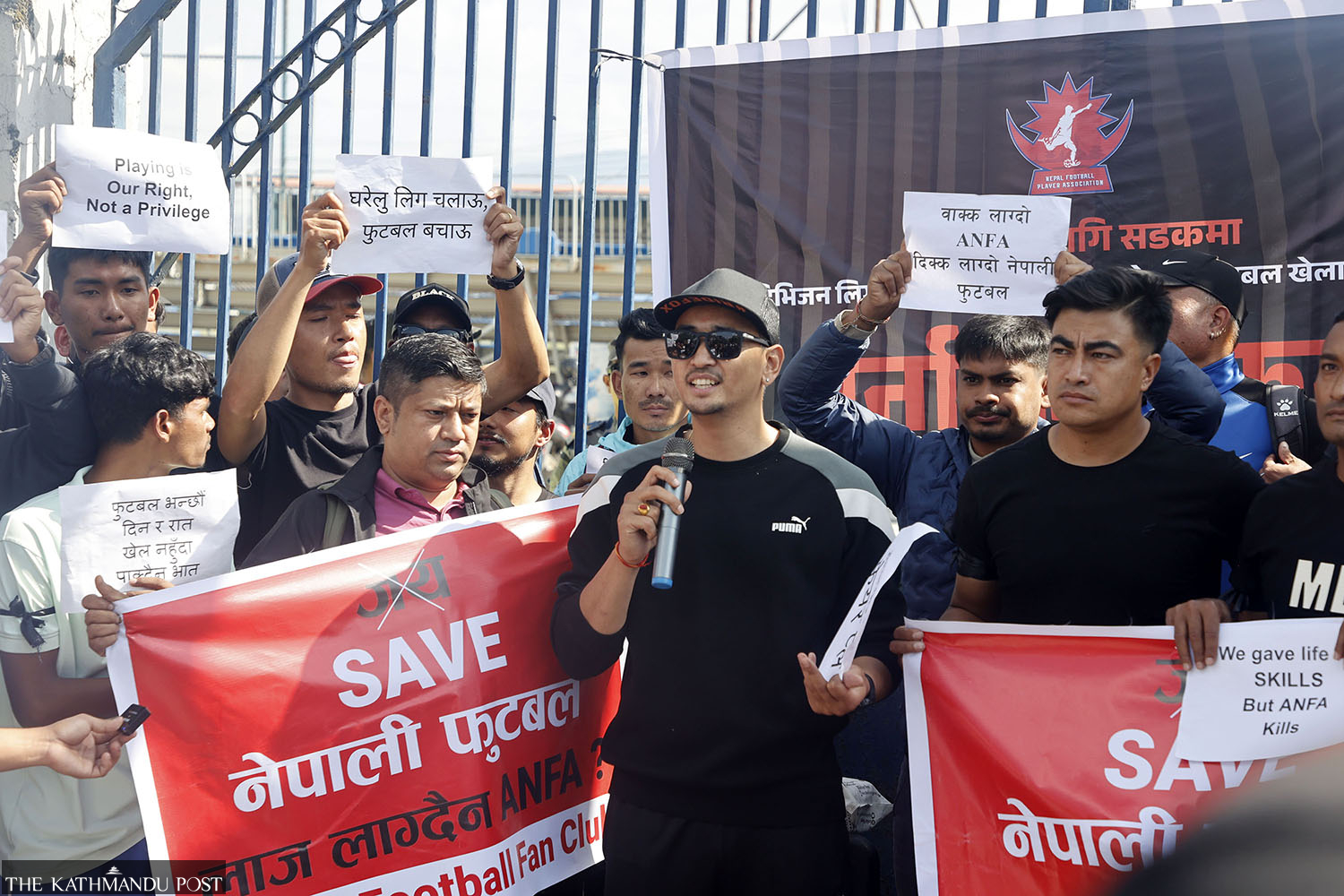
Kathmandu, Nov. 7 — The ANFA Complex in Satdobato, Lalitpur witnessed a unique and emotional event around noon on Thursday. Nepali men’s footballers who have represented the country at the international level gathered outside the complex, creating a commotion that drew attention from passersby and media alike. These players, who have kept the domestic football scene alive, took turns hanging medals they had won at various tournaments on the main gate of the complex.
The protest was a response to the recent decision to postpone the Martyr’s Memorial ‘A’ Division League for another year. The players described this move as a “gut punch” to both themselves and the dreams of Nepali football.
“We are leaving these medals as a souvenir, as a mark of thanks to the ANFA officials, who can wear these themselves,” said Bikram Lama, a former national team player and current president of the Nepal Football Player Association (NFPA).
On Thursday, the players appeared flustered under the midday heat. It was not a moment they would have ever wanted. Who, after all, would want to relinquish the medals they earned with hard work and discipline, despite the country’s crumbling football infrastructure? The players kissed the medals before they hung them, their eyes fixed on the gongs as they walked backwards.
The group of players included everyone from Nepal’s all-time joint highest scorer Anjan Bista and Rohit Chand, who recently became only the second player to reach 100 caps for the national team, to current national team players such as Manish Dangi, Arik Bista, and Sanish Shrestha. They displayed placards and chanted slogans, demanding that Nepali footballers be allowed to play the A Division League, which has not been organized since the 2023 season.
“This day was never in my wildest dreams, but it is a reality today,” said Anjan, who was with his kits loaded for the national team’s training that would begin at 3 pm. “I have seen my brothers, my best friends, leaving the country and football in the absence of a regular league. It is disheartening because I was also without a platform to play for two years before I entered Bangladesh’s league this season.”
According to the NFPA, the umbrella body of Nepali footballers who called for the protest, at least 1,250 to 2,100 players in the country will not be able to earn a livelihood when the league cycle—A, B, and C Divisions—gets postponed.
“We are gathered here today for ourselves, for others who are suffering and for the future of Nepali football,” Lama said during the protest. “We have given our blood and sweat for Nepali football, but we have not only been denied entry to the ground, but also to the ANFA premises. This all shows how much our governing body cares about us, values us.”
The peaceful protest, which began at 11 am, also included former players, such as Biraj Maharjan and ex-national team skippers turned coaches Upendra Man Singh and Bal Gopal Maharjan.
“It hurts to see the new generation of footballers being deprived of a chance to play in the country’s league cycle,” said Biraj, the most accomplished captain of Nepal’s men’s team, who retired in 2021. “I want to see them in the stadiums, not on the streets.”
There were also futsal players demanding that ANFA, which also governs the small-sized football game, take its role seriously. Nepal’s national futsal team, which is often dormant due to the lack of tournaments, missed the chance to participate in the 2026 AFC Futsal Asian Cup Qualifiers in September due to ANFA’s mistake. As Nepal had to withdraw from the tournament, the Asian Football Confederation (AFC) had slammed a $10,000 fine on the team.
Chants such as “ANFA is having fun, while players are undervalued,” “Emptiness in stadium, streets our obligation,” and “ANFA’s hope: players in hunger and hardship” continued for over one-and-a-half hours. No high-ranking ANFA officials were to be seen at the site as they were “busy” outside the Kathmandu Valley.
ANFA president Pankaj Bikram Nembang, vice-presidents Dipak Khaitwada and Dawa Lama, alongside ex-co members Bharat Bahadur Budha Thapa and Purushottam Thapa were distributing footballs in Nawalpur. This became clear through ANFA’s Facebook post even while the players were busy protesting in front of their building.
It has been over a week since Nembang’s team has been visiting different districts throughout the country, giving away footballs to children under FIFA’s Football for School programme, and spending millions in travel and stay—a step many have criticized as the president seems busier campaigning for the upcoming ANFA election rather than listening to and solving the problems of the players.
Similarly, ANFA’s general secretary Kiran Rai was in Hetauda, talking to members of the clubs participating in the President League, which kicked off on Wednesday. The talks revolved around the teams’ participation in the National League, which has been proposed as a consolation for not holding the A Division League.
Suresh Shah, ANFA’s spokesperson, was the only face seen inside the ANFA premises while the protest was underway. Shah, who arrived from Hetauda on Wednesday night, assured the protesting players that their issues would be forwarded to the higher authorities.
“We will wait for a week,” Lama announced later. “The answer we want is ‘A Division League will be organised this year’. If not, we will be forced to come out stronger than this.”
The players say that the ANFA cannot postpone the league with the excuse that the homework for home-and-away format was incomplete. “They can organise it in a centralised venue as before,” Bikesh Kuthu, Nepal’s goalkeeper and NFPA vice-president, said, addressing the crowd. “We need the league. Hundreds of players need it for survival, to call themselves footballers. The ANFA cannot just keep hitting gut punches.”
The protest also saw a sizable number of Nepali football lovers who had responded to the NFPA’s call for coaches, referees, and stakeholders to join their protest.
“We want to cheer for our teams and our players in the league,” the fans shouted when they sat outside ANFA’s main gate for a group photo with the players, who looked frustrated, tired, and hopeless.
It is not the first time that the ANFA administration has been questioned and criticised for its inability to host the league and undertake other reforms in the game. But they have been unbothered, speaking highly of themselves. Last month, for instance, ANFA’s general secretary Rai gave his team “10 out of 10” in performance.


