U.S. Military Buildup in the Caribbean
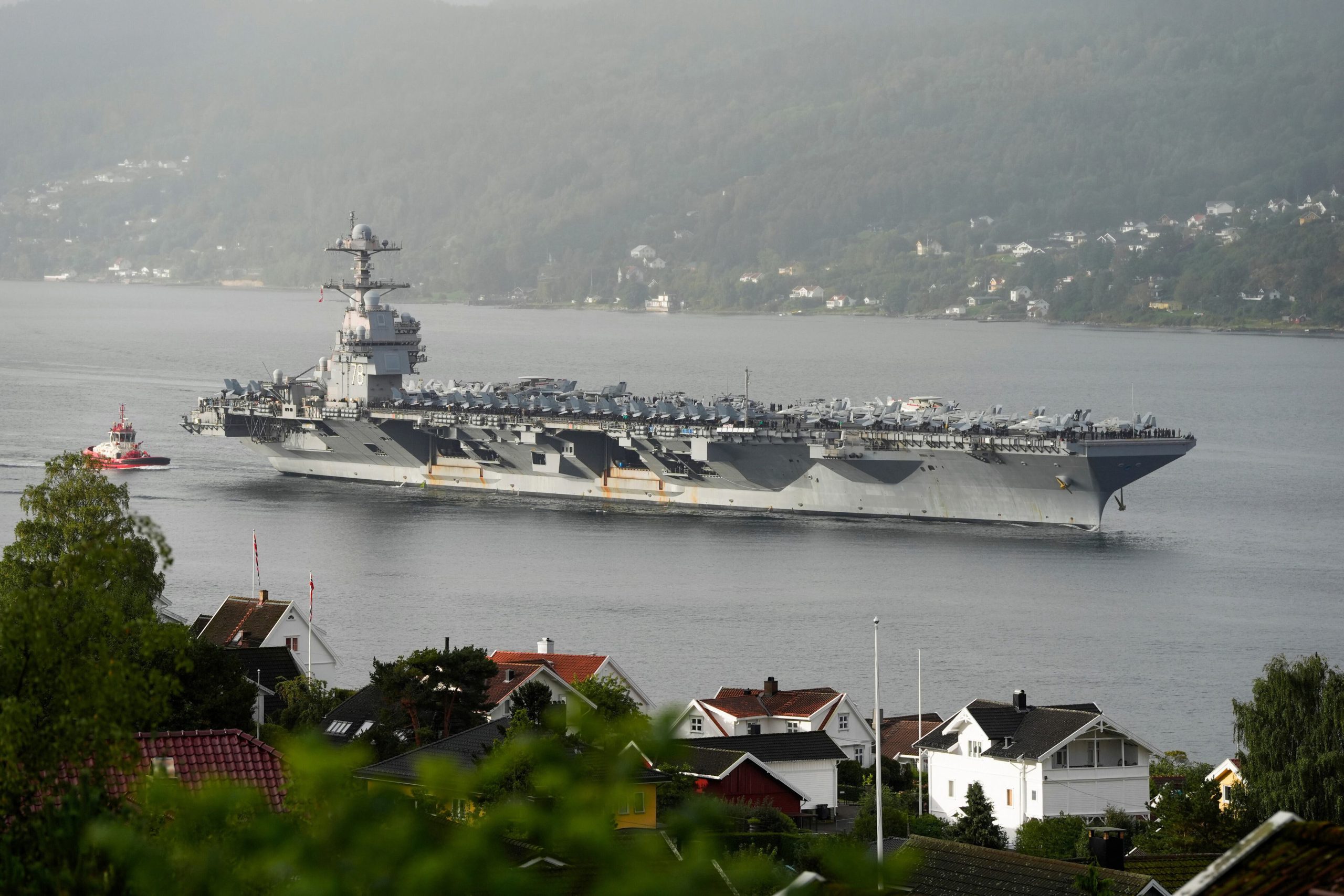
The Trump administration has deployed a significant number of military assets to the Caribbean Sea, including eight warships and one nuclear-powered attack submarine. This move is part of a broader strategy that highlights the U.S. military’s presence in the region. The Gerald R. Ford aircraft carrier, described as the world’s deadliest combat platform, was ordered to sail from the Mediterranean to the Caribbean on the 24th of last month. It is expected to reach within striking distance of Venezuela in about 10 days. This deployment represents 20% of the entire U.S. naval power, leading to the absence of U.S. aircraft carriers in the Mediterranean and the Middle East.
In addition to the naval buildup, B-52 and B-1 bombers have conducted four fly-by demonstrations of force along Venezuela’s coast. These actions suggest that the purpose of this military buildup goes beyond eradicating drug smugglers, as Venezuela is primarily a distribution route for drugs rather than a producing country.
The ultimate goal of the U.S. military power appears to be the ouster of Nicolas Maduro, Venezuela’s president, who was re-elected to a third term through a fraudulent election in July of last year. However, removing Maduro will not be an easy task. During his first term, Trump attempted to oust Maduro but failed. Even if successful, the administration lacks a detailed plan for transitioning the regime to a pro-U.S. democratic government.
The Wall Street Journal reported that the Gerald R. Ford aircraft carrier’s slow speed reflects the limitations of military operations. Meanwhile, reports indicate that Russia has delivered multiple surface-to-air missile systems, such as the Pantsir S1 and Buk missiles, to Venezuela via Il-76 transport aircraft.
Ultimately, President Trump has assessed that airstrikes alone will not remove Maduro, but he is hesitant to approve a full-scale ground bombardment operation due to the risk of failure and potential U.S. military casualties.

Fluctuating Goals of the Military Operations
Trump often makes confusing statements regarding military options against Venezuela, whether intentionally or due to capriciousness. On October 29, he told reporters that “land will be the next target for bombing.” However, two days later, when asked if he was considering an attack on Venezuela’s mainland, he answered, “No.” In a CBS broadcast’s “Sixty Minutes” interview aired on the 2nd, he responded, “I doubt it” when asked, “Are you at war with Venezuela?” When asked if Maduro’s rule has little time left, he replied, “Yes.” When pressed again about planning to bomb Venezuela, he said, “I will not answer yes or no.”
In June, Trump also told Iran, “I will give you two more weeks for nuclear negotiations,” but just three days later, he bombed Iran’s nuclear facilities with B-2 bombers. At that time, regime change in Iran was not the goal.
Secretary of State Marco Rubio and Military Solutions
After taking office, Trump adopted a “two-track” approach toward Maduro. One track involved Richard Grenell, the Venezuela special envoy, who directly contacted Maduro to secure U.S. companies’ access to Venezuela’s oil and mineral resources and strengthen anti-drug smuggling efforts. During this process, six Americans detained in Venezuela earlier this year were released.
However, in early September, President Trump instructed Grenell via video conference, in the presence of other military advisors in the Oval Office, “Stop talking to Maduro. I will try a new method.” Afterward, Trump sided with Secretary of State and National Security Advisor Marco Rubio, who prefers military operations against Venezuela, and Stephen Miller, the White House Deputy Chief of Staff, who leads strict crackdowns on illegal immigrants.
Rubio, the son of a Cuban immigrant family, hopes for the replacement of South American socialist regimes with pro-U.S. governments. To him, Maduro is like Fidel Castro. Maduro was a dangerous dictator who destabilized the U.S. by causing mass illegal immigration and providing economic footholds for China and Russia.
Secretary Rubio succeeded in capturing Trump’s attention under the pretext of drug enforcement and mobilizing large-scale military forces in the Caribbean. However, Maduro has controlled the military since taking power in 2013 and maintained his rule through corruption, suppression, and fraudulent elections.
Assassinating a Country’s President Without a “Declaration of War”
The New York Times reported that the Venezuela military operation, joined by the U.S. Central Intelligence Agency (CIA), includes airstrikes on Venezuelan military facilities, capturing or eliminating Maduro by deploying elite special forces such as the U.S. Army Delta Force and Navy SEAL Team Six, and directly seizing Venezuela’s major airports and oil facilities by deploying counter-terrorism units.
Like former President Joe Biden, Trump does not recognize Maduro as a “legitimate leader.” However, assassinating a country’s president without a “declaration of war” is a complex issue. The U.S. “War Powers Resolution” enacted in 1973 prohibits the president from engaging in combat for more than 60 days without congressional approval. To circumvent this, the Trump administration labeled Maduro a “drug terrorist,” the head of a criminal group smuggling cocaine into the U.S. In August, they even offered a $50 million bounty for Maduro’s capture.
The Trump administration claims that “removing Maduro” is similar to the drone assassination of Quds Force commander Qasem Soleimani at Baghdad International Airport in January 2020. Trump considers the “Soleimani assassination” one of his greatest achievements during his first term.
Even if Maduro is removed, there is no guarantee that a pro-U.S. government will be established. The New York Times reported that the Trump administration has made many strike plans, but has almost no concrete plans for how to govern Venezuela after a successful operation. Trump’s close aides told The Atlantic Monthly, “He is hesitating due to fear of operational failure.”


