The Secretary-General of the African Continental Free Trade Area (AfCFTA) Secretariat,\xa0 Wamkele Mene has re-emphasised that building an integrated continental market is essential to ensuring that “Africa is not poor forever,” as the organisation works to overcome decades of economic fragmentation on the continent.
Speaking on the maiden episode of the AfCFTA podcast, Wamkele Mene outlined an ambitious vision for creating a self-sufficient domestic market capable of competing with major global economies, describing the initiative as “Africa’s second continental emancipation.”
The AfCFTA podcast, which forms part of the AfCFTA Secretariat’s efforts to communicate directly with the African Public, featured an in-depth conversation with Mene about the challenges, progress, and future direction of the continent’s flagship trade agreement.
Mr \xa0Wamkele Mene emphasised that the AfCFTA stands apart from previous integration attempts because it was “organically African”, negotiated entirely by Africans themselves rather than conceived by external parties.
“The primary drivers of the AfCFTA have been the African Heads of State,” The Secretary-General explained, pointing to the historic 2018 signing of the Continental agreement in Kigali, Rwanda, where 43 heads of state endorsed the agreement as evidence of the continent’s serious commitment to economic integration.
The roadmap for the agreement was developed in 2010, with formal negotiations beginning in 2015. The pact aims to create a single continental market for 1.4 billion people across 55 countries.
The Secretary-General acknowledged that early negotiations faced significant obstacles, including “entrenched fragmentation” where delegates initially caucused based on colonial language groups, Anglophone, Francophone, and Lusophone rather than shared economic interests.
Whilst these divisions have largely been overcome, Mene said substantial challenges remain, including high infrastructure costs, transport and logistics barriers, and fragmented customs administration systems across the continent are major challenges.
To address these challenges, the Secretary General indicated that the secretariat has developed several groundbreaking initiatives that are already operational.
He highlighted the Pan-African Payment and Settlement System (PAPSS) as designed to eliminate Africa’s dependence on third party currencies for intra-continental trade, potentially saving the estimated $5 billion lost annually to currency conversion costs. “The Panaffrican payment and settlement system in my opinion is a very transformative tool for the implementation of the AfCFTA.”
“This system allows African businesses to trade in their own currencies without going through dollars or euros,” H.E. Mene explained.
The AfCFTA Adjustment Fund has already mobilised $1 billion toward its $10 billion target to support industrial development across member states. The fund is intended to help countries transition to the new trading regime and build productive capacity. “The Adjustment Fund is transformative tool for enabling us to make interventions to support industrial development and the implementation of the AfCFTA,” H.E. Mene explained.
Additionally, the AfCFTA Transit Guarantee Scheme aims to replace the costly requirement for separate insurance in each country with a single transit guarantee bond valid across the continent.
The Guided Trade Initiative (GTI), launched as a pilot project in 2022 with seven countries, has expanded dramatically to include 24 countries in 2025.
Mene described the GTI as proof that “the negotiated rules support commercially meaningful trade,” demonstrating the agreement’s practical viability beyond policy documents.
The Guided Trade Initiative has enabled businesses to test the AfCFTA framework in real trading scenarios, identifying bottlenecks and generating crucial lessons for full implementation.
Looking ahead, the Secretary-General identified digital trade and intellectual property rights as critical protocols requiring urgent attention.
He highlighted that Africa’s digital economy is projected to reach $700 billion by 2035, making the digital trade protocol essential for enabling data movement and attracting investment in digital public infrastructure.
“We must harness the digital economy to create opportunities for young Africans,” H.E. Mene asserted, noting that digital platforms offer unprecedented opportunities for small businesses to reach continental markets.
In a rare personal reflection, the Secretary-General shared that his commitment to the AfCFTA stems from a fundamental desire to transform Africa’s economic trajectory.
“My personal commitment is rooted in ensuring that Africa is not poor forever. We have the resources, the people, the creativity. What we need is the integrated market that allows these assets to generate prosperity.” The AfCFTA Boss asserted.
He encouraged young entrepreneurs across the continent to take advantage of AfCFTA platforms and digital tools, acknowledging that whilst “the journey is not easy,” the secretariat is committed to supporting them.
The AfCFTA podcast, available on the secretariat’s official YouTube page, represents part of broader communications efforts to make the complex trade agreement accessible to ordinary Africans who will ultimately determine its success.
AfCFTA Secretary-General urges the need for Africa’s financial sovereignty
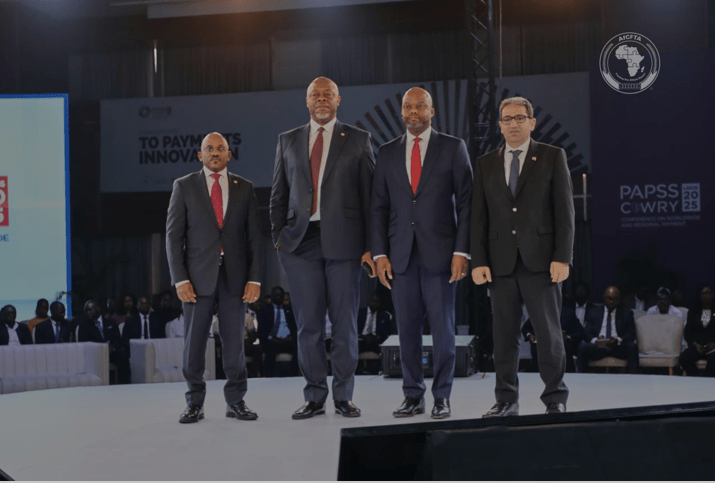
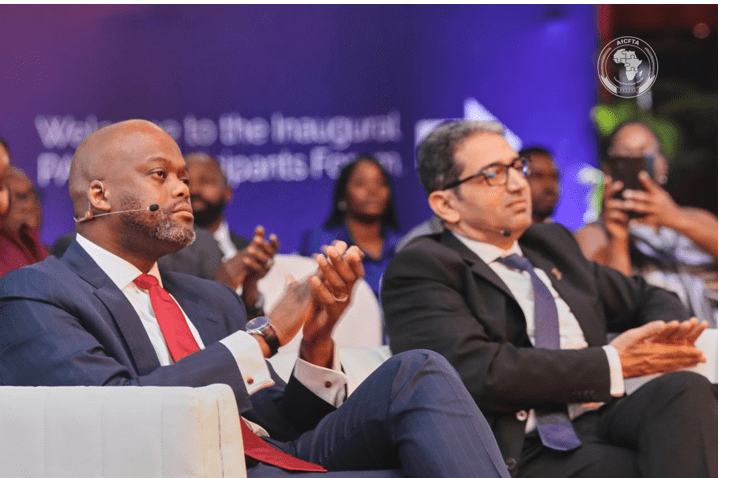
The inaugural PAPSS COWRY Conference opened in Lagos this week with a strong call for deeper financial integration across the continent, as African Continental Free Trade Area (AfCFTA) Secretary-General H.E. Wamkele Mene underscored the pivotal role of the Pan-African Payment and Settlement System (PAPSS) in advancing Africa’s economic agenda.
Speaking at the opening ceremony as a Distinguished Guest of Honour, H.E. Mene described PAPSS as a cornerstone of Africa’s financial sovereignty. He noted that the platform enables instant settlement of cross-border transactions in local currencies, lowers the cost of payments, and strengthens the foundations of a more integrated African market, reinforcing the conference’s theme: “Building an Interoperable and Sovereign African Payment Ecosystem for Trade and Economic Growth.”
The gathering, the first of its kind under the PAPSS COWRY banner, brought together policymakers, financial sector leaders, payment experts and continental institutions to deliberate on the future of Africa’s payments landscape. Discussions emphasized that interoperable, secure and cost-effective payment systems are essential to accelerating AfCFTA implementation and supporting smoother, more predictable cross-border trade.
Developed by Africa for Africa, PAPSS COWRY is positioned as the continent’s flagship platform for payments leadership. Organisers highlighted its ambition to establish a resilient and sovereign payment architecture that not only facilitates trade but also drives economic integration and supports Africa’s broader digital-economic aspirations. The initiative is open to global partners while maintaining a distinctly African focus.
In his keynote address, PAPSS CEO, Mike Ogbalu III reflected on the historical roots of Africa’s fragmented economies and how they continue to shape today’s payment difficulties. He traced these challenges back to the 1884 Berlin Conference, noting that artificial borders and a splintered currency landscape still constrain intra-African trade.
On his part, the President and Chairman of Council of the Chartered Institute of Bankers of Nigeria, Prof. Pius Olanrewaju, who was the Guest of Honour underscored the pressing need for payment systems that are owned and driven by Africans themselves. He contended that true monetary stability and continental integration will remain elusive as long as 80 per cent of intra-African transactions are settled in third party currencies that are non-African
The AfCFTA Secretariat’s participation signalled the strategic imperative of aligning payment innovation with the free trade area’s digital trade and trade facilitation agenda. Officials stressed that seamless and harmonised payment systems are critical to reducing non-tariff barriers, lowering operational costs for businesses and ensuring that African enterprises, especially SMEs, can fully benefit from the continent’s emerging Single Market.
Looking ahead, the Secretariat reaffirmed its commitment to supporting collaborative, continent-wide efforts that enhance payment interoperability and deepen the impact of the AfCFTA. Its message echoed the broader spirit of the conference, emphasizing that modernising Africa’s payments infrastructure is inseparable from the continent’s aspirations for shared prosperity and long-term economic transformation.
Provided by SyndiGate Media Inc. (Syndigate.info).