The Democratic Party of Korea plans to process the Insurrection-Dedicated Trial Division Establishment Act and the revised bill of the Information and Communications Network Act during the National Assembly’s plenary session from the 22nd to the 24th. While both bills have faced criticism for being unconstitutional, the Democratic Party stated it would make minor adjustments and proceed as planned. In response, People’s Solidarity for Participatory Democracy also called for the bills to be scrapped.
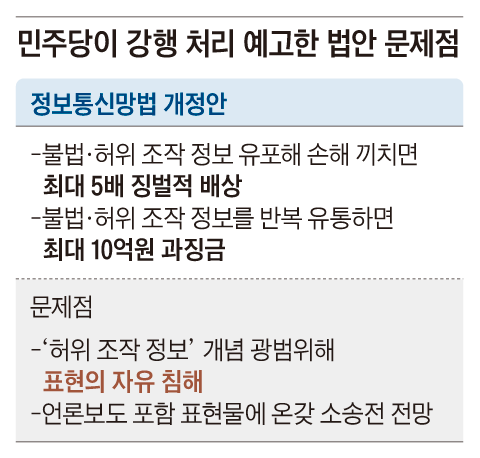
The revised bill, which the Democratic Party named the *Act on the Eradication of False and Manipulated Information*, defines the concept of “false and manipulated information” and expands the existing “illegal information” under current law to include content that incites violence or discrimination based on race, nationality, region, gender, disability, age, social status, income level, or property status. It imposes punitive damages of up to five times the amount of harm caused if someone knowingly posts such illegal or false and manipulated information with the intent to harm others. Additionally, if information ruled as illegal or false and manipulated is repeatedly distributed, a penalty of up to 1 billion Korean won can be imposed.
The Democratic Party’s hardliners recently unilaterally processed these bills at the Judiciary Committee following the SIBCC. They plan to put the revised Information and Communications Network Act on the agenda during the plenary session on the 23rd. The People Power Party has labeled the bills the “Citizen Control Act” and the “Muzzle Act,” warning of a filibuster, but the Democratic Party intends to forcibly end the debate and proceed to a vote on the morning of the 24th, 24 hours after the filibuster begins.
However, even within the ruling party, voices emerged stating, “The revised Information and Communications Network Act is unconstitutional,” ahead of the plenary session. This is because the bill includes a clause stating, “False information that infringes on public interest must not be distributed,” and the Constitutional Court ruled a similar provision in Article 47, Paragraph 1 of the former Telecommunications Basic Act unconstitutional in 2010. In response, Han Jeong-ae, the policy chief of the Democratic Party, said on the 20th, “We will coordinate and adjust the relevant parts, propose an amendment, and process it during the plenary session.” The People Power Party remarked, “The Democratic Party has admitted that the legal definition and scope of false and manipulated information are ambiguous.”
Despite this, People’s Solidarity for Participatory Democracy issued a statement on the 21st, demanding the bills be scrapped, stating, “Although the Democratic Party has proposed an amendment, the fundamental unconstitutionality remains unresolved.” They argued that the constraints on freedom of expression persist and that there are many issues beyond what the policy chief mentioned. Originally, the SIBCC bill aimed to completely abolish the crime of defamation through factual statements and change defamation based on false facts into a semi-public prosecution offense, which requires a victim’s complaint for investigation and punishment. However, the Judiciary Committee retained some provisions punishing defamation through factual statements that involve “facts concerning an individual’s private life” and canceled the introduction of the semi-public prosecution system for defamation based on false facts.
Regarding this, People’s Solidarity for Participatory Democracy stated, “The bill has been regressed,” adding, “If high-ranking officials claim that reports on their corruption suspicions involve their ‘private life’ and file lawsuits, the media’s watchdog function will be weakened.” They also pointed out, “Abandoning the amendment to semi-public prosecution ignores the intent to improve the reality where defamation charges are abused to silence third-party reports on corruption suspicions of those in power.” They further warned, “If the revised bill passes as is, lawsuits over expressions, including media reports, will run rampant.”
The Democratic Party also plans to put the Insurrection-Dedicated Trial Division Establishment Act, which continues to face unconstitutionality concerns, on the agenda during the plenary session on the 22nd and proceed to a vote on the morning of the 23rd. The bill aims to establish dedicated trial divisions for the second trials of ongoing insurrection and foreign exchange cases currently in their first trials, appointing dedicated judges based on recommendations from Chief Justice Lee’s judicial conference, the National Judges’ Representative Conference, and others.
Originally, the Democratic Party planned to establish dedicated trial divisions from the first trial and grant recommendation rights to the head of the Constitutional Court’s secretariat and the Minister of Justice, but revised the content due to concerns over unconstitutionality. Nevertheless, legal circles continued to criticize it as “still unconstitutional” and “undermining the principle of random assignment.” The Democratic Party is also set to discuss whether to amend the bill during a general meeting of lawmakers held before the plenary session on the 22nd. Earlier, the Supreme Court announced plans to form dedicated trial divisions within the existing court system through new regulations, but the Democratic Party insists on enacting a special law to establish the Insurrection-Dedicated Trial Division.


