“Please protect the backbone of the region’s advanced industries.”
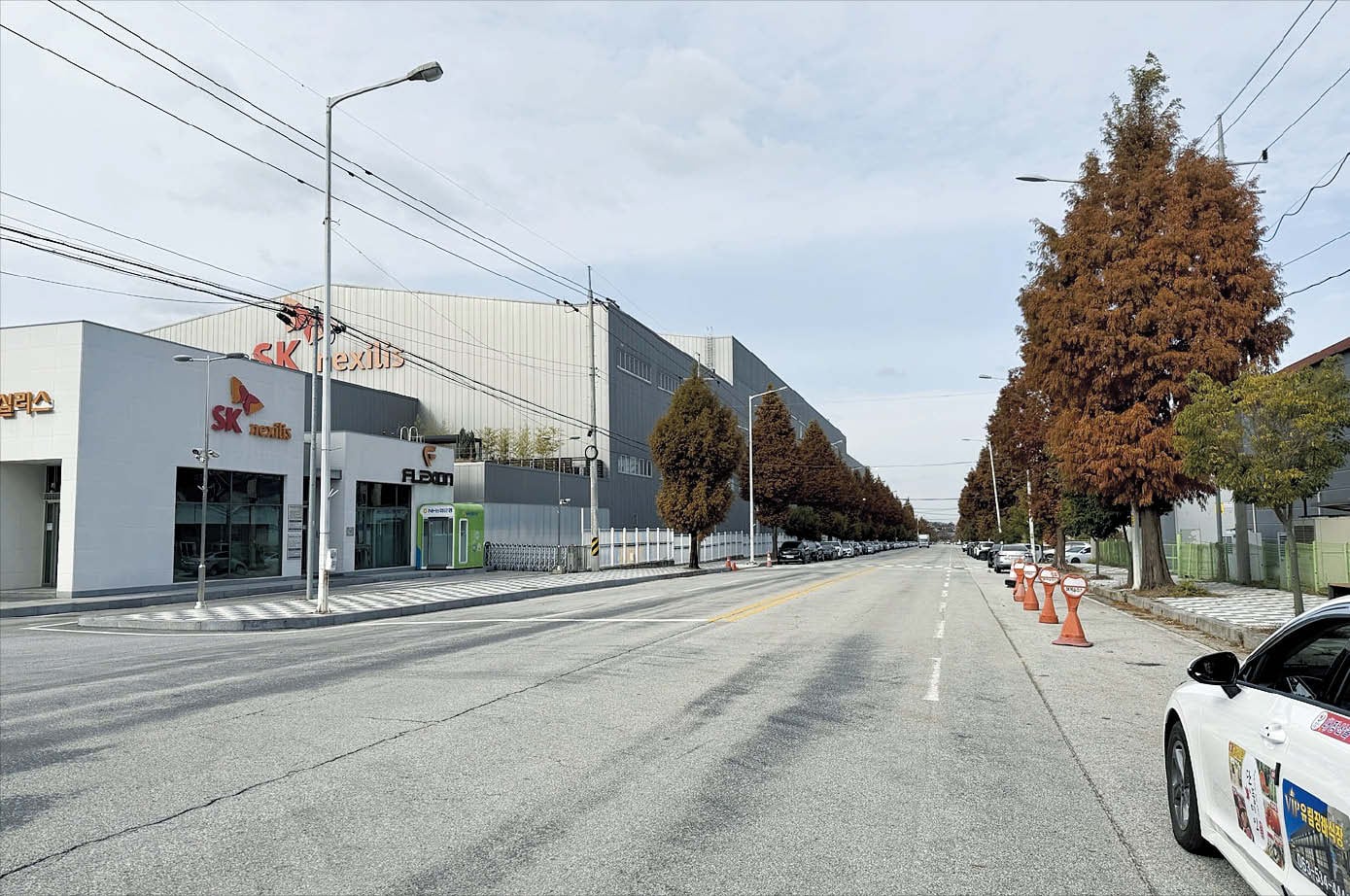
In October, at the headquarters meeting room of SK Nexilis in the third industrial complex of Jeongeup City, North Jeolla Province, Mayor Lee Hak-soo of Jeongeup appealed to the company’s executives. However, the expressions of the executives seated across from him were grave. SK Nexilis, South Korea’s largest copper foil manufacturer, has recently established production lines overseas, including in Malaysia and Poland, rather than in South Korea. When the company announced plans to relocate part of its production equipment from Jeongeup to Uzbekistan, Mayor Lee stepped in to plead.
The SK Nexilis Jeongeup plant, the company’s only domestic factory, has consumed half of the city’s total electricity. It is effectively Jeongeup’s sole large corporation, employing hundreds. However, the company has also been unable to escape the shock of “electricity bill bombs.” The copper foil industry is a device-based industry that requires massive amounts of electricity for electroplating processes. To produce copper foil as thin and long as one-thirtieth the width of a human hair, high-pressure electricity must be supplied consistently for 24 hours. This is why the industry says, “Electricity is the raw material.” As industrial electricity rates soared, SK Nexilis’ monthly electricity bill alone exceeded 5 billion Korean won. Electricity costs now account for over 30% of total production expenses.
A source from SK Nexilis stated, “The rapid increase in industrial electricity rates has made domestic production increasingly burdensome compared to overseas operations. The combination of low-cost competition from Chinese companies and global oversupply has made it difficult to bear the rising costs of domestic labor and electricity.” In the long term, the company plans to convert its existing Jeongeup plant into an R&D-based “mother factory.”
◇“No Reason to Operate Factories in Korea”
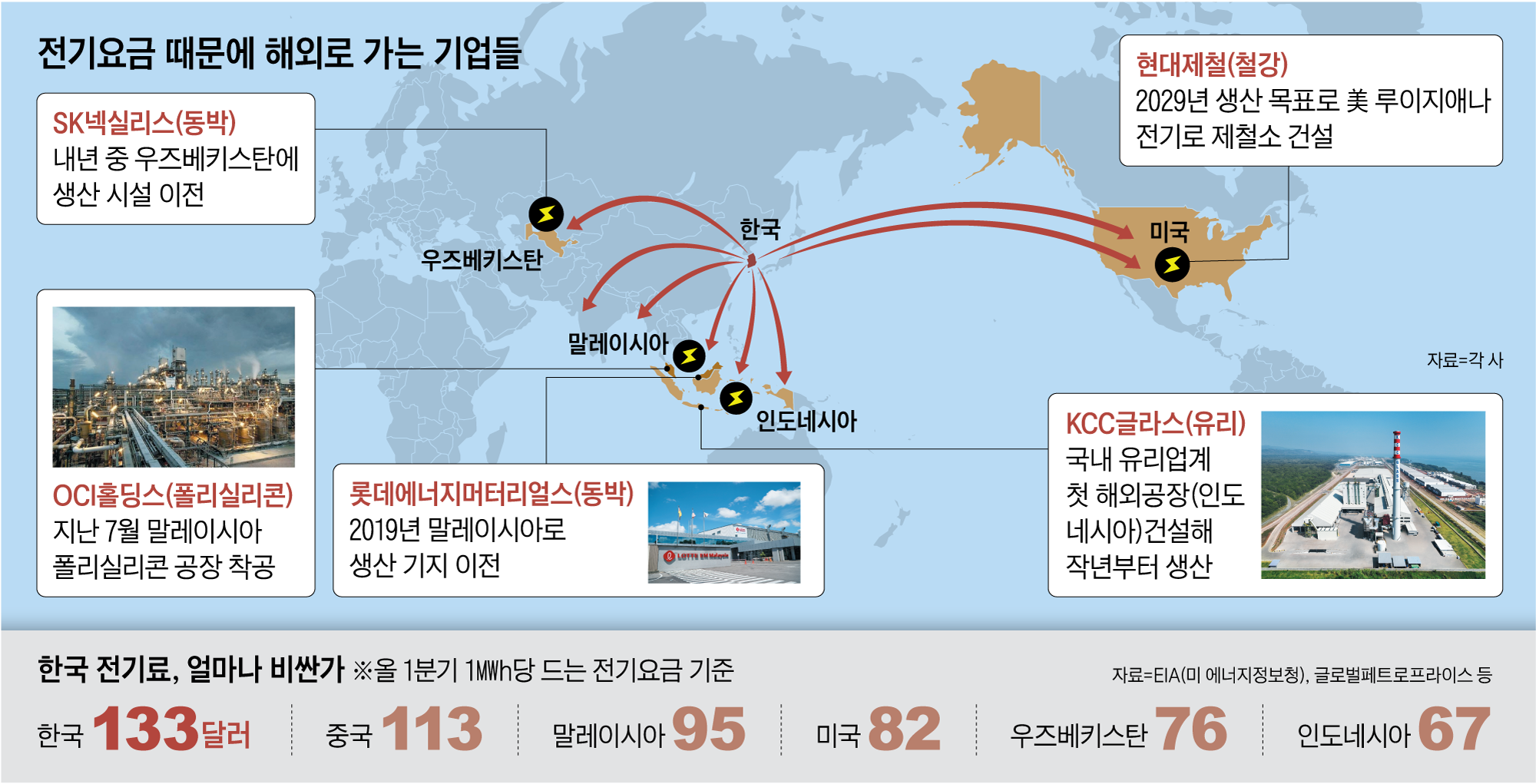
Electricity-driven offshoring (relocation of production bases overseas) is not a problem limited to specific companies. Electricity costs are a decisive factor in determining a company’s factory location. This is especially true for industries with high electricity consumption, such as copper foil, glass, and polysilicon, where electricity accounts for 30–40% of production costs. The rush to leave South Korea due to electricity costs is already spreading.
OCI Holdings, a manufacturer of solar-grade polysilicon, has acquired a local factory in Malaysia, laying the groundwork for a “second production base” to replace its South Korean operations. A key process in polysilicon manufacturing involves heating metal filaments to hundreds of degrees and attaching high-purity gases. Maintaining the filaments at high temperatures requires massive amounts of electricity. A source from OCI Holdings explained, “Electricity costs account for 40% of production expenses, but Malaysia’s electricity rates are one-third of South Korea’s. For this reason, we even signed a 10-year direct power purchase agreement with a local power company.” In July, the company also broke ground on a semiconductor-grade polysilicon production base, set to begin operations in 2029, with an investment of approximately 600 billion Korean won.
The glass industry faces similar challenges. Melting raw sand is a representative electricity-intensive process. KCC Glass produced 810,000 metric tons of glass last year and paid 69.3 billion Korean won in electricity costs. Although production decreased by 8% compared to two years ago, electricity costs increased by 56%.
Ultimately, the company became the first domestic glass manufacturer to build a factory overseas (in Indonesia) and began producing flat glass. It relocated part of the idle equipment from its Yeoju plant, one of two domestic flat glass factories, to Indonesia and completed the first production line. A source from KCC Glass stated, “Since electricity costs are one-third of South Korea’s, local investment was unavoidable. Once the initial facility stabilizes, we plan to establish additional factories in Southeast Asia and Oceania.”
Lotte Energy Materials, a copper foil manufacturer, already relocated its production base to Malaysia in 2019, where electricity rates are approximately 40% cheaper than in South Korea. Hyundai Steel has decided to build an electric arc furnace steel mill in Louisiana, U.S., aiming for commercial production in 2029. It is known that the decision was significantly influenced by the fact that electricity rates there are approximately 34% lower than in South Korea.
◇Industrial Electricity Rates Now Exceed Residential Rates
Experts point out that South Korea’s distorted electricity rate structure is pushing companies to the brink. Typically, countries set industrial electricity rates lower than residential rates to ensure corporate competitiveness. South Korea also previously maintained lower industrial rates. However, over the past three and a half years, industrial rates have risen sharply, surpassing residential rates since 2023. According to Korea Electric Power Corporation, the industrial electricity rate for the first half of this year is 179.23 Korean won per kilowatt-hour (kWh), while the residential rate is 155.52 Korean won.
Most countries with higher industrial electricity rates than South Korea are in Europe, where renewable energy ratios are high, and even there, industrial rates are generally kept below 90% of residential rates. South Korea is one of the few countries where industrial rates are catching up to residential rates.
A professor in the energy sector remarked, “It is rare globally to find a country where industrial electricity rates exceed residential rates. The very foundation of industrial competitiveness is rapidly weakening, and the ‘offshoring rush’ by companies may become an irreversible reality.”