President Mahama Outlines Vision for Transforming Ghana’s Mining Sector
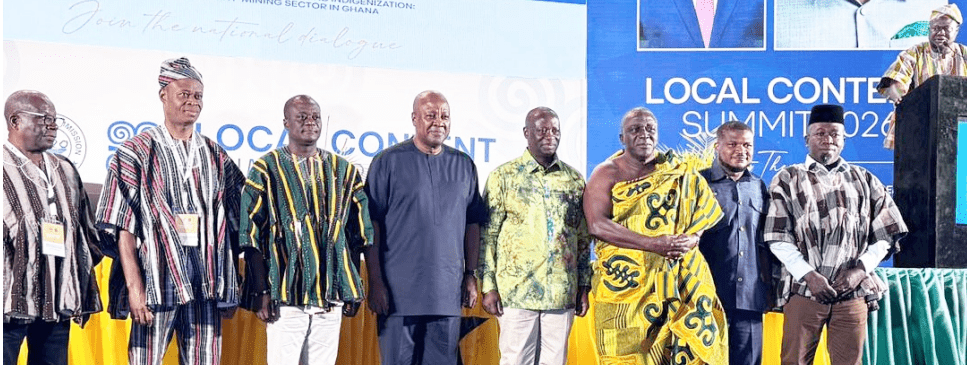
President John Dramani Mahama has emphasized the need to reposition Ghana’s economy from a primary exporter of raw minerals to a competitive player in the global extractive value chain. His remarks were delivered at the Local Content Summit 2026, hosted by the Minerals Commission in Takoradi, under the theme “Strengthening local content and indigenisation – building a resilient mining sector in Ghana.” The summit aimed to address critical issues related to the development of Ghana’s mining industry.
Mahama outlined an ambitious roadmap designed to deepen local content, accelerate industrialization, and position Ghana as a technology-driven mining hub. He highlighted that while Ghana remains Africa’s leading gold producer and ranks among the top six globally, much of the high-value activity—such as advanced engineering, processing, equipment manufacturing, technical services, and refining—still occurs outside the country.
“We’ve been prolific producers, but we have not yet become full participants in the extractive value chain,” he said, challenging stakeholders to reflect on the long-term legacy of Ghana’s mineral wealth. He asked whether future generations would remember Ghana merely in export statistics and royalty payments or as the foundation for world-class industries, thriving enterprises, and resilient communities.
Drawing inspiration from countries like Botswana, Chile, and Indonesia, Mahama stressed that smart, enforceable, and forward-looking local content policies do not deter investment but rather create sustainable competitiveness. He emphasized the importance of balance—policies must be both ambitious and practical, firm yet performance-based.
Key Strategies for Economic Transformation
The first strategy involves evolving local content from transactional procurement to transformational partnerships. The government is reviewing mining legislation and regulatory frameworks to ensure Ghanaian enterprises move up the value chain—from suppliers of consumables to manufacturers of critical components and innovators. Equity participation, technology transfer, and knowledge-sharing must become standard practice.
Second, Mahama declared it unacceptable for Ghana to continue exporting raw ores while importing finished products. He set a five-year target to eliminate raw ore exports. The government will support refineries, bullion infrastructure, mineral-based innovation, and industrial clusters, promoting downstream processing of bauxite, manganese, and lithium in line with the global green energy transition.
A third pillar focuses on human capital development. Institutions such as the University of Mines and Technology and technical universities will be strengthened, alongside expanded apprenticeship programs in partnership with the mining industry. Skills in automation, robotics, drone technology, data analytics, environmental sustainability, and renewable energy integration will be prioritized.
Embracing Digital Transformation
Mahama also emphasized that the future of mining is digital and technology-driven. Ghana must position itself as a hub for AI-assisted exploration, IoT-enabled asset management, blockchain-based supply chain transparency, and locally driven research and development. The government will explore establishing a national mining innovation and research hub to institutionalize this transformation.
Isaac Andrews Tandoh, Chief Executive of the Minerals Commission, stated that the summit marks the beginning of an annual platform to rally all industry players around responsible exploitation and management of mineral resources. He warned Ghanaians against fronting for foreign businesses to the detriment of the country’s interests, urging them to open their eyes to being used in such agreements.
Tandoh announced that the Commission is working on a new royalty regime and reviewing long-term leases that often outlive prevailing policies and regulatory systems. He pledged support for Ghanaian businesses, civil society organizations, local communities, and other stakeholders to derive tangible benefits from the sector.
Regional and Community Engagement
Western Regional Minister Joseph Nelson noted that the summit comes at an opportune time as stakeholders work toward building a more resilient, diversified, and inclusive regional economy. He urged traditional authorities and host communities to continue nurturing a peaceful and stable environment that enables sustainable mining operations to thrive.
Nelson stressed that local content must evolve from basic participation to high-value technical engagement—from the supply of goods to engineering, digital services, and manufacturing, and from labor provision to knowledge-based roles. He also highlighted the link between strengthening local content and the fight against illegal mining, arguing that empowering local enterprises, formalizing supply chains, and ensuring transparent indigenisation will reduce incentives fueling unlawful operations.
Calls for Bold Reforms
President of the Western Regional House of Chiefs, Nana Kobina Nketsia V, called for a fundamental transformation of Ghana’s mining sector to ensure that resource wealth directly benefits host communities. He emphasized the need to move beyond rhetoric and adopt bold, people-centered reforms that prioritize indigenous participation and community development.
Citing key mining towns such as Tarkwa, Prestea, Bogoso, and Wassa, he noted that despite their immense contribution to national revenue, many of these communities continue grappling with underdevelopment. He urged stakeholders to deepen local content policies, expand indigenous ownership, reduce capital flight, and build domestic industrial capacity within the mining value chain.