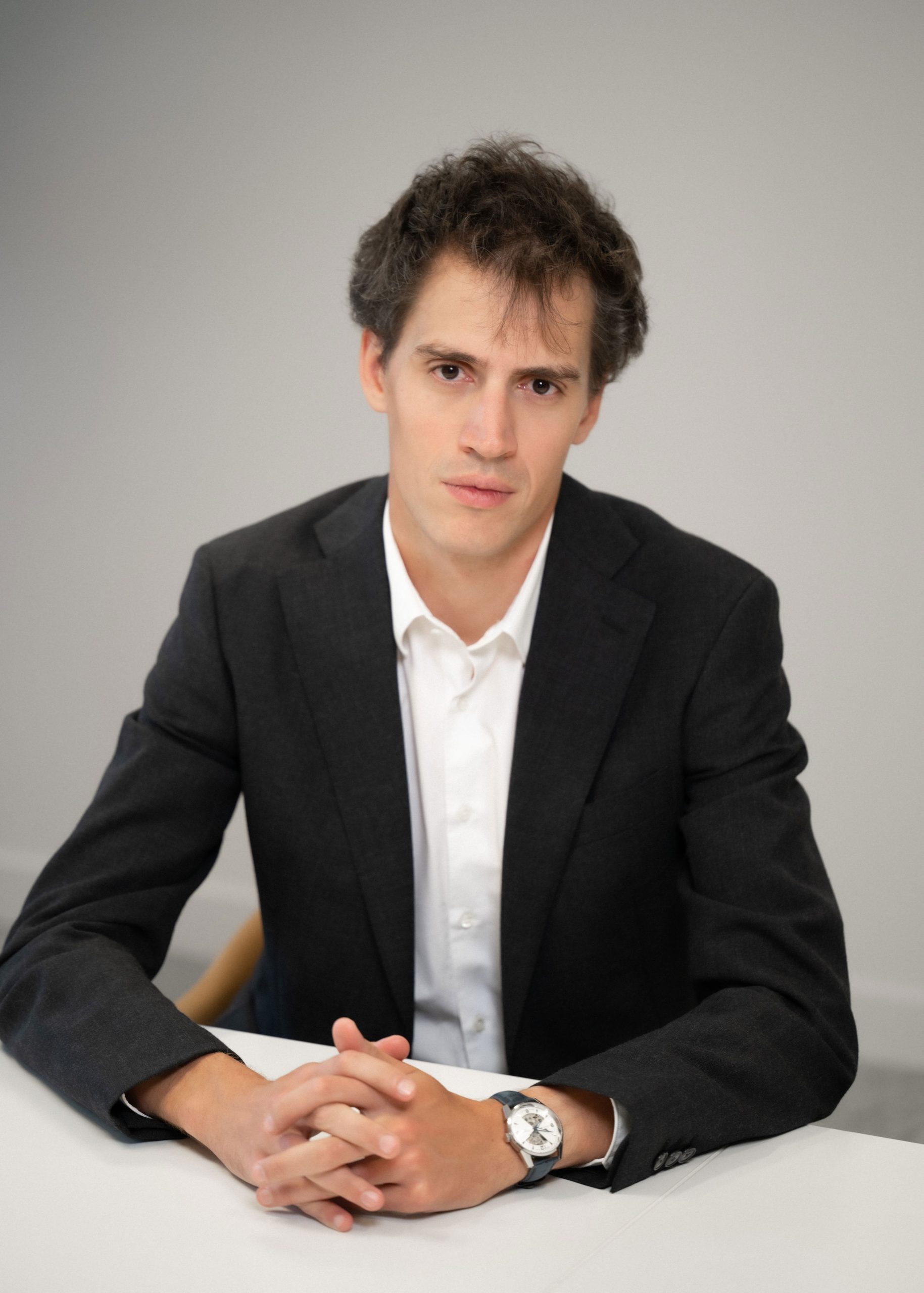
“If South Korea and Europe form a strategic alliance, they can safeguard their AI technology sovereignty without becoming dependent on either the U.S. or China,” Arthur Mensch, CEO of Mistral AI, said in a video interview with this newspaper on the 7th (local time). Mistral is recognized as the ‘pride of European AI’ challenging U.S. giants like OpenAI and Anthropic in the global AI market. Mensch emphasized, “If nations and companies want to prevent capital outflows, they must consider ways to reduce overreliance on U.S. and Chinese Big Tech supply chains,” adding, “While the U.S. and China possess immense capabilities in AI, a formidable counterweight that should never be underestimated is South Korea and Europe.”
◇ Sovereign AI Strategy Empowering Companies with Control
Mistral was co-founded in 2023 in Paris, France, by AI researchers from Google DeepMind and Meta. It stands as a representative European AI company in the global AI model competition dominated by U.S. and Chinese firms. On this day, Mistral secured a Series D investment of 3 billion euros (approximately 4.68 trillion Korean won) led by Samsung Electronics. This investment boosted the company’s valuation to 21.3 billion euros (approximately 33.2 trillion Korean won) within three years of its founding. The company stated, “This is the largest equity investment ever secured by a European tech firm.”
Mistral’s strength, distinct from U.S. giants like OpenAI and Anthropic, lies in its ‘sovereign AI’ strategy, which grants customers control over data, models, and computing environments. Major U.S. AI companies primarily adopt a closed approach, operating AI models on their own servers and requiring users to access them via APIs or cloud services. In contrast, Mistral uses an open-weight (open-source) approach, sharing the core information of AI models—‘weights’—so companies can operate, modify, and customize models directly on their own servers. The key advantage is enabling AI utilization without sending sensitive corporate data externally.
For instance, analyzing sensor data, process conditions, or yield-related information from Samsung Electronics’ semiconductor manufacturing equipment via U.S. Big Tech’s closed AI models often requires processing through external cloud services or APIs. Mistral’s open-source model, however, can be installed directly on Samsung’s internal servers, allowing analysis without external data transfer. This enables identifying process anomalies, optimizing equipment operations, and applying insights to design processes.
Mensch noted, “Data generated from factory equipment is extremely sensitive to companies,” adding, “We can create models that deeply understand industrial processes while ensuring such data never leaves the company.” This is why global firms like Samsung continue collaborating with U.S. OpenAI and Anthropic while also partnering with Mistral to secure control over core manufacturing data and AI systems.
The importance of such control is growing with the advent of the ‘AI agent era,’ where AI takes on more authority and tasks. Mensch stated, “As AI moves beyond mere advisory roles to directly executing core business processes, the most critical factor is ‘business continuity,’” explaining, “This makes it essential to have a trusted partner who can operate models on the customer’s own servers or ensure systems never halt arbitrarily, regardless of circumstances.”
However, strong competitors are emerging even in the open-weight AI model market, with Chinese AI like Alibaba’s Qwen rapidly advancing. Mensch described this as “competition that drives the entire open-weight ecosystem forward rather than a threat.” He added, “It’s highly positive for research institutes in Europe and Asia to compete for the best open-weight models,” characterizing the ecosystem as “both competition and collaboration.”
◇ “South Korea and Europe Must Become a Third AI Axis Beyond the U.S. and China”
The global AI industry is rapidly consolidating around a few companies. The U.S.-China rivalry has solidified, and the frontier AI market—requiring massive computing capital and large workforces—is concentrated among a handful of U.S. firms like OpenAI, Anthropic, and Google. One analysis estimates that by the end of 2025, these three companies will hold a combined 88% share of the enterprise-grade general-purpose LLM market. As AI evolves from a simple tool to core infrastructure, dependence on these few frontier AI companies is increasing.
This ‘concentration’ brings new risks. If a major AI provider changes pricing or policies, countless companies using their services could be simultaneously affected, and service outages could halt operations entirely. For example, on September 3, major AI services like ChatGPT, Claude, and Grok experienced outages around the same time. While no direct link was confirmed, the incidents highlighted the risk of ‘AI blackouts’ due to reliance on a few AI and cloud infrastructures. Another risk is security and data control: as AI begins reading internal source codes, design documents, customer information, and production data to perform tasks, dependence on external AI companies directly translates to security vulnerabilities.
Mensch emphasized the potential for South Korea and Europe to form a ‘third AI axis’ independent of the U.S. and China amid this situation. He stated, “The era of a unified free global market has ended, and fragmentation is an unavoidable business reality,” adding, “A structure where a single global monopolistic AI provider dominates is unsustainable.” He continued, “South Korea and Europe possess world-class advanced manufacturing companies in semiconductors, automobiles, chemicals, and robotics, along with strong pools of mathematical and engineering talent. If the private sector unites and forms a strategic alliance, it can pool capital on a scale that rivals the massive financial power of the U.S. and China, independently building large frontier models and complex local inference systems.”
- 월 5900원 멤버십, 신문 독자에게는 2900원, 조선멤버십
- 55000원 상당의 신문-잡지 8종 마음껏 보기, 조선멤버십
- 현금처럼 쓸 7000포인트 받아 알뜰한 쇼핑, 조선멤버십

Related posts:

Fiction park: He was the best in class. He still wasn’t good enough

Gagan Thapa takes oath as Congress president, vows to regain public trust

Inside knowledge that has locals gripped by fear after gran’s body found decomposing in cattle dip

New property purchase disclosure rule in Japan sparks fears it may curb foreign investment
Dino-mite treasures: inside Singapore’s Fort Knox storing playthings of ultra-rich