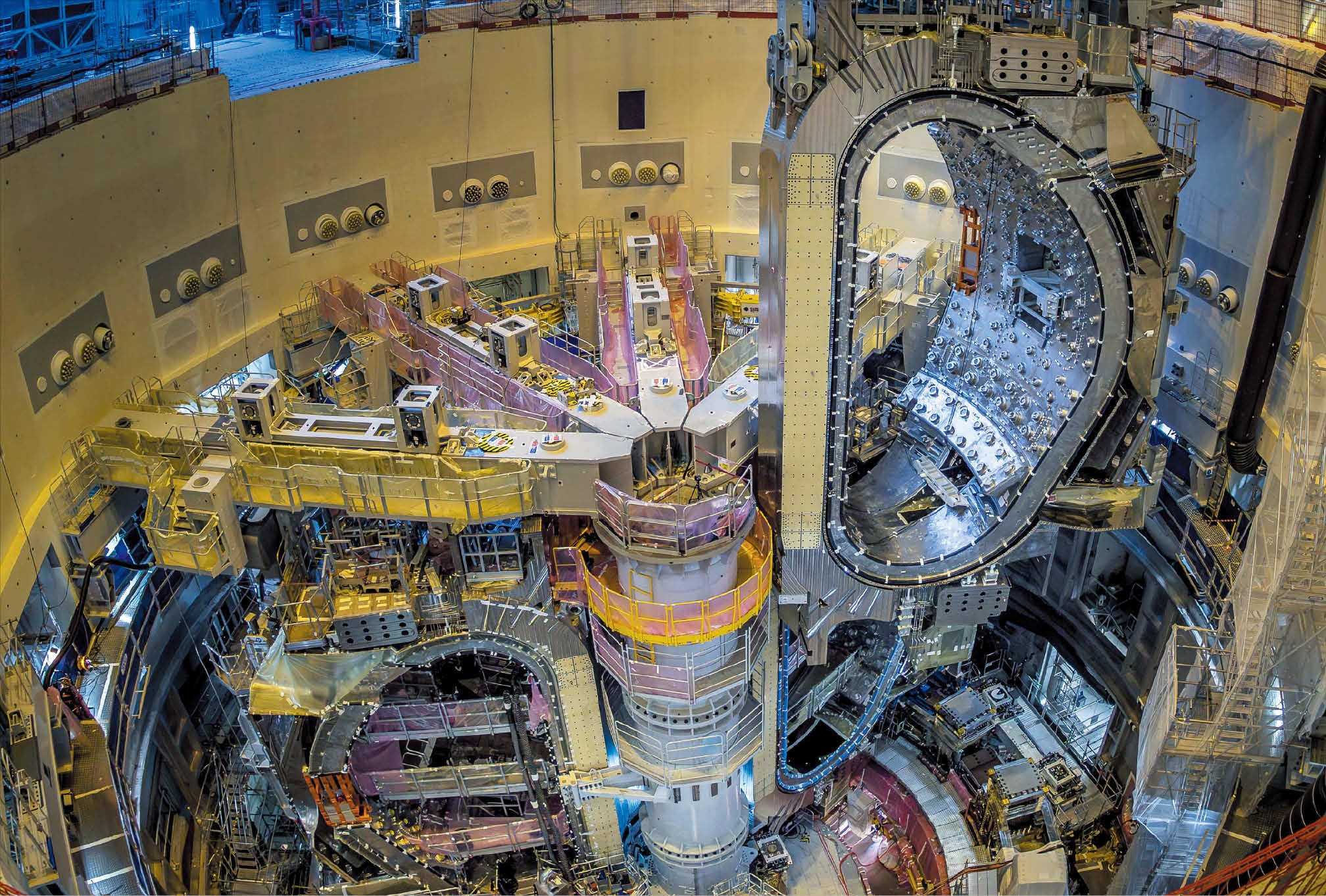
Inside a massive concrete building in the southern French region of Cadarache, a structure weighing hundreds of tons, shaped like the letter D, is lowered by a large crane into a circular space. This process involves assembling multiple such structures and superconducting magnets in a ring to complete a doughnut-shaped nuclear fusion device called a “tokamak.” Inside, hydrogen is heated to a plasma state exceeding 100 million degrees Celsius, confined by powerful magnetic fields, and nuclear fusion is induced to generate massive energy. This is the International Thermonuclear Experimental Reactor (ITER), a global project jointly constructed by major countries to replicate the sun’s energy production on Earth—a “artificial sun” initiative.
◇A ‘Artificial Sun’ Built by Seven Global Entities
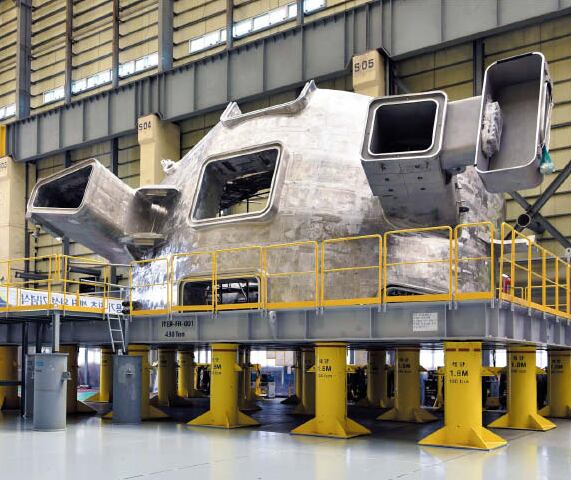
ITER is a super-large project beyond the capacity of a single nation, involving seven members: South Korea, the United States, the European Union (EU), China, Japan, Russia, and India. The EU, which provided the site, covers approximately 45.5% of the construction costs, while the remaining six members, including South Korea, each contribute about 9.1%. Payments are made not only in cash but also through in-kind contributions, where each member develops and manufactures assigned core components. South Korea has supplied parts of the vacuum vessel and superconducting conductors.
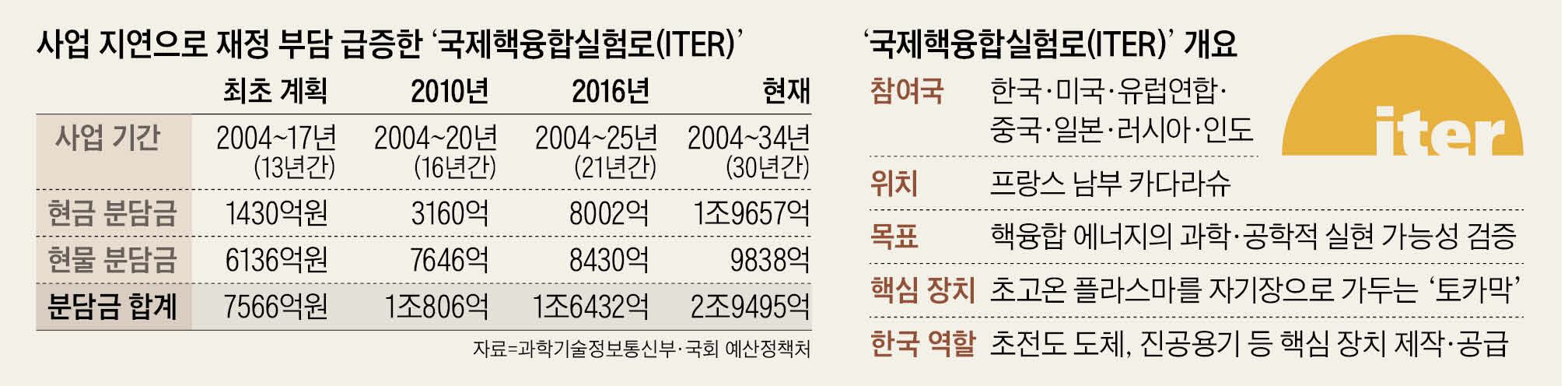
The challenge lies in the project’s prolonged timeline and escalating costs. South Korea, which joined ITER in 2003, initially planned to invest 756.6 billion Korean won over 13 years from 2004 to 2017. Of this, 143 billion Korean won was to be paid in cash, with the remaining 613.6 billion Korean won allocated for in-kind contributions. However, design changes, component defects, repairs, and assembly delays extended the project period to 16 years (2004–2020) in 2010, then to 21 years (2004–2025) in 2016, and now to 30 years (2004–2034). South Korea’s total contribution has quadrupled from the original 756.6 billion Korean won to 2.9495 trillion Korean won.
Notably, the cash contribution has surged from 143 billion Korean won to 1.9657 trillion Korean won—over 14 times the initial amount. Meanwhile, in-kind contributions rose from 613.6 billion Korean won to 983.8 billion Korean won. While the total project cost quadrupled, the cash burden increased far more sharply.
◇From a 2017 Completion Target to a 2034 Extension
ITER was always a long-term international project with high cost variability. South Korea received National Assembly ratification for the ITER agreement in 2007. At the time, the government estimated the country’s burden during the construction phase at around 876.7 billion Korean won, with the total cost including operation, radioactive decay, and decommissioning phases reaching approximately 1.6 trillion Korean won. However, the current ITER project cost managed by the South Korean government has already reached 2.9495 trillion Korean won.
Cost overruns were flagged early. In 2009, the National Assembly Budget Office warned that design changes, raw material prices, and exchange rate fluctuations could increase South Korea’s financial burden. It also suggested reviewing the project’s feasibility if costs exceeded the initially approved amount by 20% or more.
Delays have compounded. The original completion date of 2017 was extended to 2020, then 2025, and finally 2034—tripling the project period from 13 to 30 years. The unprecedented scale of the fusion device led to design revisions and manufacturing complexities, compounded by supply chain disruptions from the COVID-19 pandemic. ITER revised its entire plan, extending the timeline and costs, which increased South Korea’s burden.
◇Will 3 Trillion Korean Won Be the Final Cost? Full-scale Experiments Begin in 2039
According to ITER’s latest plan, 2034 marks the start of research operations, not the end of all experiments. Full-scale fusion operations using deuterium and tritium as fuel are scheduled to begin in 2039—four years later than the original 2035 target. ITER aims to generate 500 MW of fusion thermal output by inputting 50 MW of energy to heat plasma. While ITER itself will not produce electricity, it will demonstrate the feasibility of fusion technology, paving the way for prototype reactors and commercial power plants.
The South Korean government and fusion research community argue that the project’s value should not be judged solely by increased costs. South Korea has accumulated technology by developing and manufacturing core components like vacuum vessel sectors, superconducting conductors, and power supply systems. It is responsible for four of the nine vacuum vessel sectors. The government also notes that domestic companies have secured over 1 trillion Korean won in contracts from ITER and other member states.
Nonetheless, whether the current 3-trillion-Korean-won cost is South Korea’s final burden requires scrutiny. While South Korea’s project period ends in 2034, ITER’s deuterium-tritium operations begin in 2039, followed by operation and decommissioning phases. The National Assembly Budget Office emphasized the need to reassess the financial burden’s appropriateness given the extended timeline and costs. The Ministry of Science and ICT maintains that since South Korea’s contribution rate of 9.09% remains unchanged, no new National Assembly ratification is required.
As ITER construction delays persist, the global fusion competition has evolved. Private companies, particularly in the U.S., are now pursuing smaller fusion reactors using high-temperature superconducting magnets. Professor Han Seung-yong of Seoul National University’s Department of Electrical and Information Engineering stated, “South Korea possesses world-class competitiveness in high-temperature superconducting magnets, a core technology for compact fusion reactors. A national-level organization is needed to discuss with domestic and international experts how to allocate limited research resources and budgets more effectively.”
World-Renowned Nuclear Fusion Expert Professor Choi Won-ho
“Secure Technology and Lead Operations to Maximize Returns Rather Than Withdraw”
Professor Choi Won-ho of KAIST’s Department of Nuclear and Quantum Engineering, a world-renowned nuclear fusion expert who served as an ITER Science and Technology Advisory Committee member for 12 years, said in a September 14 interview with this newspaper, “Delays in ITER do not make it a wasteful investment. Given the significant resources already invested, South Korea must actively utilize ITER.”
Choi first emphasized the need for South Korean researchers and engineers to participate more actively in the design and construction phases. While member states share information during these phases, receiving data remotely differs from hands-on design and assembly, which accelerates technology accumulation. “South Korea should send more personnel to participate directly,” Choi said. “Technology acquired by being on-site is truly ours.” He added, “We must participate directly to secure as much information as possible during the design and construction phases.”
Second, South Korea should take a leading role in ITER’s operational phase. ITER will produce large-scale fusion reactions impossible to replicate in domestic devices. This phase will test materials and systems that withstand high-energy neutrons, develop methods to produce and reuse tritium fuel, and validate engineering technologies for commercial reactors. “ITER’s goal is to secure core engineering technologies needed for commercial reactors,” Choi said. “The key is how actively South Korea participates during the operational phase.”
Choi stressed the importance of applying ITER’s large-scale fusion data and technology to South Korea’s own reactor development. “Given the investments made, South Korea should not withdraw from ITER but instead secure maximum technological and experiential returns,” he said.
☞International Thermonuclear Experimental Reactor (ITER)
ITER is the world’s largest nuclear fusion experimental facility, jointly constructed by South Korea, the United States, the European Union (EU), China, Japan, Russia, and India in Cadarache, southern France. It aims to replicate the sun’s energy production by heating hydrogen to over 100 million degrees Celsius, creating a plasma state confined by powerful magnetic fields to induce nuclear fusion reactions.