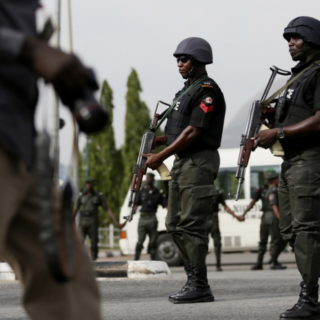
The push for state police has resurfaced in recent weeks amid rising abductions. PHILIP IBITOYE examines the hurdles and chances of the policy change finally becoming a reality.
ON February 15, 2024, President Bola Tinubu met with state governors in Abuja, and when the Minister of Information, Mohammed Idris, came out to brief journalists after the meeting, one topic stuck out: state police. According to Idris, the leaders had discussed “the possibility of setting up state police.”
Although the federal government’s top spokesperson said the federal and state governments were “mulling” the idea of states having their own police forces – ones that are not glorified vigilantes with Dane guns – there was no full-throated support from the president in public. Ten months later, on December 12, 2024, after a National Economic Council (NEC) meeting presided over by Vice-President Kashim Shettima, Kaduna State governor, Uba Sani, revealed that all 36 state governments had submitted their reports on the creation of state police to the council.
But progress stalled for nearly a year. Like every other conversation about state police in Nigeria over the years, the matter was relegated from the front burner of policy debates until another tragedy struck in September. During a meeting with a delegation of prominent citizens from Katsina State led by Governor Dikko Radda, following a surge of bandit attacks in the state, President Tinubu made his first public statement backing state police. The president acknowledged that state policing was an inevitability if Nigeria had any chance of stemming the ugly tide of insecurity.
“I am reviewing all the aspects of security; I have to create state police. We are looking at that holistically,” he said. But some observers pushed back against the president, saying he had no singular power to establish a state police system in Nigeria because the authority rests in the hands of state and federal lawmakers. And predictably, President Tinubu did no publicly known follow-up on creating state police until last week, when a wave of abductions forced him to again point to the system as a lasting solution to Nigeria’s growing insecurity.
On Wednesday, November 26, 2025, while declaring a nationwide security emergency, the president made space for one sentence about state police advocacy in the tenth paragraph of his statement. It was also the first time he had put the matter in front of the appropriate actors: the National Assembly. “I call on the National Assembly to begin reviewing our laws to allow states that require state police to establish them,” he said.
Since the President’s call, the House of Representatives has moved to act on amending the constitution to allow the establishment of state police forces. But the lower chamber has also wobbled, stalling action. Debate on multiple constitutional amendment bills, including a state policing bill, had been scheduled for last Thursday, December 4, 2025, while votes were expected this week. However, lawmakers overwhelmingly approved the postponement of the debate on Thursday over some of them not having copies of the draft amendment. With debate yet to begin and no assurance that it will start this week, the process may face further delay.
As lawmakers delay debate on the state policing bill, there are already disagreements among stakeholders over the enforcement mechanisms to pursue.
In an interview with Sunday Tribune, the former Chairman of Campaign for Democracy, Moshood Erubami, drew attention to the curious language in the president’s latest statement where he said “states that require state police,” suggesting that not all states necessarily require the system. Erubami argued that no state should be left behind. “It [state police] should be for all states, not at the discretion of state governors. Given the level of insurgency, state policing is inevitable,” he said.
However, a Senior Advocate of Nigeria (SAN) and former second national vice-president of the Nigerian Bar Association (NBA), Monday Ubani, disagreed with the notion of compulsory creation of state police forces in all states. He argued that some states may not have the capacity to fund a police force and they should not be forced to take on the responsibility.
“They [lawmakers] should make it [establishment of state police] optional, it should not be compulsory for all states. If a state is willing to create state police, they should go ahead, but if they don’t have the capacity, they should stick to the federal policing system,” Ubani told Sunday Tribune.
The abduction of 25 schoolgirls in Kebbi State, 38 worshippers in Kwara State, over 250 students and teachers of a Catholic school in Niger State, and many more, as well as the public calls of the Southern Governors Forum (SGF), Northern Governors Forum, and other stakeholders, have given the push for state police a rare momentum, but analysts say it will face the same roadblocks it has encountered in the past.
Why state police creation has been elusive
The 1999 Constitution, which guides all areas of governance in Nigeria’s deeply flawed federal system, features policing on the Exclusive Legislative List, making it the sole responsibility of the federal government, which stakeholders say no longer has the capacity to sufficiently police the entire country.
“We don’t need any more soldiers or federal police,” a chieftain of the Peoples Democratic Party (PDP), Bode George, said in response to President Tinubu ordering the recruitment of additional police personnel. “As a retired general, I can tell you that what we need is the establishment of state police. Policing is fundamentally community-based… When a Yoruba man is recruited into the police and posted to Borno State, how can he be effective?” George queried while speaking in Lagos recently.
But advocates like George have had to contend with a myriad of obstacles that have made the adoption of state police out of reach for decades. First of all, the constitutional amendment process requires approval by at least a two-thirds majority in each chamber of the National Assembly, that is, 73 senators in the 109-member Senate and 240 representatives in the 360-member lower chamber. Apart from the principal officers of the National Assembly failing to weigh in on the debate, very few lawmakers are currently backing the policy change, making its path to success very thorny. Even if the National Assembly eventually musters enough support to get a constitutional amendment through both chambers, the Houses of Assembly in at least 24 states must vote in favour, and the president must assent to it for it to become law.
Despite the historical opposition of Northern states to state police, Nasarawa State governor Abdullahi Sule has said 35 of 36 states have already agreed to setting up state police, potentially easing the path to a constitutional amendment. Speaking in an interview with ARISE News on November 25, 2025, Governor Sule said he “fully supports” the push for state police.
However, other obstacles remain on the path to state police. For years, many stakeholders have opposed the policy change due to two major concerns: first, that state police will be misused by power-drunk governors, and second, that states, which already struggle to pay the salaries of workers, will be unable to run a police force. One of the opponents is former Rivers State governor, Celestine Omehia, who said state governors have not demonstrated the competence to handle the responsibility of running state police forces.
“You can see now that in Nigeria, violence is a tool in politics to win an election. If state police is created, it becomes an easy and willing tool to be used for every election by the governors to attack political opponents,” he said.
Similarly, former Speaker of the House of Representatives, Yakubu Dogara, has resisted calls for state police, noting that some functions in the Concurrent List ceded to governors have not been well managed. “If we have state police, what will play out is that we will be giving a hangman the free man to hang; we will enable state governors to build militias. What will happen is that if you disagree with your governor, you dare not go home. The state police then becomes a militia used to rig elections by the sitting governors,” Dogara, whom President Tinubu appointed as the chairman of the board for the newly established National Credit Guarantee Company (NCGC) in May 2025, stated.
However, governors like Sani, a former senator, have pushed back against suggestions that governors will misuse state police forces. “There cannot be any abuse if this law is crafted in such a way that won’t allow governors to abuse it. That is how to address it. The crafters of that bill can make it clear that the only focus should be on criminalities, not on political issues,” the Kaduna governor said.
George has also dismissed concerns of abuse by governors, noting that the enhancement of security of lives and property by state police trumps any concerns of misuse. “We are looking for solutions to insecurity, yet some people are talking about elections. This is getting us to Armageddon,” the PDP chieftain warned.
Growing calls for state police
In recent weeks, calls for state police from political and civil society leaders have intensified amid a surge of security incidents and systemic failures. On November 24, 2025, six governors under the umbrella of the South-West Governors Forum (SWGF) renewed their call for state police and insisted that the worsening insecurity across the region has made the reform an urgent necessity which can no longer wait. “The Forum reaffirms its support for the establishment of State Police, emphasising that ‘The Time is Now’ and it can no longer be delayed,” the governors, who belong to both the ruling and opposition parties, said in their communiqué.
Two days later, 17 governors from the South-West, South-East and South-South, under the auspices of the SGF and the Southern Nigeria Traditional Rulers Council (SNTRC), met at the Ogun Governor’s Residence in Iperu-Remo to demand immediate steps to create state police as the effective response to the deepening crisis of insecurity.
“The Forum reiterated its longstanding call for the establishment of state police as a constitutional imperative. It emphasised that the success of community-based and regional security outfits underscores the urgent need for decentralised policing,” part of the communiqué from the meeting stated.
Not to be outdone by their Southern counterparts, last Monday, December 1, 2025, Northern leaders, comprising governors of the 19 Northern states and traditional rulers, including the Sultan of Sokoto, Sa’ad Abubakar III, reaffirmed their support for the rapid establishment of state police, insisting that decentralising the nation’s policing system is now essential to tackling the worsening insecurity across the region
In a communiqué they issued at the end of their security summit in Kaduna State, they warned that the North was facing a security collapse that could “undermine the very existence” of the region and called for a transfer of real security powers to the states. “Nigeria’s centralised policing model can no longer meet the demands of a nation with over two hundred million people with vast ungoverned spaces,” the Kaduna governor and the summit’s host said in his opening remarks.
This is a dramatic shift for Northern leaders who have historically rejected calls for the creation of state police. In July 2012, governors of the 36 states met in Abuja and they all backed state police as a solution to rising insecurity in the country. However, 19 Northern governors defected a few days later and kicked against the idea of state police, saying that they were ready to work with the existing federal police force. The Northern governors were reportedly afraid that their dwindling financial position would not permit the funding of state police like their Southern counterparts, who they claimed had more funds than them. They are now singing a different tune more than a decade later after creating a ₦1 billion monthly regional security fund at their latest meeting.
It may have taken 13 years to convince Northern leaders that state police is the best way to tackle the lingering insecurity in their region, but for advocates, it is better late than never. Advocates of state police are now optimistic that the issue can ride the wave of the growing call for its adoption to success. However, whether the current momentum will translate into concrete reform remains unclear. Despite the House of Representatives dragging its feet on when to start debate on the issue, many observers believe that President Tinubu’s public call and political will in seeing the constitutional amendment through would be key to it becoming a reality. The gale of abductions in recent weeks has also added urgency, and stakeholders across the political and regional divides now acknowledge that the country’s security framework requires adjustment. Whether this alignment is sufficient to drive the amendment process to conclusion remains to be seen.
Provided by SyndiGate Media Inc. (Syndigate.info).