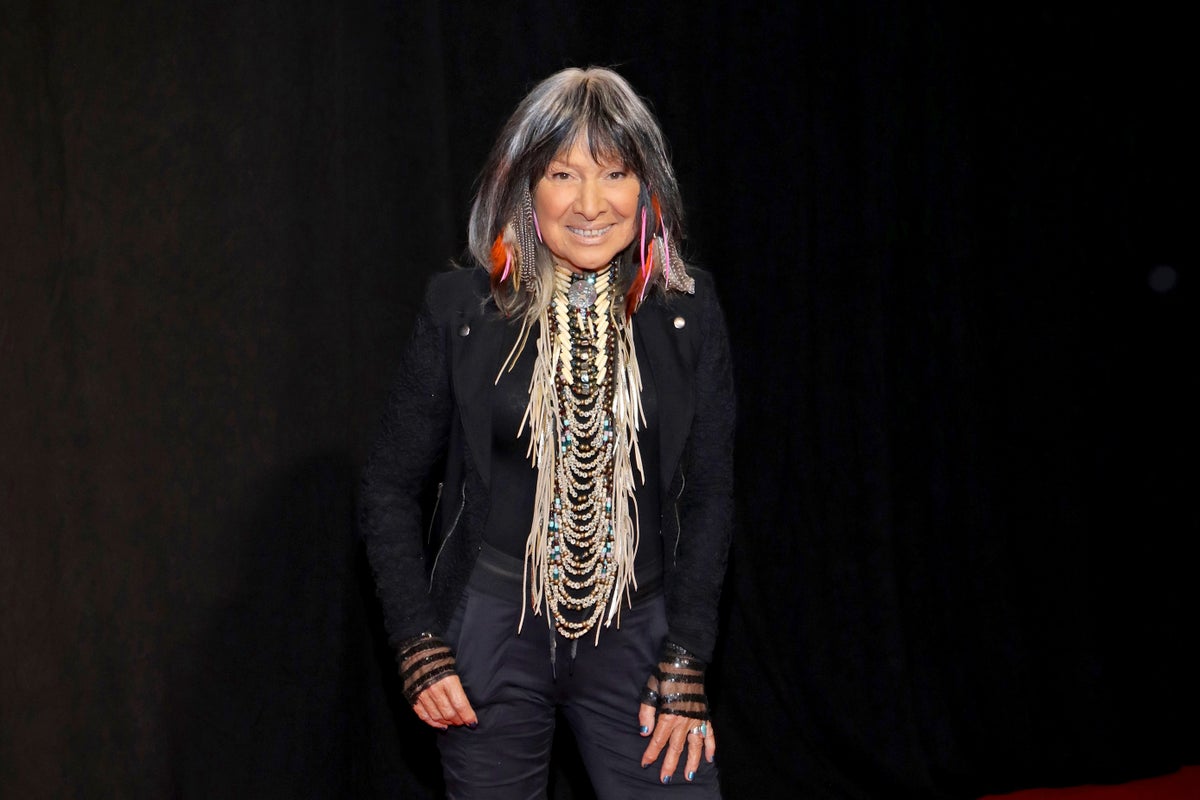
has said she has returned her Order of Canada “with a good heart”, following allegations that she fabricated claims of her Indigenous ancestry, which she has denied.
. Sainte-Marie, 84, said she is an American citizen and holds a US passport, but was adopted as a young adult by a Cree family in Saskatchewan.
in 1977.
In a statement issued on Tuesday (4 March), the singer expressed her “love and gratitude” to Canada and said she felt “overwhelmingly grateful that I’ve been able to make my contribution”.
She added: “It was very lovely to host the medals for a while, but I return them with a good heart.”
and unsuccessfully explored the possibility that she was born in Canada.
“I’ve never treated my citizenship as a secret and most of my friends and relatives in Canada have known I’m American, and it’s never been an issue,” she said.

Her statement comes as Rideau Hall, the official residence of the governor general of Canada, said it had also terminated two jubilee medals given to Sainte-Marie in 2002 and 2012, both associated with her membership to the Order of Canada, which she received in 1997.
, has long been associated with the struggles of Native Americans.
She has won seven Juno Awards – Canada’s equivalent to a Grammy – including 1997’s Best Music of Aboriginal Canada Recording and 2009’s Aboriginal Recording of the Year. In 2018, she was awarded the prize for Indigenous Music Album of the Year.
called into question her Indigenous heritage, discovering a birth certificate that indicated she was born Beverly Jean Santamaria in 1941 in Massachusetts, while both she and her parents were listed as white.
reports that biographical information supplied by Sainte-Marie’s team over the years stated that she was born on the Piapot Cree First Nations Reserve in Qu’Appelle Valley, Saskatchewan, while her 2018 authorised biography also states that she was likely born Cree.
The publication reports that her website also once stated that she was “believed to have been born in 1941 on the Piapot First Nation reserve in Saskatchewan and taken from her biological parents when she was an infant.”

In an email sent in September to CBC, Sainte-Marie’s Ontario-based lawyer said: “At no point has Buffy Sainte-Marie personally misrepresented her ancestry or any details about her personal history to the public.”
She said that any perceived consistencies CBC had found in Sainte-Marie’s story can be explained by the truth”.
In October 2023, Sainte-Marie issued a statement online with the headline, “My Truth as I Know It,” calling the questions surrounding her heritage “deeply hurtful allegations”.
“I have always struggled to answer questions [about] who I am,” she said, maintaining that she was “proud of my Indigenous-American identity, and the deep ties I have to Canada and my Piapot family”.
“What I know about my Indigenous ancestry I learned from my mother,” she said. “I may not know where I was born, but I know who I am.”
The Independent has always had a global perspective. Built on a firm foundation of superb international reporting and analysis, The Independent now enjoys a reach that was inconceivable when it was launched as an upstart player in the British news industry. For the first time since the end of the Second World War, and across the world, pluralism, reason, a progressive and humanitarian agenda, and internationalism – Independent values – are under threat. Yet we, The Independent, continue to grow.


