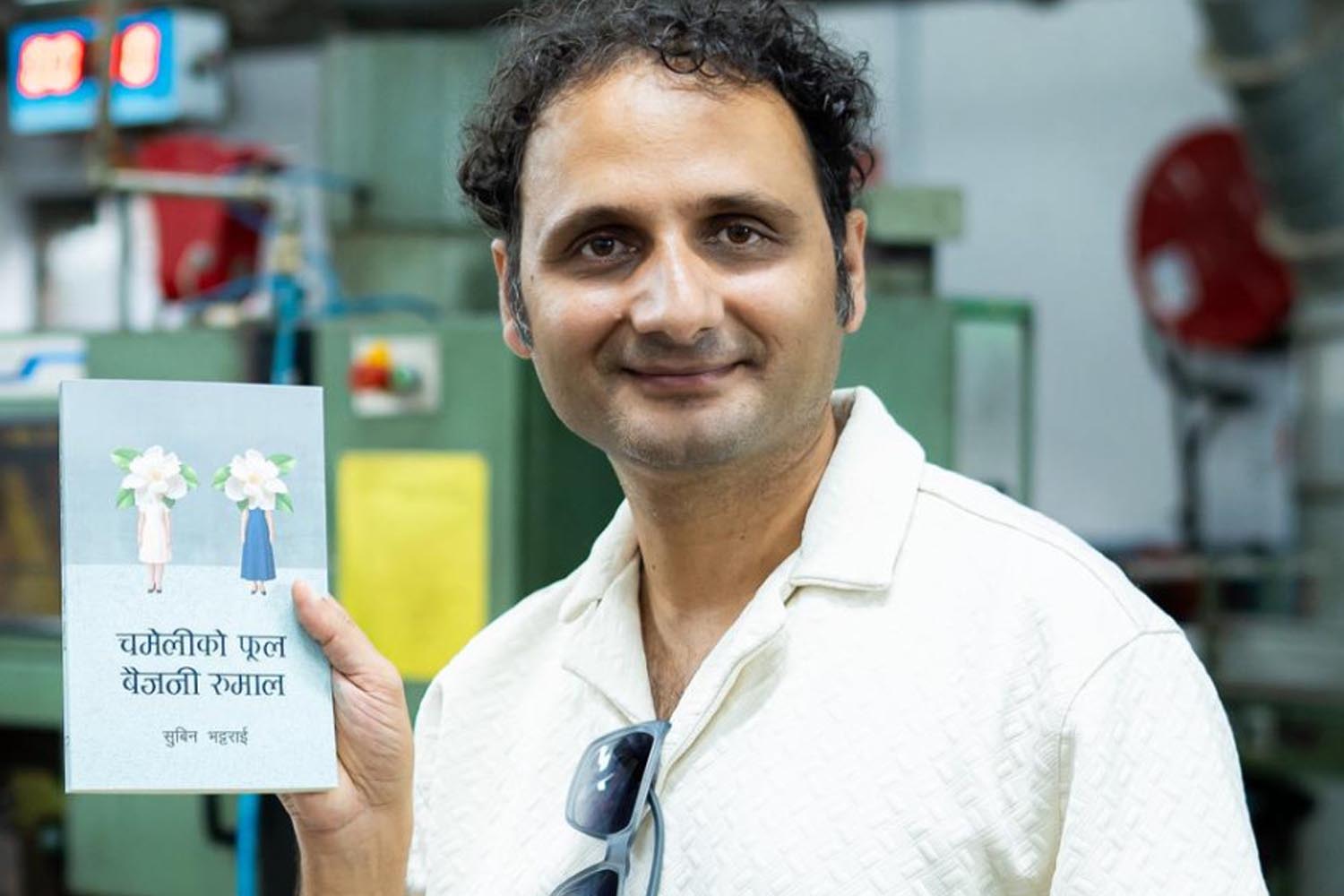
A New Chapter in Subin Bhattarai’s Literary Journey
Nepal, Oct. 15 — After three years of anticipation, Nepal’s beloved writer Subin Bhattarai has returned with a new literary work that promises to captivate readers. His latest book, a collection of stories titled Chameliko Phool Baijani Rumal, marks a significant moment in his career. Known for his experimental approach and willingness to explore new creative avenues, Bhattarai describes this collection as a “Saptarangi Samyog” — a meeting point of seven different colors. This metaphor highlights the diversity and richness of the stories within.
The book is set to launch on Friday and features seven distinct narratives, some stretching up to 40 pages. Bhattarai compares the format to Haruki Murakami’s Men Without Women, aiming to create stories that are neither novels nor short stories but something in between. He emphasizes that each story stands on its own, capable of being adapted into films without losing its essence.
The Inspiration Behind the Title
When asked about the poetic title Chameliko Phool Baijani Rumal, Bhattarai explains that it comes from one of the stories in the collection. This particular story is intense and thematically rich, and the title and cover image reflect its core themes beautifully. The name itself evokes a sense of mystery and depth, inviting readers to delve into the layers of meaning embedded in the narrative.
Returning to Storytelling
Bhattarai began his writing career with a story collection, but over the years, he has focused more on novels. However, he feels compelled to return to storytelling, not just for variety but also for the unique space it offers. He believes in experimenting and exploring new forms, and this time, he wanted to craft medium-length stories that offer character depth without being overly lengthy.
His inspiration comes from authors like Fyodor Dostoevsky and Haruki Murakami, whose works have influenced his approach to storytelling. Bhattarai emphasizes the importance of quality over quantity, focusing on creating meaningful and well-crafted stories rather than simply increasing the number of words.
A Rainbow of Stories
Compared to his previous works like Summer Love and Saya, Chameliko Phool Baijani Rumal represents a broader spectrum of themes and styles. While earlier works were painted in similar shades, this collection is a vibrant rainbow — a saptarangi samyog of seven different colors. Bhattarai sees this as a natural evolution in his writing, reflecting the changing landscape of both society and literature.
The Influence of Social Movements
The release of this book coincides with a period of intense social unrest, particularly the Gen Z movement. Bhattarai acknowledges the impact of such movements on art and culture, believing that they shape the direction of creative expression. He notes that after past upheavals, such as the Maoist unrest, many literary voices emerged, and writers often centered their stories around significant societal changes.
He feels that literature plays a crucial role in exploring the deeper psychological aspects of such movements, something that news media often overlooks. While news reports may focus on events, literature delves into the “why” behind actions, offering a more nuanced understanding of human behavior.
Managing Expectations
For many Nepali readers, Summer Love holds a special place in their hearts. Bhattarai admits that there was pressure to meet the expectations set by this earlier work. However, he has moved past that, emphasizing that he cannot and should not recreate Summer Love. He reflects on how his earlier works, such as Saya and Monsoon, were written under the shadow of Summer Love, which did not always lead to satisfying results.
In contrast, when he wrote Priya Sufi and Ijoriya, he felt free from those pressures, resulting in more fulfilling works. This freedom, he believes, is essential for genuine creativity.
The Writing Process
Bhattarai spent the past year working on this book, with several friends providing feedback on early drafts. He describes his process as highly intuitive — whenever an idea struck, he would write for two days straight, often immersing himself completely in the work. While he jokes that he usually says he needs a month to complete a piece, most of that time is spent thinking and planning, with the actual writing happening quickly.
Editing and reworking the manuscript can be exhausting, but Bhattarai finds the process rewarding. Despite the challenges, he remains optimistic about the book, believing that quality will ultimately prevail over quantity.
Looking Ahead
As the country faces difficult times, Bhattarai acknowledges that readers may not be in the mood for literature. Some may expect a novel and feel disappointed. However, he remains confident in the value of this collection, hoping that it will resonate with those who seek depth and meaning in storytelling.


