The Gen Z Movement and the Future of Democracy in Nepal
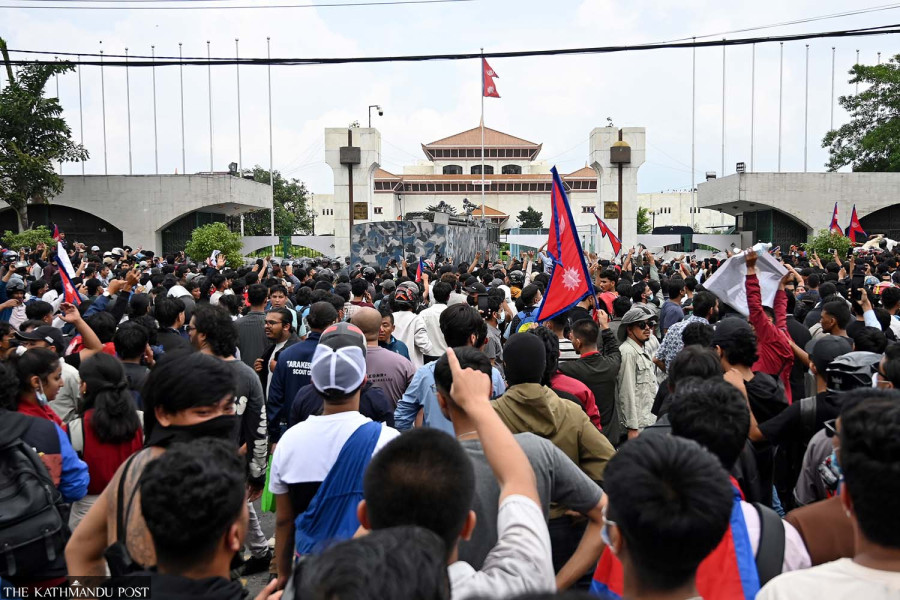
During a recent wave of protests, several key state institutions in Nepal—including the President’s Office, Parliament, and the Supreme Court—were targeted, along with government offices and the homes of political leaders. In the wake of these events, many well-wishers reached out to me, concerned about whether my own home had been affected. Their worries were understandable, especially given that I have long been an advocate for federalism. They feared that the anger directed at the political establishment might also extend to the federal system and the provinces themselves.
But do these young protesters truly reject federalism? Are they against the Constitution, the rule of law, and democracy itself? To understand this, I began reading their statements and listening to their voices. A special edition of Kantipur Daily from September 30, titled “Gen Z Road Map,” featured reflections from eight emerging youth leaders: Amit Khanal, Bablu Gupta, Bikash Yadav, James Karki, Prabesh Dahal, Rakshya Bam, Tanuja Pandey, and Yujan Rajbhandari. Some of these young leaders were at the forefront of the movement, negotiating with the military and playing active roles in forming the new government.
The Gen Z movement that shook Nepal was not a revolt against democracy or the Constitution. Instead, it was a cry against corruption, political decay, and the betrayal of constitutional values. The voices of these eight young thinkers reveal a common aspiration: They do not wish to abolish the system but to make it finally work—a federal democratic republic that truly serves its citizens.
Constitution and Federalism
Amit Khanal argues that while the Constitution and federal structure are historic achievements, their implementation has stalled. Power remains centralized, provinces lack policing and fiscal authority, and laws are twisted for partisan gain. He calls for genuine devolution, transparent fiscal practices, and direct accountability, suggesting that parliament members should not serve as ministers and that provincial and local executives should be directly elected to strengthen responsibility. For him, Gen Z embodies hope—a generation determined to renew democracy through constitutional faith and functional federalism.
Bablu Gupta extends this argument by linking governance and the economy. He believes Nepal’s renewal depends on three pillars: a stable government, a strong economy, and adherence to the rule of law. He warns that reopening debates on provincial boundaries could reignite social divisions and instead advocates for performance-based federalism—efficient, transparent, and development-oriented.
Bikash Yadav insists that corruption is the system’s deepest illness. He demands depoliticized oversight bodies, stronger auditing, and a civil service recruited on merit and supported by digital governance. Federal design, he maintains, is sound but weakened by poor implementation and political capture—the remedy lies in reform, not repeal.
James Karki interprets the uprising as a restorative movement aimed at reclaiming constitutional democracy from partisan manipulation. He emphasizes that the Constitution must remain the supreme law and that reforms should strengthen—not destabilize—it. The rule of law, he insists, must bind every public official, and citizens must remain vigilant by monitoring power, defending justice, and upholding democratic values.
Prabesh Dahal represents a distinct strand of thought, advocating for a directly elected executive system where citizens, not parties, choose and evaluate national leadership. Though he avoids deep discussion on constitutional or federal matters, his emphasis on integrity and citizen oversight reflects a desire for effective governance. In his views, Dahal avoided federalism but has publicly said provinces are unnecessary and should be abolished. On Constitution Day (September 19), when we shared a platform, he declared, “Our first demand is to abolish the provinces.”
Rakshya Bam denounces the entrenched political culture of deception, where elites reinvent themselves while corruption thrives. She sees the Gen Z movement as a call to restore constitutionalism—to make government a servant of the people, not their master. For her, federalism is essential to inclusion, and dismantling it would betray the sacrifices of marginalized communities. She envisions empowered provinces and transparent governance rooted in law and justice, calling this awakening a moral revolution to revive democracy through constitutional fidelity.
Tanuja Pandey stresses that reform must remain within constitutional boundaries—not through populist shortcuts like directly electing the Prime Minister, which could centralize power and weaken checks and balances. Federalism, she reminds, was a hard-won achievement of the Madhesh, Janajati, Dalit, and marginalized movements, and its reversal would undo decades of inclusion. For her, Gen Z’s strength lies in reawakening citizens to demand accountable, transparent, and inclusive governance.
Yujan Rajbhandari notes that protests began peacefully and escalated only after police suppression, exposing the state’s failure to respect constitutional limits. Rejecting populist calls to discard the Constitution or introduce a directly elected executive, he argues that reforms must proceed through democratic processes. For him, federalism is a cornerstone of inclusion and accountability, requiring better coordination among all tiers of government.
Vision for Reform
Across these eight perspectives, a clear consensus emerges: The Constitution is not the problem; it is the solution. The youth are not against federal democracy; they oppose its betrayal through corruption, impunity, and political manipulation. They demand a government grounded in integrity, legality, and public service, rather than party loyalty. For them, constitutionalism is both moral and practical—ensuring equal application of laws, independent institutions, and accountable leadership. Their central demand is to make the Constitution truly work in everyday governance.
Federalism lies at the center of their reform vision. Except for Dahal, all the leaders view it as vital for equality, inclusion, and decentralization. Their critique targets weak implementation, not the federal model itself. Power remains concentrated in Singha Durbar, while provinces lack control over policing, finance, and administration, and the subnational level carries heavy responsibilities without sufficient resources.
Khanal, Bam, Pandey, Rajbhandari, and Karki emphasize that genuine devolution—clear division of authority, fiscal independence, and coordination—is essential to rebuild trust in governance. Bam and Pandey note that federalism embodies the struggles of excluded communities; dismantling it would reverse social justice. Rajbhandari and Karki see democracy and federalism as interdependent: Democracy ensures accountability while federalism ensures inclusion. Yadav argues that federalism must deliver better services, jobs, and dignity to gain legitimacy, while Gupta links it to balanced growth and national unity. He urges transparency and intergovernmental cooperation to turn provinces into engines of development. Even Dahal’s opposition underscores an urgent truth—federalism must prove its worth through performance.
From these reflections emerge shared reform priorities. First, genuine devolution of power: Provinces must gain authority over policing, fiscal management, and administration. Second, integrity and accountability: Constitutional and other government bodies and the civil service must be protected from political interference. Third, efficiency and coordination: Governance should be transparent, technology-driven, and citizen-oriented. Fourth, civic vigilance: Democracy thrives when citizens, especially youth, continuously hold leaders accountable.
Ultimately, the most important challenge is achieving transformation and a generational transition within political parties that reflects the aspirations of the youth. Citizens are frustrated because both parties and the government continue to be led by the same old leadership. This situation must change to restore faith in democratic institutions and create space for new ideas and integrity-driven politics.
The Gen Z movement thus marks the next phase of the democratic journey—from the politics of promises to the politics of performance. Their uprising seeks not to dismantle the system but to redeem it through honest leadership and effective federalism. If the political class responds with humility and integrity, this generation’s discontent could become the foundation for democratic renewal. Their message is clear: Uphold the Constitution, strengthen federalism, end corruption, and restore public trust. The youth have reminded the nation that constitutions alone do not safeguard democracy—citizens do.


