APEC as Opportunity for First South Korea-U.S. Summit in Gyeongju in 20 Years
The upcoming South Korea-U.S. summit in Gyeongju marks the first such meeting in two decades and is set to take place during the APEC leaders’ meeting. The presidential office has officially confirmed that U.S. President Donald Trump will visit South Korea for a one-night, two-day stay from the 29th to the 30th. National Security Adviser Wi Sung-lac stated, “President Trump is expected to arrive on the 29th and likely stay until the 30th,” adding, “The South Korea-U.S. summit is expected to take place around that time.” Adviser Wi also mentioned, “If a U.S.-China summit occurs, it will take place during the same stay.”
The announcement of the South Korea-U.S. summit, held on the occasion of the APEC leaders’ meeting in Gyeongju, was not without challenges. Since President Trump did not confirm his visit to South Korea after President Lee Jae-myung’s inauguration in June, there was much speculation about whether he would attend APEC and how long he would stay. This uncertainty led to anxious days for the presidential office and the Ministry of Foreign Affairs, with the specific date and format of the talks remaining fluid.
While Trump is known for conducting “state visits,” which are the highest level of visits for foreign leaders, this time it is unlikely to be as grand as his 2017 visit to South Korea.
Trump’s Breach of Protocol
Regarding the South Korea-U.S. summit, the delay in the presidential office’s announcement is largely attributed to President Trump. Even amid the possibility of a change in Japan’s prime minister, he confirmed a two-night, three-day visit to Japan, but in the case of South Korea, the initial discussion was a 12-hour stay, which has been adjusted to a one-night, two-day visit. This shift is interpreted as Trump prioritizing the U.S.-China summit above all else and considering a meeting with North Korean leader Kim Jong-un at the inter-Korean truce village of Panmunjom.
There are also reports that Trump is reluctant to visit South Korea due to his caution toward President Lee’s “pro-China tendencies” during his time as Democratic Party leader and the ruling party’s pro-democracy faction’s anti-American track record. Even if that is the case, many point out that it is not befitting a U.S. leader to delay notifying South Korea of his visit schedule, especially when hosting APEC again after 20 years in an allied country, and to leave without even attending the main session. Such an attitude by Trump contrasts sharply with former President George W. Bush, who held a summit with President Roh Moo-hyun in Gyeongju on the occasion of the Busan APEC exactly 20 years ago.
Ambassador Vershbow: Gyeongju Summit Was ‘the Worst-Ever’
The South Korea-U.S. summit, to be held in two weeks on the occasion of the Gyeongju APEC, bears an eerie resemblance to the 2005 Roh Moo-hyun-Bush summit. At the time, President Roh was also a member of the Democratic Party and clashed strongly with Bush over North Korea issues; this time, there are discussions that President Lee and Trump may debate over a $350 billion investment issue in Gyeongju.
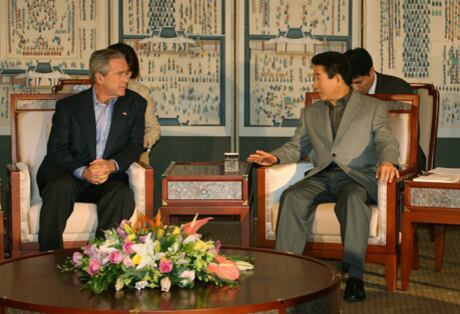
Regarding the 2005 Roh Moo-hyun-Bush summit in Gyeongju, high-level South Korean and U.S. officials who were present at the time left records of their eyewitness accounts. On November 17 of that year, President Roh met with Bush at the Hyundai Hotel in Gyeongju, following a South Korea-China summit with Chinese President Hu Jintao at Cheong Wa Dae in Seoul the previous day. This was shortly after the adoption of a joint statement on September 19, two months prior, at the six-party talks, which formalized “North Korea’s abandonment of nuclear weapons and normalization of relations with the United States.”
At the time, South Korea-U.S. relations appeared stable on the surface but were internally contentious. This was because, immediately after the September 19 joint statement, the U.S. Treasury designated Banco Delta Asia (BDA) in Macau as a channel for North Korea’s money laundering and counterfeit currency distribution, imposing financial sanctions. The Roh Moo-hyun administration strongly protested, stating, “Imposing sanctions before the agreement is even implemented suggests the U.S. is trying to undermine the negotiations.” North Korea also protested vehemently. The Gyeongju summit, held amid this tense atmosphere, was bound to be anything but smooth from the start.
Ambassador Alexander Vershbow, who was present at the summit, later recounted in the Korea Economic Institute’s (KEI) March 2009 publication Ambassadors’ Memoirs:
“President Roh Moo-hyun and his team sought to build upon the September 19 joint statement, which contained a comprehensive vision for a new peace structure on the Korean Peninsula and Northeast Asia. However, they could not understand why the U.S. was jeopardizing all of this by cracking down on North Korea’s illegal activities. This disagreement formed the backdrop to the worst-ever South Korea-U.S. summit held in Gyeongju in November 2005, where Presidents Roh and Bush debated the BDA issue for over an hour.”
Ambassador Vershbow described the Gyeongju summit he attended as the worst-ever South Korea-U.S. summit, a phrase he has repeated publicly on several occasions since.
President Roh: ‘Your Excellency and I Are Not in Sync’
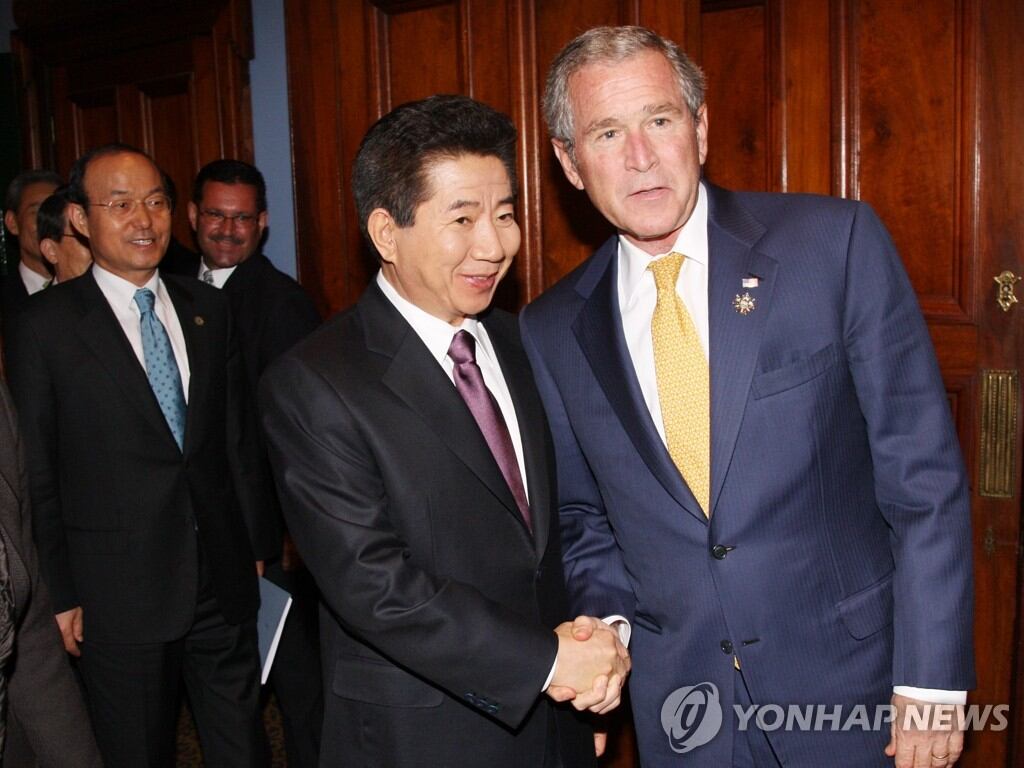
The individual who specifically documented the diplomatic scene at the time from the South Korean side was former Foreign Minister Song Min-soon. In his memoir The Glacier Moves, he vividly described the situation at the time:
“President Roh tried to persuade President Bush to flexibly address the BDA issue so that the September 19 joint statement could enter the implementation phase. However, the two presidents seated across from each other at the Hyundai Hotel in Gyeongju did not appear to be at ease.”
President Roh led the talks with his characteristic directness. He bluntly stated, “Your Excellency and I are not in sync right now.” “If we hold six-party talks internally while exerting pressure externally, North Korea will view the U.S. as trying to collapse them. If that happens, North Korea will shut its doors and resist change,” he said.
Bush did not back down either. He retorted, “Are we to ignore North Korea, the country that forges the most U.S. currency worldwide? If someone were forging South Korean won, would you just leave it alone?” Minister Song recorded, “The atmosphere was far from ordinary.”
“All attendees on both sides were tense, unsure where the conversation between the two presidents would lead. I exchanged glances with Deputy Minister Hill seated across from me, both of us frowning. Ambassador Vershbow tried not to look up, but as the local ambassador witnessing this, he must have been squirming in his seat.”
President Roh countered, “North Korea currently fears it will meet the same fate as Iraq,” to which Bush rebutted that U.S. law enforcement is a separate issue from the six-party talks, Iraq is a completely different case, and North Korea blames the U.S. for everything.
Smiling, President Roh said, “Philosophically, it seems you find it hard to accept Kim Jong-il,” to which President Bush replied, “That’s right. If I dislike someone, I say so. I don’t beat around the bush.” Former Minister Song recalled, “Watching this, I thought the conversation was as tough as soldering a log.”
Agreement Amid Conflict: Good Cop, Bad Cop
However, the tense talks did not end in complete breakdown. According to former Minister Song, President Bush proposed that he take on the role of the bad cop, while President Roh act as the good cop, to cooperate. The two presidents adopted the Joint Declaration on the ROK-US Alliance and Peace on the Korean Peninsula (also known as the Gyeongju Declaration), outlining mid- to long-term development directions in five areas including the South Korea-U.S. alliance and the North Korean nuclear issue.
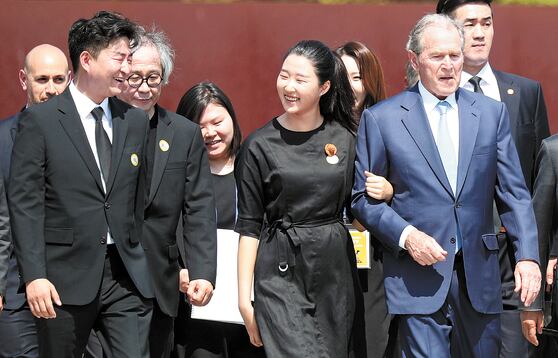
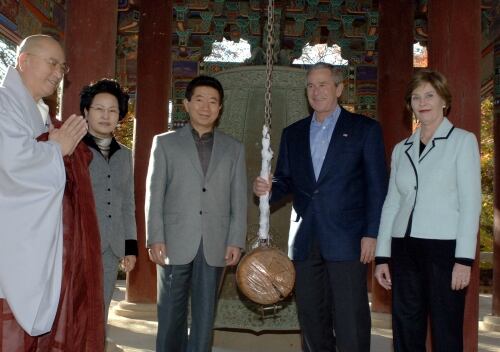
Afterward, the two presidents shared a luncheon and then walked together with their spouses for about 30 minutes around the Bulguksa Temple grounds. On a sunny autumn day, the leaders continued a light-hearted conversation while walking. President Roh explained the history of the Gyeongju area and Korean culture, while Bush nodded continuously, showing interest. First Ladies Kwon Yang-sook and Laura Bush also walked side by side, admiring the garden and autumn foliage. The presidential couples even rang the temple bell together. This scene was recalled by the media as “walking diplomacy” that eased the cold atmosphere of the official talks.
Lee Jae-myung and Trump Meet Again in Gyeongju
Exactly 20 years later, the South Korea-U.S. leaders are once again meeting in Gyeongju. President Trump, on his first Asia tour since returning to power, aims to reassess the South Korea-U.S. alliance and confirm South Korea’s stance amid the U.S.-China hegemony competition. He expects South Korea to follow his envisioned “America First” trade policy.
In contrast, President Lee advocates “pragmatic diplomacy” and seeks to maintain South Korea’s strategic autonomy between the U.S. and China. He is trying by all means to extricate himself from the $350 billion investment issue. Due to this, a repeat of the “soldering a log”-style conversation from the 2005 Roh-Bush talks cannot be ruled out.


