The Enduring Legacy of Bob Dylan in Kathmandu
Kathmandu, May 29 — Rodin Lal Shrestha, a 20-year-old from Tokha, describes Bob Dylan’s music and poetry as the closest things to completeness he can imagine. As a child, “Knockin’ on Heaven’s Door” captured his attention, and since then, he has been fascinated by Dylan’s reflections on love, loss, prophecies, and preachings. “No other musician channels the wisdom of the ages while also commanding an equally youthful energy as he does,” says Shrestha.
For many young people, music preferences are more than just personal tastes; they form a communal tapestry that brings people together. They engage in shared experiences rooted in collective admiration for celebrated artists such as Gyanu Rana, Nepathya, Ozzy Osbourne, and Adele. Lyricism, rhythms, and melodies have the power to unite communities, reminding us of the beauty of celebrating art collectively—humming favorite songs and finding ourselves in the subtle, poignant layers of lyrics.
This kind of music transcends generations, rivers, mountains, and oceans. One such community is shaped by the musical legacy of the American singer, Bob Dylan.
Born on May 24, 1941, in Duluth, Minnesota, Dylan’s life has always revolved around music. He became a central figure in the American folk scene and later evolved into a rock revolutionary. His lyricism, more than his musicality, has been widely praised for its ability to balance personal expression with socio-political advocacy.
On May 24, 2026, listeners in Kathmandu gathered in various locations, including Moksh Restaurant Jhamsikhel, Sadhana Ghar Theatre, and Eden, to celebrate Dylan’s 85th birthday. These tributes were organized to reflect on the universality, relatability, and longevity of his music and poetry. Shrestha, too, was swept up in the event, eager to join a community equally passionate about Dylan’s work.
Moksh Restaurant Jhamsikhel has been hosting tribute events for Dylan for several years. The events were paused in 2020 due to the pandemic but have now resumed this year.
Sadhana Ghar Theatre partnered with students from Oscar International College of Film Studies to screen Dylan’s biopic, “A Complete Unknown.” Later, artists performed his songs. A poster of Dylan, featuring his endearing pictures with a harmonica wrapped around his neck and his hands holding his guitar, was projected on the stage.
Arjun Tiruwa, one of the organizers and a representative of Oscar College, recalls how Dylan’s songs helped him cope with the September 2025 Gen-Z movement. “That was the first time I delved deeper into Dylan’s songs,” he says. “I consciously searched for his lyrics that would help me cope with the political scenario at the time.”
He believes there is a Dylan song for every situation in life, allowing people to connect emotionally. “Even 80 years from now, people will still find relatability in his music,” he adds.
For Tiruwa, hosting such events means bringing together an emotionally connected community. Since there are few opportunities for artists to know about such events, the organizers believe these gatherings also aim to introduce the audience to new forms of art and music.
“After the event, people who had not yet discovered Bob Dylan came up to me and said that they might explore his songs now,” Tiruwa shares. “We do this for people to come together, discover music or talk about the ones that are close to them, or perhaps grew up listening to.”
The organizing team uses social media, including Instagram and Facebook, for open calls. Artists contact them based on their interests for the open mic. “Social media helps us significantly to know about such events,” Tiruwa says.
One of the artists at the college’s event was Bikram Parki. He participated to make friends who share his interest in music. After the event, he admits to having networked with Dylan’s fans, especially those who appreciate his work.
“When I posted a video of me singing ‘Mr Tambourine Man’ on Instagram, people’s replies flooded,” he says. This recognition gave him a chance to promote his own music among an established audience. “Events like this, as important as they are to pay homage to a legendary artist, become equally meaningful to the emerging ones too,” Parki adds.
Between the echoes of songs sung by performers and the audience, moments of silence rippled, allowing each note and lyric to settle.
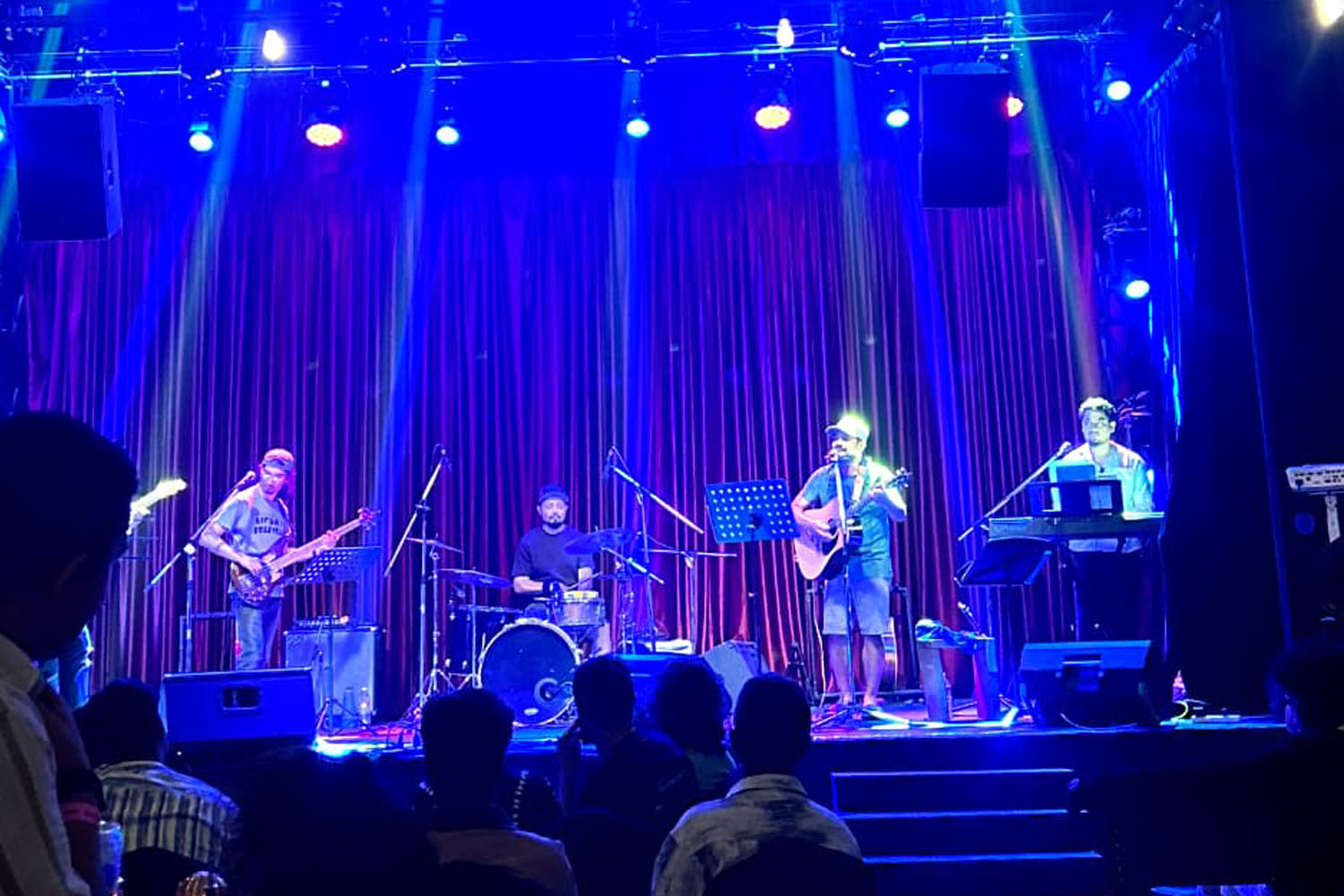
In this atmosphere of reflection, the early celebration at Eden, Sanepa brought together renowned Nepali bands, Phosphenes and Kta Haru, who performed in tribute to Dylan’s musical legacy.
What emerged that evening was a convergence of personal histories with listeners, performers, and organizers bound together by a shared archive of songs.
“It came to me as a surprise when I heard of this tribute event,” says musician Prasanna Shah. “It was also exciting to see the audiences across different age groups immersed in Dylan’s music just as we were.”
Even before his birthday, Dylan’s music has been returning to Nepal at different moments—from playlists to protests to subtle conversations in gatherings. “When I meet my friends from Phosphenes, there is always an hour or two we spend talking about Dylan and The Beatles,” Shah adds.
He first began listening to Dylan’s songs in 2010. As a singer-songwriter himself, he says that the encounter has deeply inspired him to create, resurfacing at different points in his musical journey.
In this sense of continuity, for listeners like Rodin Lal Shrestha, the appeal lies precisely in the musician’s ability to remain relevant across changing times and contexts.
He says, “The quality of being able to survive and prosper with his overwhelming youthful wisdom, even with the changing times, is what makes Dylan’s music immortal.”