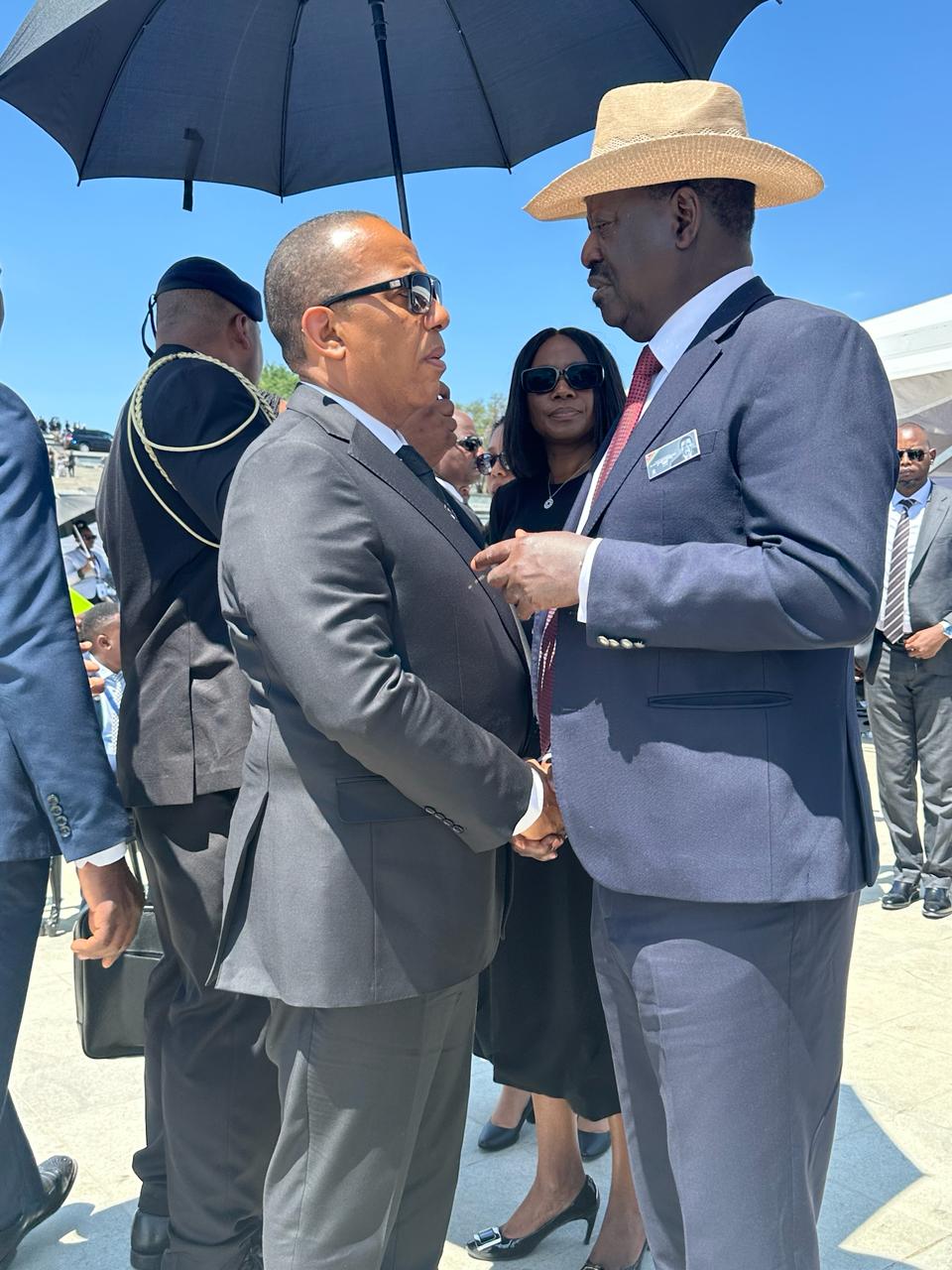
A Final Farewell: The Burial of Raila Odinga
Raila Odinga, the former Prime Minister of Kenya, was laid to rest today in Siaya, marking the end of a journey that began with a symbolic return to his Nyanza political stronghold. His final trip was aboard a Kenya Air Force aircraft, the Leonardo C-27J Spartan, with the call sign Enigma01. The aircraft touched down at Kisumu Airport at around 7:20 am, greeted by a ceremonial water salute, a tradition where fire trucks spray a water arch over the plane.
For Mr. Odinga, this marked a continuation of top military honours typically reserved for former heads of state. These included a flag-draped casket, military pallbearers, a military gun carriage, and a body lying in state in Parliament. A gun salute is also expected at the burial site today. Only four others have received such honours before: Presidents Jomo Kenyatta, Daniel arap Moi, Mwai Kibaki, and General Francis Ogolla, who died in office as Chief of Defence Forces in 2012. Michael Kijana Wamalwa, who died while serving as vice-president in 2003, had his body lie in state in Parliament but did not receive all the military honours.
A City in Mourning
The lakeside city of Kisumu was sombre on the day of the funeral. Locals held candle-lit vigils on major streets and nightclubs the previous night, and when the sun rose on Saturday, many poured into the streets. Some marched to the airport, while others headed towards Jomo Kenyatta Sports Ground, creating confusion about whether there would be a procession from the airport to the stadium.
The stadium, which can hold 30,000 people, became a sea of humanity as the body was airlifted for public view. Thousands were locked outside, waiting for their turn to see Mr. Odinga’s body. Emotions ran high, with locals wailing and some rolling on the ground in grief.
Funeral Traditions and Cultural Practices
Mr. Odinga’s funeral was a blend of Luo customs, military traditions, and the demands of his political followers, along with the dictates of the Anglican Church. Bishop David Kodia of the Anglican Church of Kenya Diocese of Bondo stated that the funeral service would be a full Christian burial. He emphasized that other rituals could take place before the church took over, but once the church began, it would be the main focus.
The bishop also mentioned that certain traditions, like the overnight stay of the deceased’s body in their home, are not harmful and can be allowed. “We should respect decisions Mr. Odinga made before he died, like working with the President,” said Bishop Kodia.
Cultural Significance and Personal Legacy
The preservation of Luo cultural practices has long been central to Mr. Odinga’s life. However, some age-old customs may not be observed strictly in his death, while others will be followed out of reverence. In his later years, Mr. Odinga advocated for reforming certain cultural practices, such as protracted mourning periods and lavish funerals.
In Luo culture, the passing of a person, especially one who dies away from home, is traditionally announced through personal visits rather than modern means. A family member, usually the spouse, would travel home to deliver the news. According to Mzee Onyango Radiel, a former councillor and long-time aide to Jaramogi Oginga Odinga, the bearer of such news should ideally be the deceased’s spouse or eldest son.
The Final Resting Place
Luo custom dictates that adults are typically buried in their ancestral homelands. Men are interred on the right side of the homestead, facing inward, while women are buried on the left. Unmarried daughters are often laid to rest near the fence, symbolising their unfulfilled journey to another home.
Opinions varied on where Mr. Odinga should be buried. Some elders and family members felt he should be interred at the family cemetery in Kangó ka Jaramogi in Nyamira, Bondo, alongside his father and late son. Others argued he should be laid to rest at his Opoda Farm. Ultimately, it was confirmed that the body would be laid beside his father’s grave.
Elders insisted that given Mr. Odinga’s stature, a mausoleum must be built in his honour, just as was done for his father. Their wishes were respected, and a mausoleum was agreed upon at the family cemetery.
Changing Burial Practices
In recent years, families in Western Kenya, particularly among the Luo, have increasingly embraced private cemeteries within their homesteads. While controversial, the practice is gaining traction. Advocates argue that designated burial plots create order and conserve land, especially as traditional homesteads become crowded with graves.
One of the most dramatic Luo burial rituals is Tero Buru, the driving away of the spirit of death from the homestead. On Thursday morning, mourners forced their way into Mr. Odinga’s Opoda home to perform the rite, involving cattle, traditional attire, spears, and shields.
After the burial, another tradition requires close family members to remain seated outside the deceased’s home — four days for a man, three for a woman. Some customs, however, have faded, including the shaving of hair by close male relatives, once a symbol of mourning and humility.


