The Interstellar Object 3I/ATLAS: A Mysterious Visitor from Beyond
The interstellar object traveling through our solar system has just made its most startling move yet, appearing to reverse thrust as it disappeared behind our sun. This unusual behavior has sparked renewed interest and debate among scientists about the nature of this celestial visitor.
Harvard physicist Avi Loeb has been one of the leading voices suggesting that 3I/ATLAS may not be an ordinary comet but rather a sign of something more extraordinary. He argues that there is enough evidence to consider the possibility that this object could be guided by an unknown intelligence.
The next significant event will occur on October 29 when 3I/ATLAS is projected to reach its closest point to the sun. Loeb believes that if the object emerges from this blind spot in a completely different location than expected, it would be a strong indication that it is artificial and possibly powered by some kind of engine.
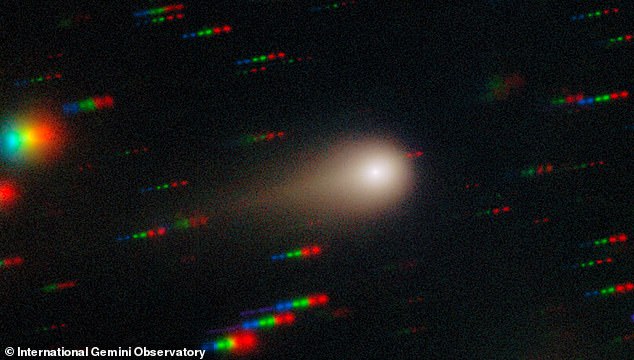
Most astronomers remain skeptical, pointing out that 3I/ATLAS exhibits classic signs of a comet, such as a tail and a coma—a cloud of gas and dust surrounding it. Previous studies have suggested that its unique chemical composition, rich in carbon dioxide, is due to its formation in a distant solar system.
However, Loeb contends that some members of the scientific community are hesitant to explore more extraordinary possibilities, fearing criticism and wanting to maintain their reputations. He emphasizes the importance of considering all potential explanations, especially when dealing with an object that could have significant implications for humanity.
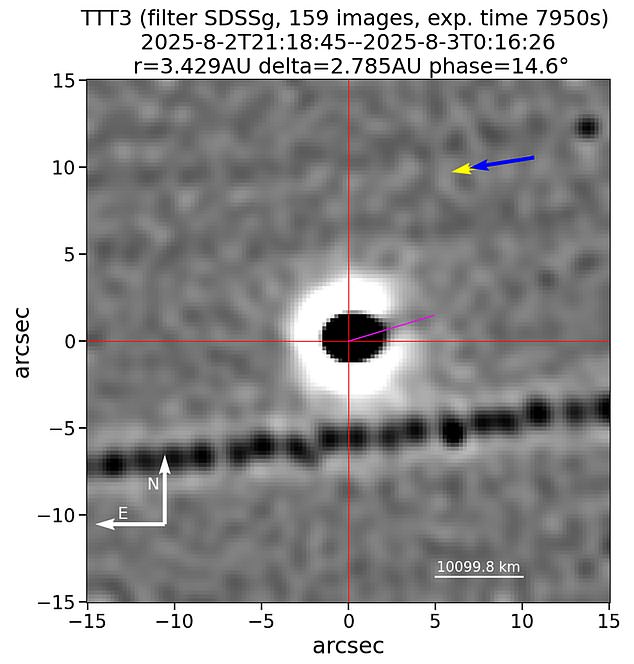
In August, a study detected an unusual nickel plume from 3I/ATLAS. Unlike natural comets, which typically emit nickel alongside iron, this object showed nickel without any detectable iron. A new study published by Chilean astrophysicists found that 3I/ATLAS is shedding nickel at roughly five grams per second and cyanide at 20 grams per second, with both emissions increasing as the object approaches the sun.
Researchers noted that the mechanisms driving these emissions are not typical of natural cometary processes. Scans of 3I/ATLAS released in the same month suggested it is likely an unusual comet that is much smaller than previously thought and unexpectedly releasing large amounts of carbon dioxide gas (CO2).
The large amount of CO2 pouring out, about 940 trillion molecules per second, was a major finding, indicating that 3I/ATLAS formed in a star system unlike our own, where comets are significantly different.

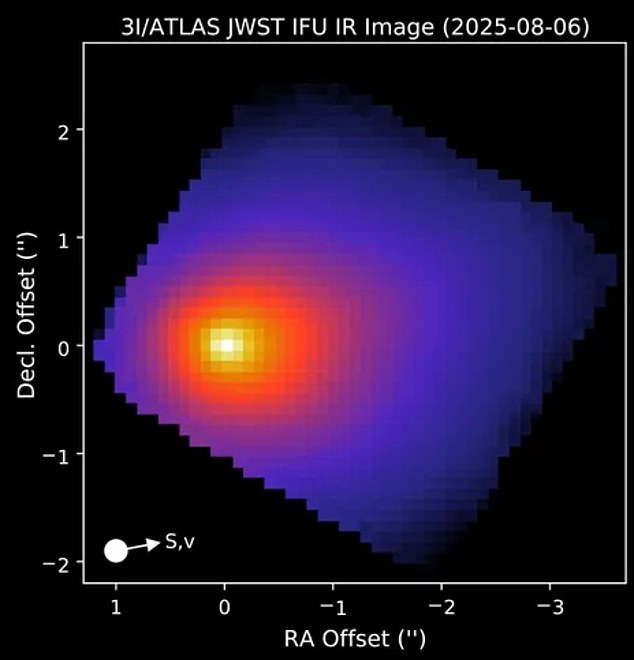
Based on all the light coming from 3I/ATLAS, scientists initially estimated the object to be more than 12 miles in diameter. However, NASA’s most powerful telescopes have revised this estimate down to 1.7 miles. The comet appeared larger because over 99 percent of the observed light came from a large, bright cloud of dust and gas surrounding it, known as a coma.
3I/ATLAS is currently about 298 million miles from Earth. Not only is the interstellar object much smaller, but a new study by NASA’s SPHEREx telescope discovered that 3I/ATLAS is releasing a large amount of CO2 and is covered in water ice.
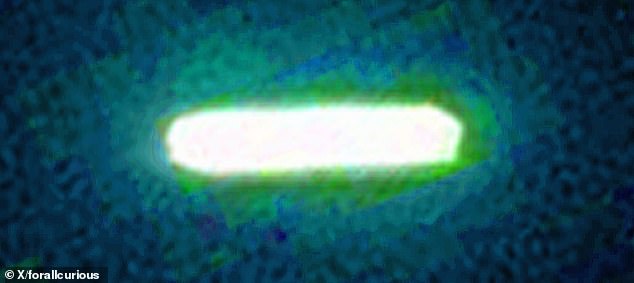
This month, NASA’s Perseverance rover on Mars sent back photos of the object, showing what appears to be a massive cylindrical shape. Stargazers on social media shared color-enhanced images of the object, dubbed 3I/ATLAS, which showed the interstellar visitor having a green glow as it passed Mars and heads closer to the sun.
Loeb analyzed the Perseverance rover’s photos by calculating its distance, speed, and camera settings. According to his initial study, he was not convinced that 3I/ATLAS is actually a massive cylindrical object, noting that the strange shape might have been a trick of the rover’s camera stretching out its shape.
He explained that the apparent cylinder from the rover’s ‘Navcam’ was likely caused by the camera stacking hundreds of images of 3I/ATLAS over a period of about 10 minutes, making it look more like a log than a ball. The professor added that 3I/ATLAS is likely smaller and rounder, but still massive, with a potential diameter of more than 28 miles across.
More than five studies, with dozens of researchers involved, have concluded that the object is just a unique, natural comet, which many other scientists have been echoing for months. Jonathan McDowell, an astronomer and astrophysicist working at the Harvard–Smithsonian Center for Astrophysics, previously claimed: ‘It is clearly a natural comet; suggestions to the contrary are laughed at by people who are actual comet experts.’
UCLA research David Jewitt recently agreed with the comet theory, publishing a paper that explained the object’s shifting tail as it moved behind the sun as normal cometary behavior. An international team of researchers also concluded that the increasing dust activity around 3I/ATLAS, its changing color, and apparent lack of a tail were due to our perspective from Earth at the time of the scans, not the comet acting strangely.
First spotted on July 1, 3I/ATLAS is just the third recorded object to travel through our solar system from another point in the Milky Way galaxy. The other two, Oumuamua in 2017 and the comet Borisov in 2019, were nowhere near the size and mass of 3I/ATLAS, which Loeb has calculated to be at least 3.1 miles long and 33 billion tons.
Loeb explained that the object’s size is yet another clue that it may not be a comet, as there isn’t enough rocky material in interstellar space to have created such a structure naturally. ‘It’s bigger than the asteroid that killed a dinosaur 66 million years ago, and such objects are extremely rare. It would have been on the order of 10 million times more massive than Oumuamua and 10,000 times more massive than Borisov,’ Loeb revealed.
However, the scientist said his first clue that something wasn’t adding up with 3I/ATLAS was the sheer brightness of the object while it was still far away from our planet and the sun. The supposed comet’s backward ‘anti-tail,’ its strange course taking it close to three planets, and its unique chemical combination of nickel and carbon dioxide have all contributed to a growing belief that 3I/ATLAS is not a floating space rock.
Loeb noted that one oddity would be explainable, but he calculated that there were no fewer than eight anomalies with this space rock. The scientist calculated that the odds of these strange occurrences happening at the same time were one in 10,000,000,000,000,000 (that’s 10 quadrillion).
Despite not being projected to collide with the planet, NASA took the extraordinary step of adding 3I/ATLAS to the list of threats tracked by a United Nations-endorsed group focused on planetary defense against near-Earth objects. The decision has helped to mobilize all of the world’s telescopes to observe the interstellar visitor, with 227 observatories already tracking it.
Loeb noted that 3I/ATLAS will make its closest approach to Earth on December 19 and NASA is planning to take even more detailed readings of the object as it approaches the Juno spacecraft near Jupiter on March 16, 2026. ‘We should not miss an opportunity, because this is a gift from interstellar space,’ the Harvard professor explained.
Loeb concluded by saying the arrival of 3I/ATLAS and the recent visit of Oumuamua just eight years ago cannot be dismissed as random events in the cosmos. ‘What nature is trying to tell us is that we don’t understand something.’


