The UK and the Viral Chart: A Misleading Narrative
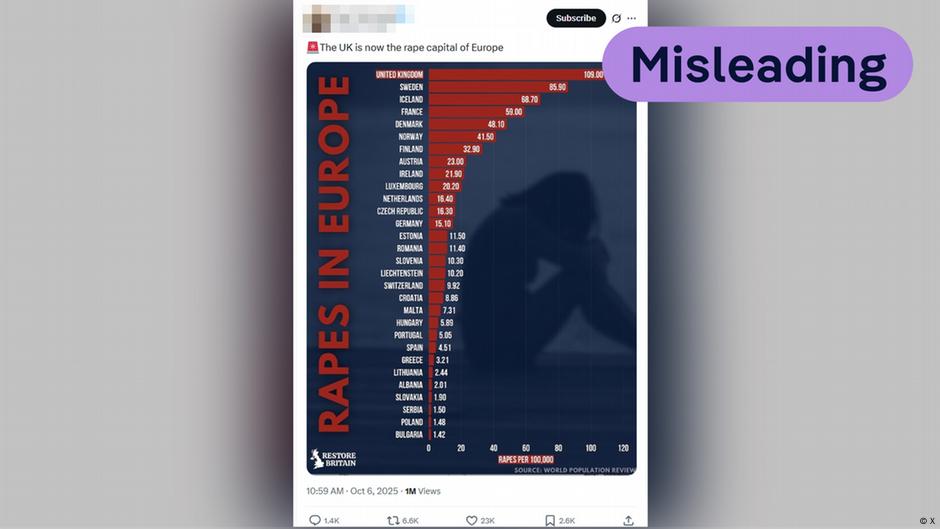
A viral bar chart circulating on social media has claimed that the United Kingdom has the highest rape rate in Europe. This graphic, which gained significant attention, presents a red bar labeled “United Kingdom” extending far beyond others, accompanied by the headline “rapes in Europe.” However, this chart is a textbook example of how accurate data can be misused to distort facts.
Warning: This article contains references to sexual assault, and other details that readers may find disturbing.
The chart’s claim that the UK is the “rape capital of Europe” was viewed over a million times. According to the graphic, the number of rapes in the UK per 100,000 people in 2022 appeared to be exponentially higher than in Spain, Greece, Germany, and other European countries. However, this data is misleading due to several factors, including differences in legal definitions, reporting practices, and cultural attitudes.
Why the Numbers Are Misleading
The data showing that the UK reported 109 rapes per 100,000 people comes from the World Population Review, which draws its figures from the United Nations Office on Drugs and Crime (UNODC). The site itself warns that international rape statistics are often “apples-to-oranges” due to major differences in legal definitions, reporting practices, and cultural factors.
Tanya Serisier, a lecturer in criminology at Birkbeck University of London, explained that the source explicitly cautions against using the data in this way. She emphasized that the UK’s seemingly high rate is more reflective of its reporting practices and legal definitions than actual prevalence.
Why Cross-Country Comparisons Fail
Crime statistics are notoriously difficult to compare across borders for several reasons:
- Legal Definitions: Different countries have varying legal definitions of rape. Some require proof of physical attack, threat, or coercion, while others use broader definitions. The UK revised its sexual offenses law in 2003 to be consent-based.
- Reporting Practices: Countries differ in how they count and report crimes. For example, a group rape might be counted as a single offense in some places, but as multiple offenses in the UK.
- Data Collection Methods: Some countries use input statistics, where a case is counted when a police report is filed. Others wait until after an investigation is closed.
- Cultural Factors: Trust in the criminal justice system, societal attitudes toward consent, and awareness of sexual violence all influence whether victims report crimes.
These factors affect whether a victim decides to report the crime, which ultimately shapes the statistics presented in the graphic.
A Better Way to Measure
Criminologists recommend using victim surveys instead of relying solely on police reports. These surveys provide a more comprehensive picture of crime by asking representative samples of people about their experiences over a period of time.
“Crime statistics only show us the things above the sea level — those that get reported,” said Serisier. “But for nearly all crimes, there’s another layer of things that don’t ever come to the attention of authorities.”
In the UK, police recorded over 71,000 rapes in England and Wales in 2024, a 479% increase since 2002. However, the Crime Survey for England and Wales estimates that about 1.9 million adults experienced rape or attempted rape in 2022. Yet, the share of adults reporting having been raped has remained relatively stable since 2005.
The Role of Migration
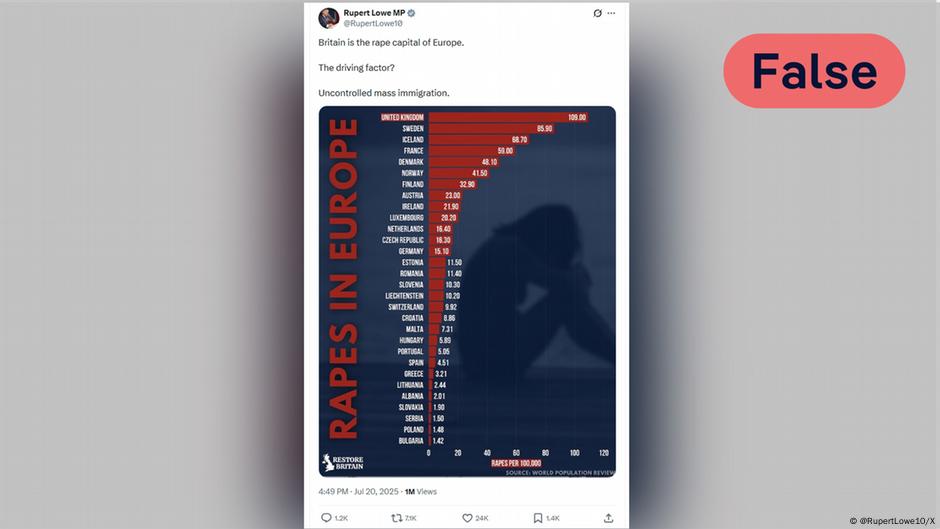
A claim that the UK’s high rape rate is driven by “uncontrolled mass immigration” was made by British MP Rupert Lowe, leader of the anti-migration group Restore Britain. However, this claim is false.
The UK and the Netherlands have nearly identical shares of foreign-born residents — around 16% as of 2022 — yet the Dutch rate of rapes per 100,000 is less than one-sixth that of the UK’s. Serisier explained that there is no evidence to support the idea that immigration increases rates of sexual violence.
The UK does not publish data on the nationality or ethnicity of perpetrators. National data shows that 85% of victims knew their offender, according to a government survey conducted between 2014 and 2017.
Other factors likely contributed to the rise in reported rapes. After a Metropolitan Police whistleblower revealed in 2014 that sexual offenses were being under-recorded by roughly a quarter, the police reformed how it records crime reports. Cultural changes, such as the #MeToo movement and high-profile cases, have also encouraged victims to come forward.
Lowe, a former member of Nigel Farage’s Reform UK party, launched Restore Britain in 2025. He has pushed for an anti-immigration platform, calling for “mass deportations” and “the removal of millions of people.”
Marcelo Aebi, a comparative criminologist at the University of Lausanne, emphasized the need for standardized, Europe-wide surveys to accurately measure rape rates. “A well-executed European victims of crime survey is a better source of knowledge,” he said.
While the UK’s rape statistics appear alarmingly high, the reality is far more complex. Differences in legal definitions, reporting practices, and cultural factors make international comparisons misleading — and claims linking immigration to sexual violence are not supported by evidence.
If you are suffering from emotional strain, seek professional help. You can find information on where to find help, no matter where you live in the world, at this website: www.befrienders.org.


