President Xi Jinping’s APEC Visit to South Korea
Chinese President Xi Jinping will attend the Asia-Pacific Economic Cooperation (APEC) Leaders’ Meeting in Gyeongju, set to open on the 31st. This marks his first visit to South Korea in 11 years. After a series of twists and turns, the South Korean government has decided to once again accord him the status of a state guest, as it did in 2014. It is the first time a state guest has been received in a region outside Seoul for a summit.
However, Wang Yi, a member of the Chinese Communist Party Central Committee Political Bureau and Minister of Foreign Affairs, was not included in President Xi’s delegation. It is unusual for the Chinese foreign minister not to accompany the president during a summit in South Korea. Wang Yi, who resumed his role as foreign minister in July 2023, holds significant influence within the Chinese Communist Party and government. His absence is particularly notable as China is the next APEC chair. A senior diplomatic source in Seoul pointed out, “It is not normal for President Xi to visit South Korea after 11 years without Wang Yi accompanying him.” Some analysts suggest that Beijing may be expressing discontent toward South Korea by excluding its foreign minister.
Breaking Formality: Tang Jiaxuan’s 1999 Visit
When reflecting on this situation, the figure who comes to mind is Tang Jiaxuan, the former State Council member and Chinese foreign minister in 1999. A graduate of Peking University’s Japanese studies program, he played a central role in the practical negotiations for the establishment of diplomatic relations between South Korea and China as a vice minister. He is recognized as a diplomat who maintained a relatively relaxed demeanor even during conflicts between the two countries.
My first encounter with a foreign official as a Ministry of Foreign Affairs correspondent in December 1999 was with Minister Tang. During his three-day visit from December 10, 1999, he focused on elevating bilateral relations to a “21st-century partnership” through a meeting with President Kim Dae-jung, a foreign ministerial talk, and a dinner hosted by the Korea-China Friendship Association. Notably, his discussion with Foreign Minister Hong Sun-young solidified plans for Premier Zhu Rongji and Defense Minister Chi Haotian to visit South Korea in 2000, a meaningful achievement.
A government official who attended the talks recalled, “Minister Tang repeatedly emphasized, ‘China aims to elevate its relationship with South Korea to a higher level,’ conveying the Chinese leadership’s firm resolve.”
During his visit, Minister Tang engaged in “hot spring diplomacy” with Foreign Minister Hong, visiting Icheon, Gyeonggi Province. The two foreign ministers boarded a 16-seat luxury minibus from Seoul to Icheon, sitting side by side to enjoy the winter scenery while conversing. They later toured a ceramics factory and continued their discussions over dinner at a hot spring in Icheon.

Although they did not enter the hot spring together due to protocol, it was a bold and open exchange, even earning the nickname “naked diplomacy.” The diplomacy of that era exuded leisure, dignity, and a human touch. Despite covering numerous South Korea-China foreign ministerial meetings afterward, I never witnessed another encounter as informal as that between Hong Sun-young and Tang Jiaxuan.
Welcome to Journalists from South Korea
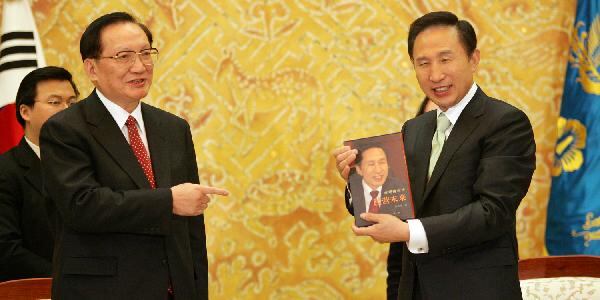
I met Minister Tang again four months later, in April 2000, during Foreign Minister Lee Myung-bak’s visit to Beijing. Minister Tang congratulated the upcoming inter-Korean summit in June and praised it as a “brilliant advancement in the peace process.” He expressed active support, stating, “I hope the two Koreas will achieve positive results by embracing the spirit of seeking common ground while reserving differences.” The talks extended for three and a half hours, an hour and a half longer than scheduled—a rare occurrence for a foreign ministerial meeting.
Before the talks began, Minister Tang left a special impression on the South Korean journalists accompanying Foreign Minister Lee. He unusually addressed them, saying, “Thank you for coming all the way. The Chinese Ministry of Foreign Affairs will do its best to assist your reporting.” It is uncommon for a foreign minister to directly thank a press corps.
During the closed-door talks, he also made a witty remark about South Korean journalists: “South Korean journalists are the second most fearsome in the world—the most fearsome are American journalists, followed by South Koreans. Although Li Peng’s visit to North Korea has not been finalized, South Korean media have already set the date.” This comment drew laughter, as it referenced a South Korean outlet’s prominent front-page report that Li Peng, chairman of the Standing Committee of the National People’s Congress, would visit North Korea in May. Minister Tang was also mindful of South Korean media’s strong criticism of China’s “non-humanitarian treatment” in the case of seven North Korean defectors repatriated by China and Russia, a “ping-pong game.” Instead of directly expressing frustration, he chose an indirect approach, which left a strong impression.
During the talks with Foreign Minister Lee, Minister Tang made an unexpected proposal: he wanted to host a dinner for the South Korean journalists visiting China. Following his instruction, the journalists had an unplanned dinner with Chinese Ministry of Foreign Affairs officials, creating connections with diplomats responsible for the Korean Peninsula that continued for years.
Strengthening Trilateral Cooperation
After rising to State Council member, Minister Tang oversaw major diplomatic issues, including the Korean Peninsula, U.S.-China, Japan-China, and Russia-China relations. He attended President Lee Myung-bak’s inauguration as a special envoy of Chinese President Hu Jintao and later visited South Korea to meet President Park Geun-hye after her inauguration.
I met Minister Tang for the third time in 2011, after his retirement as State Council member. On October 19, 2011, an international conference titled “Toward a New Northeast Asian Era of Peace and Shared Prosperity” was held at The Shilla Seoul to commemorate the launch of the Trilateral Cooperation Secretariat (TCS) among South Korea, China, and Japan. Former Prime Minister Lee Hong-koo of South Korea, former Prime Minister Yukio Hatoyama of Japan, and former State Council member Tang Jiaxuan of China attended as representatives.
Introduced by Shin Bong-gil, the first secretary-general of the TCS, Minister Tang declared, “South Korea, China, and Japan are a de facto community of shared interests,” emphasizing that “despite historical issues and conflicts, cooperation based on trust must continue.” He also stated, “The situation on the Korean Peninsula stabilizes as the parties engage in dialogue,” describing the six-party talks on North Korea’s nuclear program as a “golden key to opening the door to peace.” Minister Tang actively exchanged opinions with former Foreign Minister Kong Ngo Nam and others at the TCS conference. His visit to the TCS office in Jung-gu, Seoul, to encourage young staff before the international conference was impressive. Even after retirement, he continued to engage in South Korea-China relations by meeting behind the scenes with South Korean experts on China, such as former National Assembly Speaker Park Byeong-seug.

Looking back, South Korea-China relations from the 1990s to the 2010s had relative flexibility. Although conflicts arose over defectors and historical issues, there was a time when the Chinese foreign minister thanked South Korean journalists and led talks with humor.
Respect for Former President Kim Dae-jung
According to a memoir by former Ambassador to China Kim Ha-jung (later Minister of Unification), published by the Korea National Diplomatic Academy, Minister Tang showed deep respect for former President Kim Dae-jung even after his retirement. When Kim visited Beijing from June 28 to July 2, 2004, he met with Jiang Zemin, chairman of the Central Military Commission, on June 30 to discuss the Korean Peninsula situation and the resumption of the six-party talks. Later that evening, he attended a dinner hosted by State Council member Tang Jiaxuan. Ambassador Kim recounted in his memoir:
“A dinner hosted by State Council member Tang Jiaxuan was scheduled for that evening (June 30). However, Tang felt it would be discourteous not to greet former President Kim personally before the dinner. He first visited Kim’s accommodation at the Diaoyutai State Guesthouse to pay his respects, spending about 30 minutes in conversation. Tang explained that President Hu Jintao deeply regretted his inability to meet former President Kim due to unavoidable diplomatic and domestic schedules, including meetings with the Mongolian and Argentine presidents, and a local inspection tour. He also conveyed Hu’s special regards.”
After the conversation, Tang proceeded to the Yangyuanzhai banquet hall he had prepared within the Diaoyutai complex, and former President Kim’s party followed. In his opening remarks, Tang welcomed former President Kim and his wife on behalf of China, stating that no one in China was unfamiliar with Kim’s Sunshine Policy, which, as Chairman Jiang mentioned, had become a significant chapter in history and was deeply respected by the Chinese people. He added that Kim’s vision and philosophy aligned with those of Chinese leaders and expressed hope for his continued contributions to regional peace and stability.”
Minister Tang visited former President Kim’s accommodation to apologize for not greeting him first, demonstrating exceptional respect for a retired South Korean leader. His consideration offers much to reflect upon.
South Korea-China Relations Lacking Leisure and Consideration
Current South Korea-China relations lack such leisure and consideration. Chinese President Xi Jinping appears to be visiting South Korea reluctantly as the next APEC chair. On the 14th, the Chinese Ministry of Commerce announced sanctions banning transactions with five subsidiaries of Hanwha Ocean in the U.S. Wang Yi, regarded as the most powerful foreign minister in Chinese history, seems focused on diplomacy with other countries while bypassing South Korea. Although China’s economic power has grown incomparably compared to 25 years ago, its diplomatic strategy and dignity have faded. South Korea, too, seems to lack diplomats capable of countering such a China.


