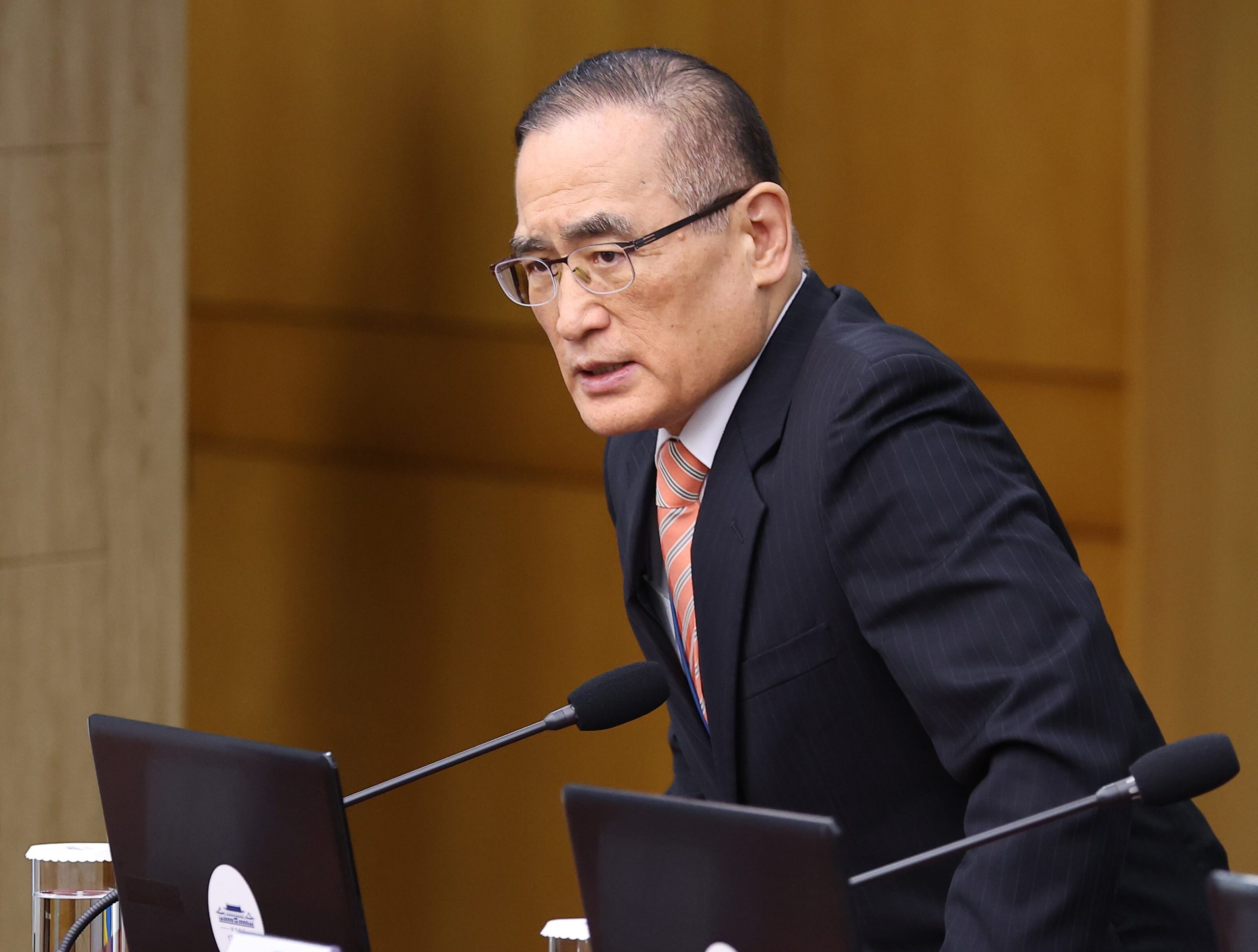
On the 21st, when Sanae Takaichi assumed office as Japan’s new prime minister, Wi Sung-lac, the presidential office’s National Security Adviser, traveled to Tokyo. This was an unusual two-day trip during a busy schedule preparing for the Asia-Pacific Economic Cooperation (APEC) summit, which would open on the 31st.
Adviser Wi met with the newly appointed National Security Council (NSS) Director Keiichi Ichikawa to coordinate the schedule for the first summit between President Lee Jae-myung and Prime Minister Takaichi. He also exchanged opinions on “stable South Korea-Japan relations.” Additionally, he held talks with former Prime Minister Taro Aso, who played a key role in Prime Minister Takaichi’s rise, and former Prime Minister Yoshihide Suga, who chairs the Japan-Korea Diet Members’ League, requesting their support for a future-oriented South Korea-Japan relationship.
Typically, when a new administration takes office in Japan and the NSS director changes, it is customary for the Japanese side to visit South Korea. However, this time, South Korea took the initiative. The presidential office stated that Adviser Wi’s visit to Japan was “to continue the developmental momentum in South Korea-Japan relations.” It announced, “Under the new Takaichi administration, we shared the recognition of the importance of stable development in South Korea-Japan relations and agreed to maintain various cooperation channels between governments, legislatures, and the private sector.”
Adviser Wi’s Strategic Visit to Japan… “Good South Korea-Japan Relations Needed to Engage North Korea”
Amid escalating U.S.-China tensions, Adviser Wi’s visit to Japan was a strategic diplomatic move rather than mere protocol. He proactively managed concerns that the Takaichi administration’s hardline conservative stance could destabilize South Korea-Japan relations in the future, particularly over the Dokdo and Yasukuni issues. Simultaneously, the visit laid the groundwork for the successful hosting of the APEC summit. This is because, with U.S. President Donald Trump having announced his absence from the main APEC session, Japan’s cooperation is crucial to securing the “Gyeongju Declaration.”
The Lee Jae-myung administration’s diplomatic approach toward Japan deeply reflects not only Foreign Minister Cho Hyun’s earlier admonition to the president that “he could not become president without shedding his anti-Japan, pro-China image” but also Adviser Wi’s strategy prioritizing South Korea-Japan relations.

President Lee Jae-myung’s Three Meetings with Ishiba
Contrary to expectations, President Lee Jae-myung met with then-Prime Minister Shigeru Ishiba three times within his first 100 days in office, pushing to restore shuttle diplomacy. The first meeting took place at the June G7 summit, the second during his August visit to Tokyo, and the third in September in Busan in the form of a farewell summit.
President Lee evaluated the normalization of South Korea-Japan relations as a key diplomatic achievement, stating, “Within 100 days of taking office, I met Prime Minister Ishiba three times. This is the essence of shuttle diplomacy.” This would have been unimaginable during his time as Democratic Party leader, when he took a hardline stance on issues such as compensation for forced labor during Japanese colonial rule and the Fukushima contaminated water discharge.
Adviser Wi believes that stable South Korea-Japan relations are necessary to overcome U.S. President Donald Trump’s unprecedentedly erratic policies. He views that if South Korea-Japan relations also falter amid unstable U.S.-South Korea ties over tariff and investment issues, it could lead to a diplomatic crisis. For this reason, he consistently emphasizes trilateral cooperation based on South Korea-Japan relations.
At a press briefing in August, Adviser Wi stressed, “Our government considers South Korea-U.S.-Japan cooperation, based on the South Korea-U.S. alliance and South Korea-Japan partnership, as the central axis of diplomacy.” President Lee Jae-myung’s consecutive visits to Tokyo, Japan, and Washington, D.C., the United States, at the time also reflected this diplomatic philosophy.

Sending a Message to North Korea Through South Korea-Japan Cooperation
Adviser Wi’s diplomatic vision, which prioritizes South Korea-Japan relations, is also connected to improving inter-Korean relations. He believes that friendly South Korea-Japan relations can be a breakthrough for improving inter-Korean ties. To restart dialogue with North Korea, he advocates for the “parallel development” of South Korea-Japan and inter-Korean relations, as seen during the Kim Dae-jung administration.
It is reported that Adviser Wi views the deterioration of South Korea-Japan relations as one of the factors behind the failure of former President Moon Jae-in’s North Korea policy. A diplomatic source in Seoul stated, “Adviser Wi believes that a package approach, encompassing U.S.-North Korea and Japan-North Korea relations, is necessary to bring North Korea to the negotiating table.”
This realist approach was evident during the September UN General Assembly briefing. Regarding Minister of Unification Chung Dong-young’s remarks on the “two-state theory,” Adviser Wi emphasized, “The government does not support or recognize the two-state theory” and that “inter-Korean relations are a special relationship temporarily formed in the process of pursuing unification.” He warned that perceiving North Korea as a separate state could lead to misjudgments not only by the Kim Jong-un regime but also by neighboring countries.
This was not only a critique of Minister Chung but also a warning to pro-North Korea figures within the Lee Jae-myung administration who push for reckless policies, even at the expense of the South Korea-U.S. alliance and trilateral cooperation, to gain favor with Kim Jong-un.
Adviser Wi’s remarks reassured U.S. officials sensitive to North Korea’s regime issues and contributed to deepening trust with key figures in the Trump administration. It is reported that Adviser Wi’s philosophy of prioritizing the South Korea-U.S. alliance influenced the extension of President Trump’s APEC-related visit to South Korea from a same-day trip to a one-night, two-day stay.
Practical discussions between South Korean and U.S. officials include plans for Presidents Lee Jae-myung and Trump to hold a “state visit” meeting followed by a walk around the Bomun Tourist Complex or Bulguksa Temple in Gyeongju. Meanwhile, it is also reported that Chinese President Xi Jinping, though not visiting Seoul, is discussing a roughly three-day stay in South Korea in the form of a “state visit.”
While Adviser Wi prioritizes the South Korea-U.S. alliance and South Korea-Japan relations, he is cautious about being labeled as part of the “alliance faction.” He has stated, “People call me part of some faction, but within the presidential office, I am one of those who take a very strong stance toward the U.S.” He acknowledges that on issues like the $350 billion investment, clashes with the U.S. are inevitable. To avoid potential failure and resignation if conflicts between the “alliance faction” and the “autonomy faction” within the administration intensify, Adviser Wi appears to steer clear of direct confrontations with autonomy faction figures such as Minister of Unification Chung Dong-young and NIS Director Lee Jong-seok.

Related posts:
Fiction park: He was the best in class. He still wasn’t good enough
Gagan Thapa takes oath as Congress president, vows to regain public trust

Inside knowledge that has locals gripped by fear after gran’s body found decomposing in cattle dip
New property purchase disclosure rule in Japan sparks fears it may curb foreign investment
Dino-mite treasures: inside Singapore’s Fort Knox storing playthings of ultra-rich