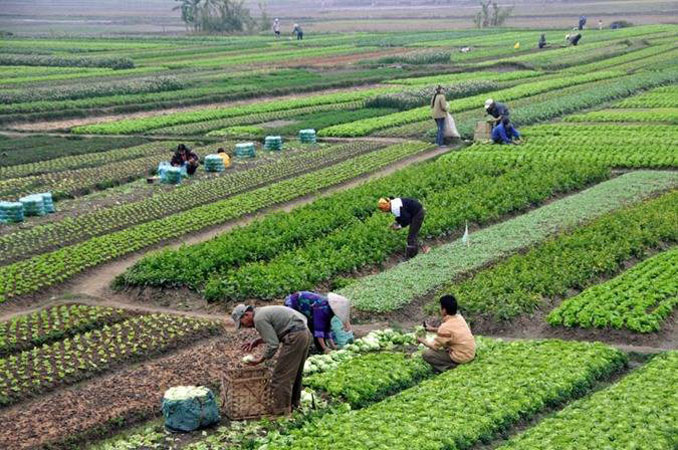
Urgent Need to Revitalize Pakistan’s Agricultural Sector
Federal Minister for Planning, Development and Special Initiatives, Prof. Ahsan Iqbal, has emphasized the critical importance of revitalizing Pakistan’s agricultural sector. He highlighted that the implementation of the 18th Constitutional Amendment has not fully realized its intended goals, particularly in the context of agriculture. According to the minister, the devolution of powers to the provinces has not led to the expected improvements in this vital sector.
During a visit to a cotton research farm on Defence Road Lahore, the planning minister expressed concerns about the lack of attention given to agriculture after the 18th Amendment. “Although the amendment transferred authority and resources to the provinces, agriculture has not received the necessary focus,” he stated. The minister pointed out that the provinces have failed to deliver tangible progress in improving agricultural productivity.
The minister was accompanied by Engineer Javed Saleem Qureshi, an agricultural expert who has spent 25 years developing a new variety of cotton seed. This innovation is expected to significantly boost cotton yields and address some of the challenges faced by farmers.
Prof. Ahsan Iqbal noted that due to the lack of focus and commitment at the provincial level, there has been little improvement in per-acre yield or the introduction of high-quality seeds for key crops. He also criticized the inactivity of research institutions in contributing to agricultural advancements.
The minister stressed the need for concrete planning to enhance agricultural productivity, especially in critical crops such as cotton, canola, and rice. “We must now plan for the next ten years with clear goals. Time is slipping by, and unless we act decisively, we will continue to lag behind. Competing with the world requires us to function as a united and forward-thinking nation,” he said.
He also raised concerns about the absence of long-term national planning for the next 10 to 20 years. “Pakistan must achieve self-sufficiency in agriculture. We cannot afford to rely on imports for essential crops any longer,” he added.
During the visit, Ahsan Iqbal praised the groundbreaking work of Engineer Javed Saleem Qureshi, who introduced a climate-resilient cotton seed variety capable of thriving in temperatures up to 50degC. This new seed, developed and successfully tested in Lahore while considering the impact of climate change, has the potential to increase cotton yield from the current 15 maunds per acre to an impressive 40-50 maunds per acre.
“This is nothing short of an agricultural revolution,” the minister remarked. “The government will fully support experts from the private sector who bring such innovations, and we will provide all possible cooperation to ensure their success.”
The minister also highlighted the immense potential in other crops such as canola, noting that increasing domestic production of canola oil could save the country billions of dollars in foreign exchange currently spent on imports.
In response to questions about recent heavy rains, the minister mentioned that the federal government has formed a committee comprising representatives from the federation and all four provinces to assess the damages. He added that the National Disaster Management Authority (NDMA) is currently collecting data to determine the scale of impact and future response strategies.
Ahsan Iqbal reiterated the government’s commitment to supporting agricultural innovation and emphasized that agriculture must become the cornerstone of Pakistan’s economic self-reliance in the coming years. His statements underscore the urgent need for coordinated efforts to revitalize the sector and ensure sustainable growth for the country’s future.