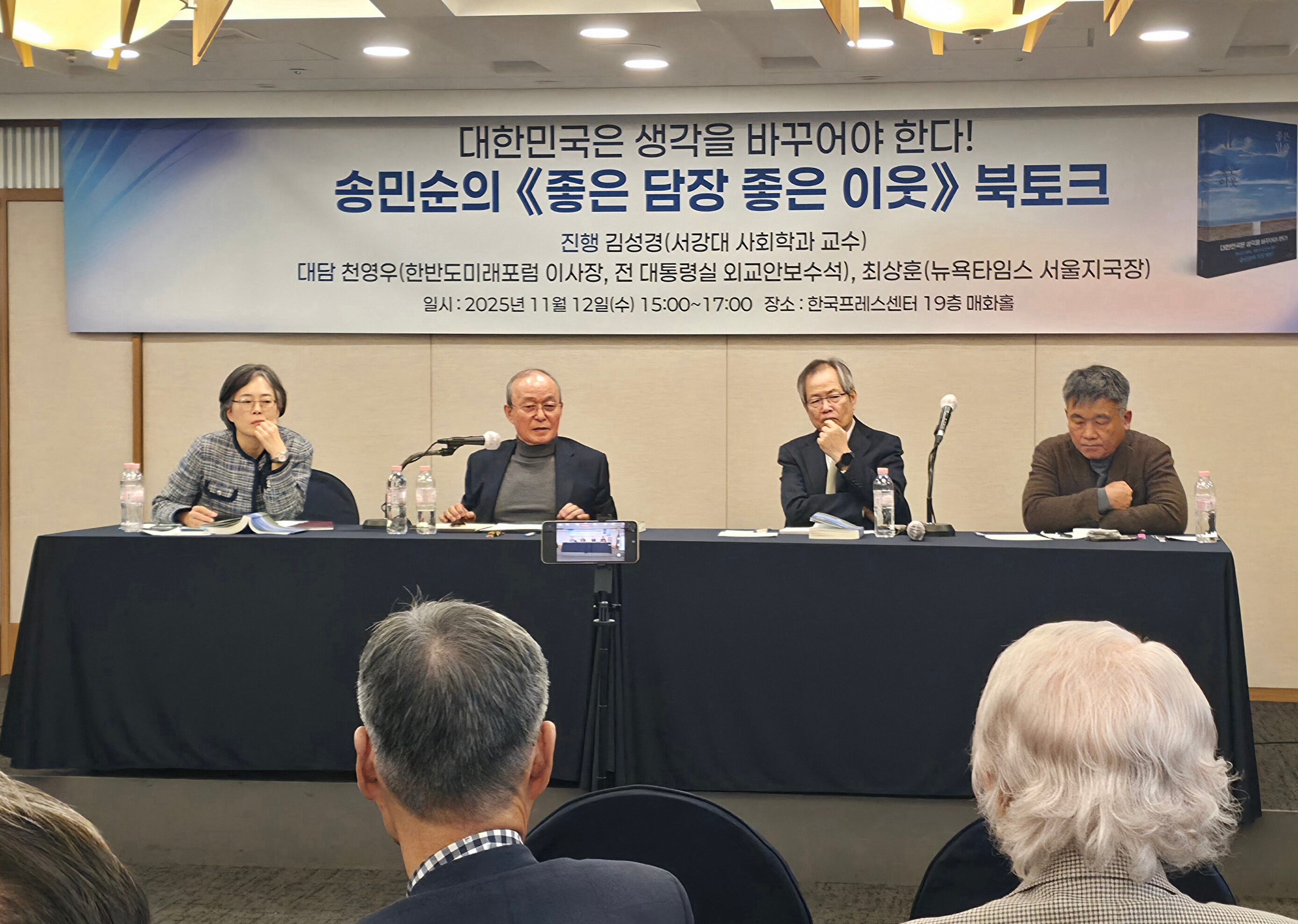
A book talk was held on the 12th to commemorate the publication of Good Fence, Good Neighbor, a new book by former Minister of Foreign Affairs Song Min-soon. The event took place at the Seoul Press Center and attracted a wide range of attendees, including former high-ranking officials in diplomacy and security, academics, and media professionals. Many arrived early to hear Song’s insights directly.
Emeritus Professor Choi Jang-jip of Korea University, known for his work Democracy After Democratization, was among the notable figures seated in the front row. Other attendees included former ambassadors to Russia, Singapore, Canada, Germany, and the EU, as well as current and former members of the Korean Diplomatic Association. Panelists such as former National Security Director Cheon Young-woo and New York Times Seoul Bureau Chief Choi Sang-hoon also participated.
Song Min-soon’s remarks drew attention due to the controversial nature of his book, which includes arguments that North Korea’s denuclearization is impossible and that South Korea should secure latent nuclear capabilities. These views have sparked debate between conservatives and progressives, with each side reacting differently to his proposals.
Controversial Content and Acknowledgment of Misinterpretation
Song acknowledged the potential for misreading his work during the book talk, noting that there is a “high potential for misreading.” He also mentioned the need for a revised edition, suggesting that his ideas may require further refinement or clarification.
Cheon Young-woo, a panelist and former director, praised Song for his strategic insight, stating that his realist approach could elevate diplomatic and security discourse. Cheon also confessed that his own focus on international support for unification had been a “futile obsession,” raising questions about the feasibility of cold peace and its potential to lead to warmer relations.
Academic Praise and Historical Context
Professor Choi Jang-jip delivered one of the most impactful remarks, calling the book an “event” and highlighting its high-level analysis of ethnic issues amid changing international circumstances. He referenced Princeton Professor John Ikenberry and George Kennan, drawing parallels between Song’s work and historical diplomatic strategies. Choi noted that Song’s book emerges in an era of uncertain U.S.-China relations surrounding the Korean Peninsula, emphasizing its significance.
A Crisis Just a Week After Appointment
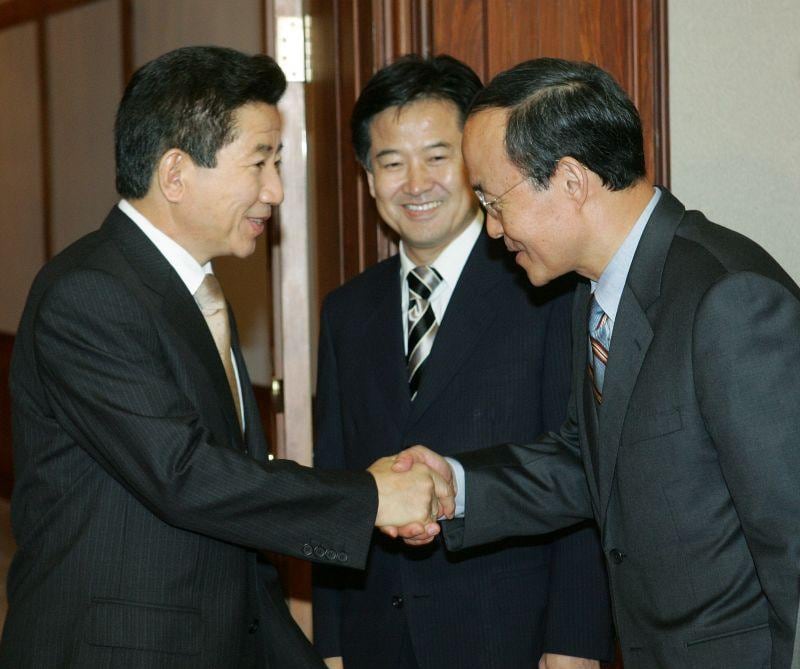
The book talk prompted reflection on Song’s earlier career challenges. In his 2016 memoir The Glacier Moves, Song recounted a crisis that occurred shortly after his appointment as National Security Director in 2006. A week into his role, he faced a tense discussion with President Roh Moo-hyun regarding the strategic flexibility of U.S. forces in Korea.
During a breakfast meeting, Song explained the agreement reached at the January 10, 2006, South Korea-U.S. foreign ministers’ meeting. However, President Roh interrupted him, questioning whether the agreement conflicted with the South Korea-U.S. Mutual Defense Treaty and whether it required National Assembly approval.
The meeting ended abruptly, with Song feeling dismissed and walking alone down a rainy hill. Despite this, he later received a call from President Roh, requesting another meeting the next day. Through careful preparation, Song managed to overcome the crisis, demonstrating his ability to navigate complex diplomatic situations.
Some analysts believe that President Roh’s initial rejection of Song was a test of his resolve. His stiff style and nickname “Colonel Song” among U.S. counterparts were reportedly factors in the decision. Roh’s comment, “How defiant can he be?” before appointing him, suggests that his appointment was a deliberate challenge to gauge Song’s adaptability.