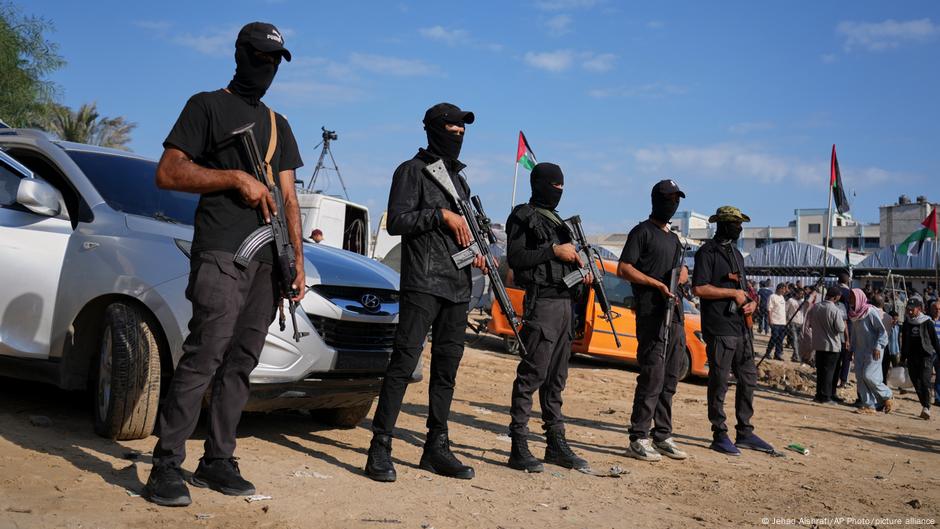
Hamas’s Persistent Presence in Gaza
Hamas, the Palestinian Islamist group based in Gaza, continues to exert its influence despite ongoing conflicts and power struggles with rival factions. The group has been executing individuals it claims are criminals or traitors from competing clans and groups within the territory. These executions have sometimes been carried out publicly, with Hamas sharing footage of the killings on social media. The organization asserts that some of the executed individuals committed murder, while others are accused of spying for Israel.
Hamas, which is classified as a terrorist organization by several countries including Germany and the United States, has shown a strong desire to reassert control over Gaza shortly after its conflict with Israel ended. According to reports from Israeli daily Haaretz, the group still commands approximately 40,000 fighters, who can now be seen reappearing on the streets and squares of Gaza.
Hamas operatives are targeting Palestinians in Gaza whom they accuse of committing serious crimes or political offenses. Journalist Khaled Abu Toameh, speaking with the Israeli daily The Jerusalem Post, reported that dozens of people have been arrested. He suggested that many of them may face execution.
Rival Clans and Power Struggles
The Doghmush clan, known for its long-standing clashes with Hamas, is a significant group in Gaza. Originally from Turkey, the clan settled in the Gaza Strip during the 20th century and gradually took control of two districts in the territory. It is affiliated with the Fatah party and the Palestinian Authority (PA), both led by Palestinian President Mahmoud Abbas. Members of the Doghmush clan were involved in the kidnapping of Israeli soldier Gilad Shalit in 2006, according to a report by Arabic news broadcaster Al Jazeera.
Another group involved in a power struggle with Hamas is the Abu Shabab clan, a Bedouin group based in the south of Gaza. Hamas accuses the Abu Shabab clan of collaborating with Israel, a claim the clan denies. A report by the Times of Israel indicated that Israeli Prime Minister Benjamin Netanyahu’s government has supported Abu Shabab with weapons, and Netanyahu confirmed this move.
Future Prospects for Hamas
The future of Hamas remains uncertain, particularly in light of these power struggles. US President Donald Trump’s peace plan calls for Hamas to be completely disarmed, but this outcome appears unlikely at present. Trump has made contradictory statements regarding the group’s disarmament. During a speech to the Israeli parliament, he claimed that “virtually the entire region has endorsed the plan that Gaza will be immediately demilitarized, that Hamas will be disarmed and Israel’s security will no longer be threatened in any way, shape or form.”
However, before his speech, Trump stated that his administration had allowed Hamas to temporarily rearm itself as it attempts to restore order after months of war. Recently, Trump appeared to reaffirm his stance on disarmament, stating that if Hamas does not lay down its weapons, the US would disarm it by force.
Hamas’s Message of Continued Presence
Hamas has made it clear that it has not disappeared from the Gaza Strip. Simon Wolfgang Fuchs, a professor of Islam at the Hebrew University of Jerusalem, noted that Hamas sent a strong message when its armed operatives appeared in Gaza City shortly after the Israeli withdrawal. He emphasized that the group continues to claim a role in the territory.
An analysis by the US Atlantic Council think tank suggests that disarming Hamas could be a long process. The study indicated that as long as Hamas exists—whether as an armed group, political movement, or idea—there is a considerable risk it could regain influence in Gaza to assert its own interests.
Internal Security in Gaza
After taking control of Gaza in 2007, Hamas was responsible for police and internal security as well as the judiciary. It maintained security in Gaza until October 7, 2023, the day it launched an attack on Israel. Disarming Hamas entirely will likely be difficult.
It remains unclear who will assume responsibility for Gaza’s internal security in the future. Egypt and Jordan have announced plans to train around 5,000 security officers for potential deployment in Gaza. Police authorities from the PA may also be involved, according to Trump’s Arab partners.
Potential for Hamas to Go Underground
Ignoring the interests of Hamas entirely could pose risks, according to Martin Jäger, head of the German foreign intelligence service. He warned that there is a “very real risk” Hamas could become active outside of Gaza if it is not involved in the transitional administration of the Palestinian enclave, but pushed out of territory or forced underground.
This scenario could affect the entire Arab region, as well as Europe, Jäger said. All observers agree that ensuring the dignity of Palestinians must remain a priority. If this is not achieved, violence could erupt once again.


