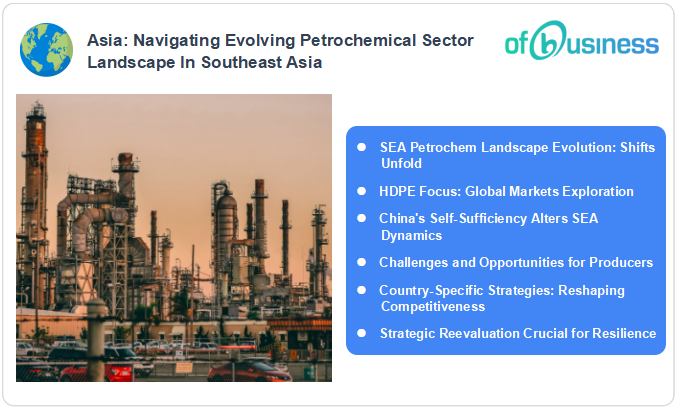
Global Petrochemical Sector Faces Persistent Challenges
Despite the global economy recovering from the pandemic, the petrochemical sector has not seen a return to stability. Overcapacity, slowing demand growth, and increased competition have led to the lowest profit margins in over a decade. This oversupply is expected to remain a major issue throughout this decade.
The utilisation rates for core petrochemical products are significantly below historical averages. At the same time, new capacity is expanding in regions like China and the Middle East, further pressuring margins. As these trends continue, the future of the petrochemical market could take one of three forms. In the first scenario, regions with abundant feedstock and growing markets will dominate global trade. The second possibility involves national oil companies (NOCs) taking control through scale and integration. The third scenario suggests that protectionism could lead to the rise of regional champions.
Southeast Asia remains one of the few regions with strong demand growth, but it must navigate a market where global oversupply has reduced returns. Between 2019 and 2024, the annualised total shareholder return (TSR) for the industry fell to -1%, compared to 15.3% for the S&P 500. This gap has had a significant impact on Southeast Asian players, despite their strong local demand.
Strategic Adjustments in Response to Industry Headwinds
In response to these challenges, companies across Southeast Asia have made difficult but necessary strategic choices. For example, JG Summit in the Philippines closed its naphtha cracker in January, which produced 480,000 tonnes of ethylene and 240,000 tonnes of propylene annually, due to high costs and weak margins. Similarly, Lotte Chemical Titan in Malaysia paused operations at its Pasir Gudang Complex in December to reduce losses.
These actions highlight the urgency for the region’s industry players to adapt. Rationalisation is the first step in addressing the current imbalance. European companies have already taken steps to reduce capacity, such as Sabic closing its Olefins 3 cracker in the Netherlands and ExxonMobil shutting down its Gravenchon steam cracker. According to Boston Consulting Group (BCG), at least 10 million tonnes per annum of global cracker capacity must be rationalised to restore balance. Without such action, utilisation rates will remain low, limiting investment in the transition to low-carbon and downstream products.
Consolidation as a Path Forward
Rationalisation alone is not sufficient. Consolidation has emerged as a key strategy to cut costs, capture synergies, and build resilience. More than 300 deals were announced in 2024, including INEOS acquiring TotalEnergies’ 50% stake in several joint ventures. These transactions aim to leverage critical advantages such as feedstock access, market expansion, technology, and portfolio diversification.
In Southeast Asia, consolidation is reshaping the industry landscape. Chandra Asri, in partnership with Glencore, acquired Shell’s Singapore refinery and petrochemical assets and later purchased Chevron Phillips’ polyethylene plant, adding 400,000 tonnes of annual capacity. These moves demonstrate how regional players are seeking scale and integration to compete effectively in a challenging market.
Three Possible Futures for the Petrochemical Industry
The next decade will be crucial for the petrochemical industry, with value creation shifting based on global dynamics. BCG analysis highlights three potential futures:
-
Feedstock and Market-Advantaged Players: Producers in the U.S. and the Middle East, with their low-cost feedstock, are well-positioned to dominate global exports. Meanwhile, India and China can capitalise on domestic demand growth. In this scenario, Southeast Asian producers would face structural disadvantages. They would need to move downstream into higher-value or specialty products to differentiate themselves and offset cost disadvantages.
-
National Oil Companies (NOCs) Dominate: As global transport-fuel demand slows, many NOCs are re-entering the petrochemical sector to capture growth and diversify earnings. With government backing and large-scale investments, they could gain a significant share of the market. Southeast Asian producers would face tougher competition unless they form strategic partnerships or focus on niche products.
-
Regional Champions Emerge in a Protectionist World: Trade barriers and stricter environmental regulations could slow global flows, pushing countries to develop self-sufficient value chains. In this context, petrochemical industries may consolidate around two to three dominant players in each region. Southeast Asia’s strong local demand could support the emergence of regional champions, but success would depend on consolidation and integration.
The Case for Bold Action
Consolidation is no longer an option but a necessity, regardless of which future unfolds. However, Southeast Asian producers face structural disadvantages compared to rivals in the U.S. and Middle East, who benefit from low-cost feedstock. Chinese mega-plants also enjoy greater scale and lower capital intensity. Many Southeast Asian producers are in the third quartile of the global cost curve for key petrochemical commodities, making them vulnerable in a competitive environment.
Some regional players are experimenting with new approaches. One company is importing ethane from the U.S. to supply its regional petrochemical complex, reducing costs by over 30%. Others are exploring mergers to integrate assets and build resilience.
The challenge now is urgency. As consolidation reshapes the global industry, Southeast Asian producers must act decisively to scale, integrate, and reposition. Those that move boldly can become regional champions. Those that delay risk being left behind in the next era of petrochemicals.

Related posts:

Fiction park: He was the best in class. He still wasn’t good enough

Gagan Thapa takes oath as Congress president, vows to regain public trust

Inside knowledge that has locals gripped by fear after gran’s body found decomposing in cattle dip

New property purchase disclosure rule in Japan sparks fears it may curb foreign investment

Dino-mite treasures: inside Singapore’s Fort Knox storing playthings of ultra-rich