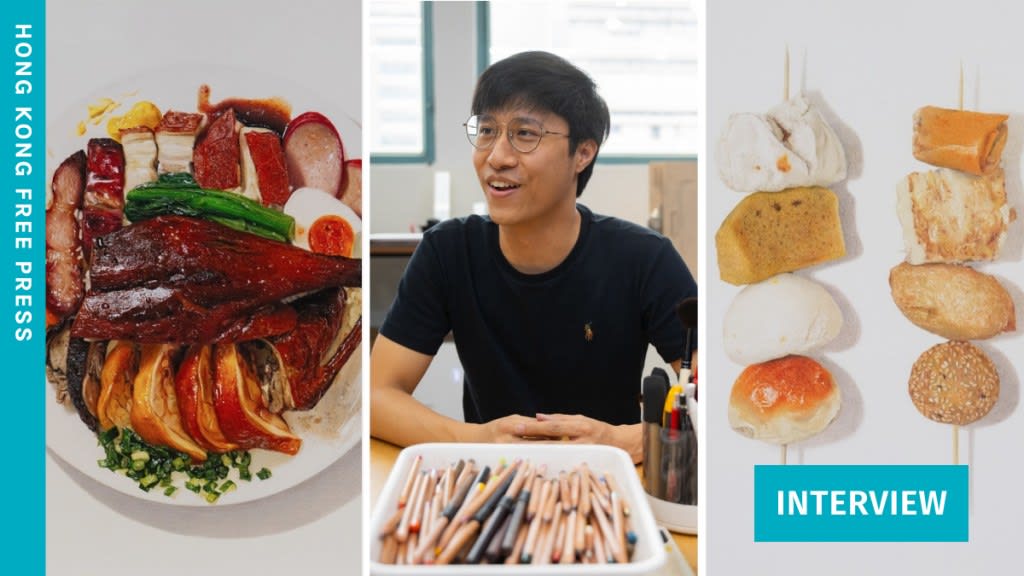
Steven Tang’s Instagram feed might initially seem like a collection of food photography, showcasing popular local dishes such as roasted meat rice, egg tarts, and instant noodles with luncheon meat. However, upon closer inspection, it becomes clear that these images are not photographs but intricate hand-drawn artworks by the 26-year-old Hong Kong artist.

Since its inception in 2018, Tang’s Instagram page has garnered over 45,000 followers. Many have praised his ability to make his drawings “make them drool,” while others have commended the lifelike quality of his work. Despite this success, Tang is entirely self-taught and never pursued formal art education. He shared with HKFP that he never anticipated that drawing with colored pencils would turn his childhood hobby into a profession.
As a food enthusiast, Tang began sharing his food art as a way to bring his favorite dishes to life on paper. His first artwork to gain significant attention was a bowl of Yunnan-style rice noodles from the popular local restaurant chain TamJai. Since then, he has participated in several group exhibitions, some of which focused specifically on food-related realist art. He was featured in Art Central in 2023 and the Affordable Art Fair last year.

Despite the realistic appearance of his work, Tang clarifies that it is not exactly “real.” He sometimes uses photos as references or purchases food items to create the ideal version of a dish. He may alter the form and structure of the food to enhance its visual appeal.
When drawing a plate of siu mei rice, for example, Tang added some char siu pieces even though he did not buy them because finding the perfect barbecued pork was difficult. This allowed him to create a more visually appealing image rather than being limited by how the chef prepared the dish.
“Whether you can ‘make stuff up’ depends on your experience, meaning how many times you’ve drawn that item before,” he said in Cantonese. Some dishes he loves, such as those heavily sauced, may not appear in his drawings because they may not look visually appealing. He considers what “can sell” when creating his work.

Tang is inspired to draw everyday Hong Kong cuisine partly to share his passion for food with the world and partly because he fears that some dishes may disappear, especially in a city where store closures are common. As a Chinese University of Hong Kong graduate, he created a drawing of a two-dish rice meal from a campus canteen he frequently visited during his studies. After the eatery closed, he could no longer find the same taste elsewhere.
“Some people may say that taking a photo is enough, but I think making a drawing renders it more memorable. I think it is quite meaningful to capture the tastes that may be disappearing through my drawings,” he said.

Creating realistic food art for over seven years has presented its own set of challenges for Tang. He often struggles to come up with creative ways to present familiar Hong Kong food. He previously drew the famous “pork patty mountain rice” dish from Man Shing Restaurant in the shape of Lion Rock and also depicted dim sum dishes on skewers.
Keeping his creativity alive is not easy, Tang said. In addition to carefully designing the composition of his drawings, he also spends considerable time planning how to present his work on social media. He used to post time-lapse videos documenting his creative process, which initially attracted a lot of engagement. However, changing content algorithms have made promotion more challenging.
To make his art more engaging, he now incorporates real-life utensils, such as bamboo sticks and chopsticks, into his short videos on Instagram. Another challenge he faces is balancing running his own drawing studio and teaching classes. He used to spend hours on each piece, sacrificing sleep. Now, he often feels too exhausted.
Many full-time artists work closely with galleries and dedicate all their time to creating new pieces instead of teaching. Tang understands this may be a necessary step if he wishes to advance his career, but he is not ready to give up teaching yet, especially since he is unsure whether he can make a living solely through art sales.
“The art market may not necessarily like my work, so it is a gamble,” he said.

Not threatened by AI
Looking ahead, Tang has big plans for next year, including his first-ever solo exhibition in September. He will need to create more than 10 new drawings for the show. He also wants to revive his YouTube channel, which has been dormant for over five years, and continue filling the gap in drawing tutorials available in Cantonese.
As artificial intelligence (AI) technology continues to evolve, machines can now recreate images based on prompts asking for specific artist styles. When asked if he feels the rise of AI threatens his work, Tang remains confident that successful artists will retain their value.
“AI perhaps can generate a painting by Van Gogh, but you will not think that his work is worthless because of AI,” he said. “I hope that one day, when people talk about coloured-pencil artists in Hong Kong, I will be the first name that comes to their mind.”


