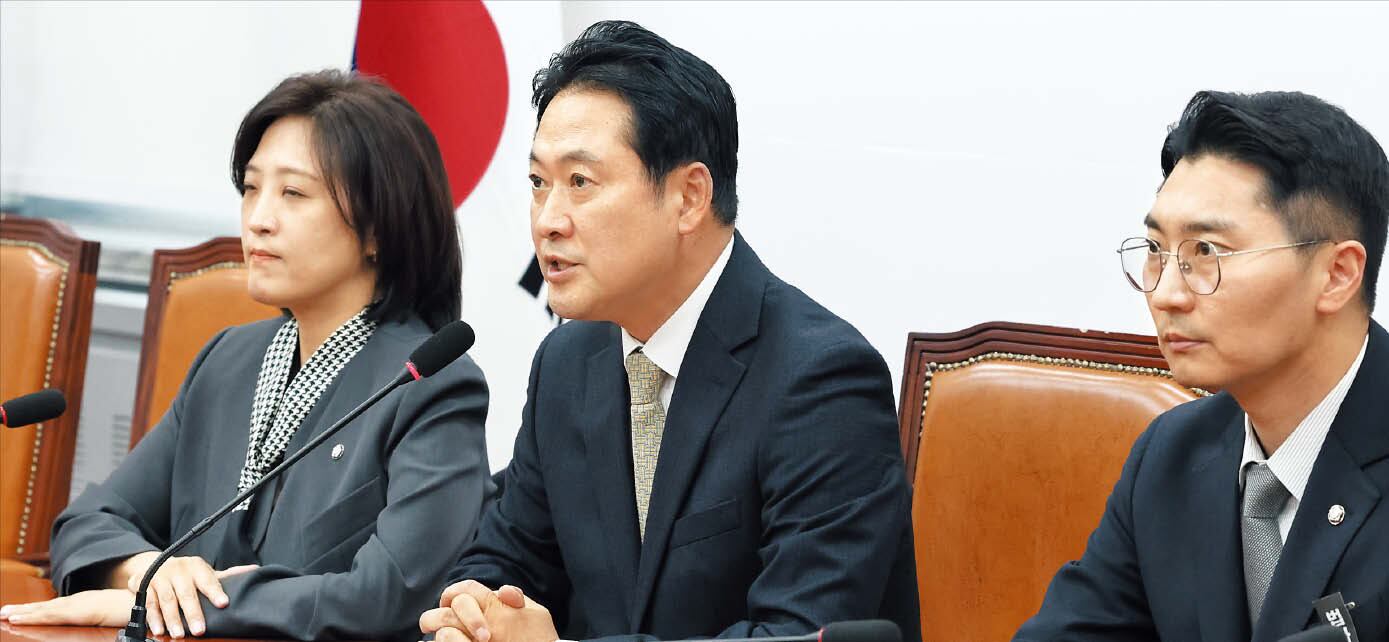
The Democratic Party of Korea announced on the 20th a ‘judicial reform bill’ to increase the number of justices from 14 to 26. According to this, President Lee Jae-myung will be able to appoint up to 22 justices during his term.
The Democratic Party also stated it will push for the introduction of a trial constitutional appeal system, which allows constitutional appeals against Supreme Court rulings, despite controversies over the ‘four-tier system.’ The party had initially considered excluding this from the judicial reform bill due to falling approval ratings but reportedly resumed efforts after recent coordination with the presidential office. The People Power Party criticized, “Under the guise of judicial reform, the Democratic Party is once again shaking the foundations of South Korea’s rule of law. Their judicial reform is a roadmap to control the judiciary and a project to distort the Supreme Court solely for President Lee Jae-myung.”
The Democratic Party announced plans to pass the judicial reform bill at the National Assembly plenary session within this year. The bill includes increasing the number of justices and revising the justice recommendation committee to exclude the head of the National Court Administration and include the head of the Constitutional Court’s administrative office. A source from the opposition said, “This aims to downgrade the Supreme Court’s status under the Constitutional Court and overturn President Lee’s trial.” Other measures in the bill include introducing a judge evaluation system, expanding the disclosure of lower court rulings, and implementing a pre-review system for search and seizure warrants.
The Democratic Party also stated it will introduce the trial constitutional appeal system, often referred to as the ‘four-tier system.’ Representative Jung Chung-rae said, “No matter how high the court, it is an institution under the Constitution. If a court ruling violates constitutional procedures or infringes on citizens’ basic rights, it can be subject to a constitutional appeal.” He added, “We will propose legislation as a party leadership decision and push for its passage at the National Assembly plenary session.”
In relation to this, the Democratic Party proposed a Constitutional Court Act amendment bill on the same day, with Representative Kim Gi-pyo as the main sponsor and leaders including Representative Jung Chung-rae as co-sponsors. The amendment allows constitutional appeals for rulings that violate the Constitution or laws or infringe on basic rights, but critics argue the criteria for the four-tier system remain vague.
◇If the four-tier system is implemented… President Lee’s case could go to the Constitutional Court
If the four-tier system is implemented, the case of President Lee Jae-myung under the Public Official Election Act, which the Supreme Court’s full bench overturned and remanded with a guilty ruling in May, could become subject to a constitutional appeal. Even if the Supreme Court finalizes the ruling in a retrial, the constitutional appeal route would remain open. President Lee’s trials have been suspended since he took office.
The Democratic Party had formed a judicial reform special committee to discuss the bill. However, amid falling party approval ratings due to pressure from Chief Justice Jo Hee-de and the judiciary, there were concerns that the four-tier system—which could cause public confusion by overhauling the trial system—would be excluded. However, the party’s stance recently shifted. A senior source from the ruling party said, “At a high-level party-government meeting on the 12th, the party and the presidential office agreed to proceed with the four-tier system.”
A constitutional appeal is a system where individuals can file a lawsuit with the Constitutional Court if their basic rights under the Constitution are violated by public authority. The current Constitutional Court Act specifies that constitutional appeals can be filed if a ‘state institution’s action’ infringes on basic rights, but ‘court rulings’ are excluded. This reflects the principle of respecting court decisions and not allowing trial constitutional appeals.
For this reason, when the Democratic Party proposed a Constitutional Court Act amendment bill on May 7—immediately after the Supreme Court overturned President Lee’s election law case on May 1—legal circles criticized it. Song Eon-seog, the People Power Party’s floor leader, wrote on Facebook, “Introducing a four-tier system that allows the overturning of finalized Supreme Court rulings prepares a mechanism to nullify even the already finalized guilty ruling for President Lee’s violation of the Public Official Election Act. Additionally, appointing new justices aligned with the president and the ruling party could turn the Supreme Court into a ‘post-retirement judicial insurance institution’ that guarantees the president’s safety from judicial risks after leaving office.”
If the four-tier system is implemented as proposed by the Democratic Party, the Constitutional Court’s workload is expected to surge. The court acknowledges this. In written materials submitted to Representative Shin Dong-wook of the People Power Party, the Constitutional Court stated, “The Supreme Court receives about 40,000 cases annually. Based on an average appeal rate of 30%, approximately 12,000 trial constitutional appeals are expected each year.” Last year, the Constitutional Court received a total of 2,522 cases. The four-tier system would increase this by about six times. However, the Constitutional Court submitted an opinion to the National Assembly in May stating, “We sympathize with the purpose of introducing the trial constitutional appeal system,” and Chief Justice Kim Sang-hwan expressed support during a national audit on the 17th, calling it “more ideal in terms of protecting basic rights.”
The Supreme Court opposes the trial constitutional appeal system. Chun Dae-yup, head of the National Court Administration, testified at the National Assembly’s Legislation and Judiciary Committee in May, “Under the current Constitution, trial constitutional appeals are interpreted as not permitted, so this would violate constitutional provisions.” The Constitution grants the Supreme Court final authority over trials, and the trial constitutional appeal system contradicts this.
Lee Chang-hyun, a professor at Hankuk University of Foreign Studies, said, “The four-tier system shakes and breaks the framework of the Constitution.” He added, “The four-tier system asks the Constitutional Court to review a case already tried three times, which contradicts President Lee’s recent statement that prosecutors should not appeal or retrial if he is acquitted in the first trial on the 30th of last month.” One legal professional said, “This will only increase the financial burden on citizens. Only those who can afford high legal fees will benefit from the four-tier system.”

Related posts:

Fiction park: He was the best in class. He still wasn’t good enough

Gagan Thapa takes oath as Congress president, vows to regain public trust

Inside knowledge that has locals gripped by fear after gran’s body found decomposing in cattle dip

New property purchase disclosure rule in Japan sparks fears it may curb foreign investment

Dino-mite treasures: inside Singapore’s Fort Knox storing playthings of ultra-rich