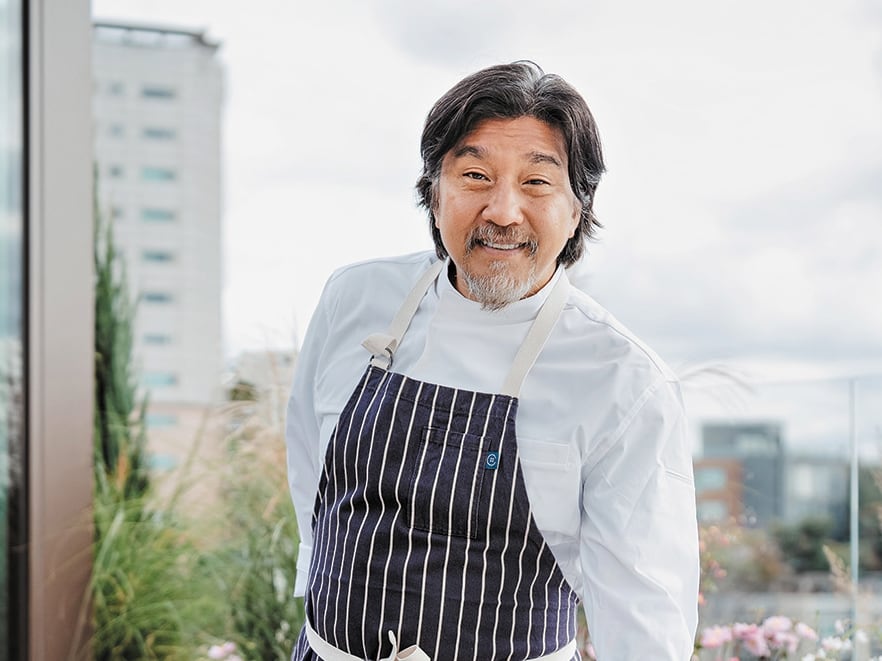

“I think every day, ‘Is this a dream?’ I never expected a new chapter in life after turning fifty. For a man in his fifties, it’s time to gradually consider retirement, but suddenly a new chapter is given to me. This new adventure is both beautiful and surreal. If it’s a dream, I don’t want to wake up.”
Edward Lee (53), the runner-up of Culinary Class Wars, defines himself as a “mixed rice human.” This “mixed rice human,” blending Korea and America deliciously, became an overnight star through Culinary Class Wars. Many say, “Although the winner is the Naples Mafia (Chef Kwon Sung-jun), the protagonist is Edward Lee.”
Initially, there was skepticism about a chef with a prestigious background—winner of the U.S. culinary survival program Iron Chef and former head of state dinners at the White House—challenging himself on a competition show again. However, Chef Lee captivated viewers with his exceptional culinary skills, creativity, and charismatic yet humble and humorous personality that exuded human charm as the rounds progressed.
Edward Lee, who actively works between the U.S. and South Korea, was met on the 30th of last month at the “Capella Residence Seoul Club” in Hannam-dong, Seoul. “The Loop,” the club’s top floor, is the restaurant where Chef Lee first presents his cuisine in Korea. The meeting took place the day before the welcoming dinner for the APEC (Asia-Pacific Economic Cooperation) Leaders’ Meeting in Gyeongju.
APEC Dinner Showcasing ‘Different Korean Cuisine’

Chef Lee oversaw the welcoming dinner. Collaborating with Lotte Hotel chefs, he presented a course blending traditional and innovative Korean cuisine. He said, “I want to help sustain the momentum of Korean cuisine, which is gaining global attention,” and “I want to showcase the true essence of Korean food.”
- How did you come to be in charge of the APEC dinner?
“The government requested it. I felt honored to take on such a significant international event and accepted. I was burdened by how to represent Korea through Korean cuisine. Still, I was very proud and prepared diligently. I hoped they would enjoy the meal and remember the taste of Korea.”
- What was the overall concept behind the menu?
“A government official said, ‘You can do fusion,’ but I replied, ‘No.’ Korean cuisine is perfect. I didn’t want to alter traditional Korean food. Korean ingredients have infinite potential and adaptability to transform into any global cuisine. Half the menu was traditional Korean dishes, and the other half was creative and innovative Korean cuisine. I wanted to create an opportunity to reflect on the history of Korean cuisine and look toward its future through the APEC dinner.”
The dinner began with a crab salad appetizer with persimmon and pine nut sauce developed by Chef Lee. Pine nuts are a Korean ingredient he frequently uses. This was followed by a main course of Gyeongju Hanwoo galbijjim (braised short rib) with Jeju abalone and tteok (rice cake). For the meal, there was Gyeongju gondalbinabi (wild vegetable) bibimbap, Gyeongju bean sundubu-jjigae (soft tofu stew), and side dishes of baek-kimchi (white kimchi), bean leaves, and stir-fried lotus root with perilla seeds. It was praised for faithfully reflecting local ingredients from Gyeongju, where APEC was held.
The dessert was a grilled pine nut pie and doenjang caramel developed by Chef Lee, along with traditional injeolmi (rice cake coated with bean powder). Chef Lee said, “Typical American desserts like caramel are often enhanced with salt, but I thought, ‘What if I use doenjang instead of salt?’ I wanted people to experience the taste of Korea alongside American sensibilities.” The dessert was served in a traditional lacquerware box engraved with the Korean flag as a souvenir for the leaders, accompanied by chrysanthemum tea from Jirisan. The dinner wine was “Tiger Yuzu Makgeolli.”
- How long did it take to prepare the dinner?
“It took about a month to meet with the Lotte Hotel culinary team, finalize candidate dishes for the dinner, and confirm the final menu after government approval.”
- Were dishes prepared differently for each leader?
“We maintained the basic flavors but adjusted details according to each leader’s dietary restrictions, such as allergies or religious preferences. However, we aimed to properly showcase Korean cuisine without altering the taste to suit foreign palates.”
- What is the true essence of Korean cuisine?
“In the U.S., people think Korean food is all about spicy and garlic-heavy dishes. I want to show the other side of Korean cuisine—its subtlety and gentleness. Mild and pure Korean dishes allow you to savor the flavors meditatively. Samgyetang (ginseng chicken soup) also reveals various flavors the more you eat it. I especially love baek-kimchi. My grandmother made it deliciously.”
A New York Chef Settling in Kentucky

Chef Lee grew up in a typical Korean immigrant family. When he was one, his family moved from Seoul to the U.S. He was raised in Brooklyn, New York, where his family settled. After graduating from New York University with a degree in English literature, he briefly worked at a publishing company but found it unsuited to his interests. He quit and became a chef at a restaurant.
- Your parents didn’t approve of your becoming a chef.
“To immigrant parents, being a chef was a wrong career choice. My father dreamed of me becoming a diplomat. My mother was ashamed of me for years. Her friends’ children were successful in prestigious professions, while I was just a chef. Of course, she’s proud now.”
- You first gained fame as a chef in 1998 by opening ‘Clay’ near New York’s Chinatown.
“It was a restaurant serving Korean cuisine reinterpreted in my style. Shortly after opening, it was briefly featured in The New York Times. The next day, a line of customers wrapped around the block where the restaurant was located. I was completely unprepared and panicked.”
- You closed the restaurant after the 9/11 attacks.
“The restaurant was doing well, and I had almost paid off the loan I took when opening it. But the 9/11 attacks in 2001 destroyed everything. I lost friends and customers. It was horrifying. I wanted to leave New York. I wanted to clear my mind. In 2003, I sold the restaurant and embarked on a cross-country trip in the U.S.”
- Why did you settle in the southern U.S., where you had no connections?
“Louisville, Kentucky, hosts the famous Kentucky Derby horse race annually. I went to watch it and was captivated by the friendly Southern hospitality and food culture. I thought I’d work in Louisville for a year or two and then return to my original life. I never imagined Louisville would become my home.”
- You said you wouldn’t have come to love Korean cuisine if you hadn’t moved to the South.
“There were many similarities with Korean cuisine, like long-simmered broth dishes. It reminded me of the Korean food I ate as a child. New York only favors new and innovative cuisine; traditional food isn’t preferred. In the South, I saw family recipes passed down for five or six generations. It made me reflect on my ‘Korean legacy.’ Also, there were no decent Korean restaurants in Louisville at the time. I had no choice but to cook Korean food myself, which improved my skills.”
- What led you to acquire ‘610 Magnolia’?
“A friend recommended the restaurant, and I became close with the owner-chef. I helped in the kitchen for about a week. Though it was a beloved local restaurant, it was about to close due to a lack of successors. After returning to New York, I received earnest requests to take over the restaurant and eventually acquired it. Now, Louisville is my home.”
- How did you gain recognition as a chef in the southern U.S., where Asians are rare?
“Since I’m not from the South, I was free from criticism and stereotypes, allowing me to create new dishes. Although there were ups and downs, such as losing regular customers, my reinterpretations of Southern cuisine gradually received positive reviews.”
He married a local woman in Louisville and has lived there for over 20 years. They have one daughter.
- What kind of food do you prepare during holidays like Thanksgiving (the fourth Thursday of November) in a household with a Korean-American husband and a German-American wife?
“Our home blends American, Korean, and German cuisines. For Thanksgiving, we roast turkey with gochujang glaze. The stuffing inside the turkey includes diced German sausage. On New Year’s Day, my wife makes German cabbage stew, and I boil tteokguk (rice cake soup) to eat with our child. Kimchi-jjigae (kimchi stew) is a staple on our holiday table because my wife loves it.”
Culinary Class Wars That Made Me a 50-Year-Old Idol

Before appearing on Culinary Class Wars, Chef Lee was already well-known in the U.S. for winning Iron Chef, placing fifth on Top Chef, and authoring books like Buttermilk Graffiti, Bourbon Land, and Smoke & Pickles. However, his leap to global star chef status was undoubtedly due to Culinary Class Wars.
- You received more spotlight than the winner.
“It’s shocking that even children run up to me for photos or autographs. I don’t know why kids cheer for a 50-year-old man like an idol (laughs). I really don’t know why the public loves me. I’m just deeply grateful. I only tried to be honest and true to myself.”
- Netflix initially offered you a judge position.
“They asked, ‘Can you speak Korean?’ I replied, ‘Yes.’ After a Zoom meeting, they were surprised: ‘You can’t speak Korean!’ (laughs). A few weeks later, they asked, ‘Can you come as a contestant?’ It was a no-brainer. I’ve always sought opportunities to use Korean ingredients, and I wanted to do something significant in Korea before I die.”
- If offered the judge position again, would you accept?
“I’d decline. To be a judge, one must evaluate precisely in the language, but my Korean isn’t sufficient yet.”
- Can you still not eat tofu?
“I couldn’t eat it for about three months. Now I enjoy it as before. Actually, the ‘tofu hell’ wasn’t as tough compared to speaking Korean (laughs).”
The second semifinal of Culinary Class Wars is called “tofu hell.” Contestants had to create a dish every 30 minutes using tofu as the theme. Chef Lee showcased creative dishes utilizing tofu in various ways from the first to the sixth round, becoming the final winner and advancing to the finals.
-Revealing your Korean name (Lee Gyun) in the finals was a hot topic.
“Halfway through the show, I made a personal vow: If I reach the finals, I’ll reveal my Korean name. I’ve never used my Korean name in my life. Growing up with a name no one knows is a strange experience. I wanted the chance to reveal and use my Korean name. I thought no one would pay attention, but the video spread wildly. Thousands of Korean, Japanese, and Mexican Americans contacted me, saying, ‘Thank you for voicing my feelings.’”
“Bibim-Naengmyeon Is My Favorite Korean Dish”
While operating four restaurants in the U.S., Edward Lee is busy in Korea with consulting, advertising, events, and broadcasting. He said, “I come to Korea once a month, stay for about five days, and return to the U.S.,” and “I expect to be busy until December.”
- You personally prepared 1,000 servings of galbijjim for underprivileged seniors.
“I worked with the Korea Legacy Committee (KLC), a volunteer group supporting meals for the elderly. I feel obligated to give back to society for the love I’ve received in Korea. From 8 a.m., I boiled galbijjim for three hours and served it. KLC said they hadn’t been able to treat the elderly to beef due to budget constraints. I also donated 5,000 US dollars to purchase the beef ribs for the galbijjim. I wanted to give them a special treat, not just their everyday meal.”
- You want to help sustain and spread the momentum of Korean cuisine.
“Korean cuisine is currently the trendiest globally. Last summer, I visited Paris and was surprised by the sheer number of Korean restaurants. When people worldwide think of Korean food, they only know K-barbeque like galbi and bulgogi, and bibimbap. Now, I want to show the rest.”
- You also want to promote K-whiskey.
“K-barbeque pairs perfectly with whiskey. If it’s Korean-made, it would be an even better match. Japanese whiskey is too sweet, soft, and delicate to pair with galbi or bulgogi. I recently learned that whiskey is produced in Korea. I’m preparing a special dinner with ‘Giwhan Whiskey.’ I look forward to the day when K-whiskey is recognized worldwide like Japanese whiskey.”
- What is your favorite Korean food?
“I love bibim-naengmyeon. A dish combining spicy, cold sauce and chewy noodles! It’s a uniquely Korean food found nowhere else in the world.”
- What dish represents you?
“Humans evolve daily. The same goes for me. A dish I made two years ago cannot represent who I am now. The dish I’m currently developing is my signature menu.”
- What would you eat for your last meal?
“If I’m with my family, it doesn’t matter what we eat.”


