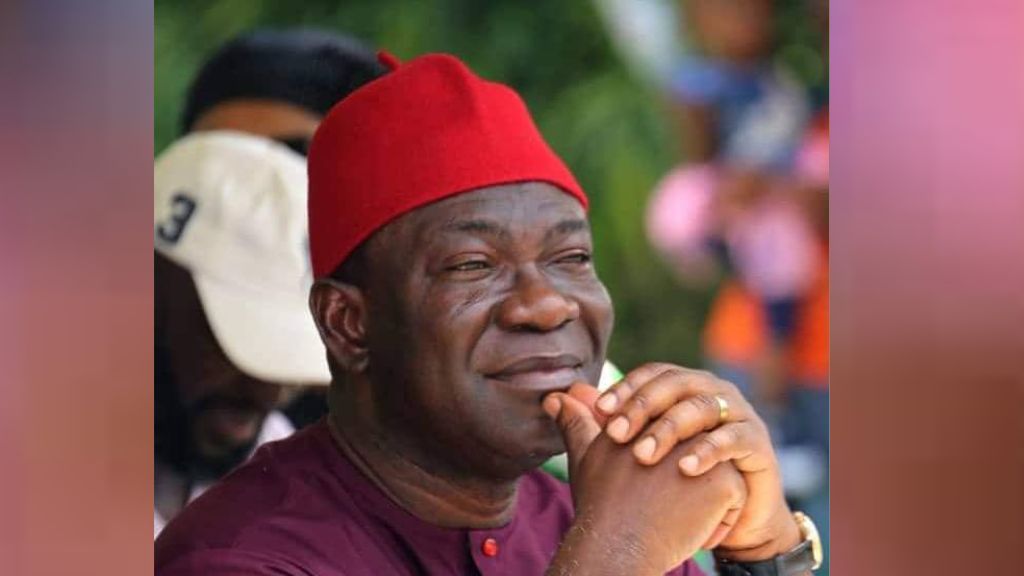
Leadership Responses to the Transfer of Senator Ike Ekweremadu
Leaders from various groups in the South-East have expressed differing opinions regarding the Federal Government’s decision to transfer former Deputy Senate President, Senator Ike Ekweremadu, from a United Kingdom correctional facility to a Nigerian custodial centre. While some questioned the plan, suggesting it might be aimed at bolstering President Bola Tinubu’s chances for re-election in 2027, others emphasized that the motives behind the move were less important than the action itself.
Ekweremadu was convicted in the UK for organ trafficking. In June 2022, he and his wife, Beatrice, were arrested by the London Metropolitan Police after a man claimed to be a cousin to their daughter, Sonia, in an attempt to facilitate a kidney transplant for her. This incident led to their conviction under the UK Modern Slavery Act in 2023. Ekweremadu received a nine-year and eight-month prison sentence, while his wife was sentenced to four years and six months. Beatrice was released earlier this year and has since returned to Nigeria.
President Bola Tinubu sent a high-level delegation to London to discuss Ekweremadu’s case. The delegation, led by the Minister of Foreign Affairs, Yusuf Tuggar, and the Attorney General of the Federation and Minister of Justice, Lateef Fagbemi, met with officials of the UK Ministry of Justice to explore the possibility of allowing Ekweremadu to serve the remainder of his sentence in Nigeria.
Following the meeting, the delegation visited the Nigerian High Commission in London, where the Acting High Commissioner, Ambassador Mohammed Maidugu, received them.
Concerns Over Political Motives
The President of the Igbo National Council, Chilos Godsent, raised concerns about the motive and timing of the government’s request. He warned against what he described as “political manipulation” or “vendetta” disguised as compassion. Godsent accused the previous administration of Muhammadu Buhari of failing to protect Ekweremadu during his legal ordeal in the UK. He argued that the negligence allowed British authorities to try a sitting senator of the Federal Republic.
Godsent said, “There is one thing that is really not clear: are they bringing him back to Nigeria to set him free or bringing him back to put him on trial, or to let him continue his jail term? These things are not really clear. That is why people are sceptical that he can be brought back and then, as part of political vendetta, he might be retried, which is not proper.”
Similarly, the President of the Ala-Igbo Development Foundation, Prof. Awuzie Unachukwu, questioned the government’s motive. He pointed out that if the government truly believed Ekweremadu should return to serve his sentence, it should also consider releasing Mazi Nnamdi Kanu, who was detained for advocating self-determination for the Igbos.
Unachukwu commended Tinubu for initiating steps toward the repatriation of the embattled senator but cautioned that Ekweremadu should not be sent back to serve a jail term in Nigeria. He added, “If he is coming back to Nigeria, it shouldn’t be for a jail term.”
Support for the Move
Despite these concerns, several leaders supported the government’s decision. The Deputy President General, Ohanaeze Ndigbo, Mazi Okechukwu Isiguzoro, stated that the move was not politically motivated. He said, “Ohanaeze is supporting the President and we are at the forefront to ensure that the President repatriates and rehabilitates him. He is a political leader. The President doesn’t hate the Igbo people.”
The Abia State Peoples Democratic Party Chairman, Abraham Amah, also expressed support for the government’s actions. He said, “There was nothing wrong with any administration taking steps it considered appropriate in the interest of justice, humanitarian consideration, or national responsibility.”
Reviving the Prisoner Transfer Agreement
Meanwhile, the Federal Government has begun fresh efforts to revive the long-stalled Nigeria–United Kingdom prisoner transfer programme as part of diplomatic consultations to repatriate Ekweremadu. This move has reignited discussions about the 2014 Nigeria–UK Prisoner Transfer Agreement, which has remained unimplemented more than a decade after it was signed.
The agreement, intended to allow convicted nationals to serve their sentences in their home countries, includes provisions for a £700,000, 112-bed wing at the Kirikiri Custodial Centre in Lagos, compliant with United Nations standards. Despite these arrangements, no prisoner has been transferred under the scheme.
At the 2025 Nigeria–United Kingdom Migration, Justice, and Home Affairs Dialogue held in Abuja, both nations reaffirmed their commitment to reviving the agreement. The joint communique released after the meeting stated that Nigeria had called for a review of the document to ensure alignment with the Nigerian Correctional Services Act of 2019.
The push to operationalise the prisoner transfer agreement comes as Nigeria continues to face severe overcrowding in its correctional facilities. Over 70,000 inmates are currently housed across the country, many awaiting trial, while frequent jailbreaks have underscored the strain on the prison system.
To tackle congestion, the Federal Government has inaugurated new correctional centres in Abuja, Kano, Lagos, Port Harcourt, and other parts of the country, including 3,000-capacity facilities across the six geopolitical zones.


