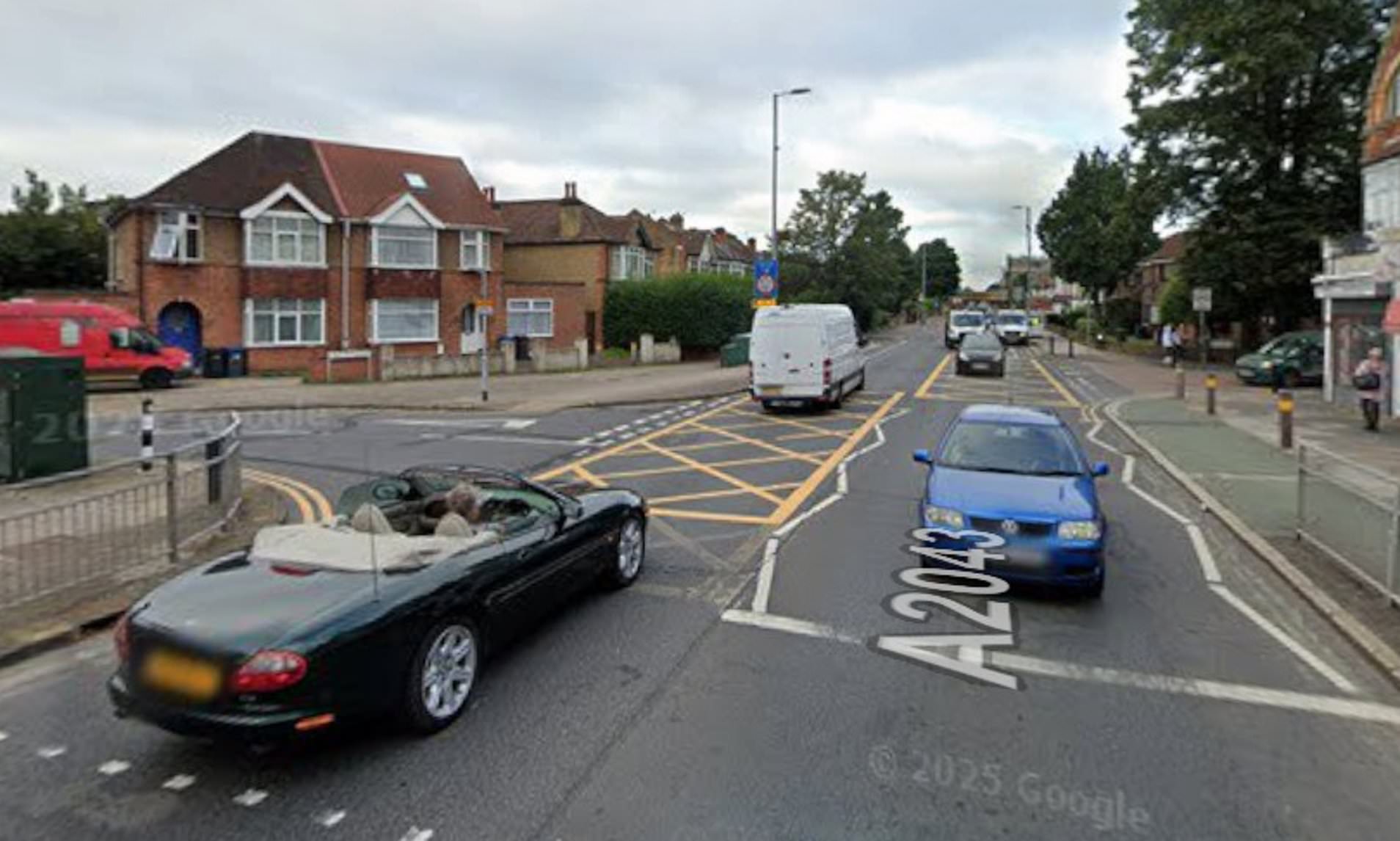
The Controversial Double-Box Junction in Kingston Upon Thames
In the UK, a particular double-box junction has become infamous for its significant financial impact on drivers. This junction, located on Kingston Road, is generating over £1,800 per day from trapped drivers. Between January and August of this year alone, the Royal Borough of Kingston upon Thames issued 6,568 penalty charge notices (PCNs) for violations at this location.
The junction consists of two yellow boxes, which result in an average of 27 penalties being issued daily. Over the course of eight months, drivers have been fined a total of £451,405 for these infractions, according to data obtained through a Freedom of Information Act inquiry.
Roland Head, 75, who has owned The Real Butchers for 42 years and operates next to the junction, described it as a “cash cow.” He claims that the local government isn’t going to make any changes because the fines are providing them with revenue. The two yellow boxes, situated between Elm Road and Westbury Road, have been in place since 2015, but it wasn’t until five years later that fines were introduced.


To prevent drivers from attempting to avoid penalties by driving onto the pavement, the council has added a bollard in front of The Real Butchers. According to the Highway Code, drivers must not enter a yellow box unless they can drive through it without stopping.
Understanding Yellow Box Junctions
A yellow box junction is a traffic control measure designed to prevent gridlock at intersections. It is easily identifiable by the yellow box filled with criss-cross yellow lines painted on the road. Under the Highway Code, drivers are not allowed to enter the yellow box unless their exit is clear and there is enough space on the other side of the junction to clear the box completely without stopping.
The exception to this rule is when turning right and waiting for oncoming traffic to pass. However, many believe the fines can be unfair, as drivers may end up stopping in the box unexpectedly due to someone else’s actions.
New Malden ambulance depot is less than half a mile from the junction, where ambulances often get stuck behind cars unwilling to move into the yellow box out of fear of receiving fines.
The fine for stopping in a yellow box junction is £160 in all London boroughs, reduced to £80 if paid within the first 14 days. Outside London, the fine is £70, reduced to £35. There is no fixed minimum time a car must be stopped in a yellow box to be issued with a PCN.
Council Response and Financial Impact
The council stated that all the money generated from the fines is used for essential traffic and parking management, as well as other priority transport-related initiatives. A Royal Borough of Kingston upon Thames council spokesman said that the two yellow box junctions are in place to prevent traffic from blocking each junction, allowing vehicles to enter and exit side roads, and ensuring clear sight for pedestrians and cyclists.
The council also disputes the claim that the junction has the highest revenue in the UK, stating that it is two boxes rather than one.
Between 2022 and 2024, the number of Penalty Charge Notices (PCNs) for “moving traffic offences” in London increased by 8.5% to 3.45 million, or about one for every three residents. London and Cardiff were the only areas where drivers could be fined for yellow box offences until new legislation in 2022 allowed all councils across England to apply for enforcement powers.
Data from English councils showed that just 36 yellow boxes outside London and Cardiff were enforced last year, triggering 32,748 PCNs. Manchester City Council issued the most box junction-related PCNs, with 13,130 for six box junctions across its network, bringing in £446,706.
Kent’s Medway Council raised the second-highest amount at £145,162 after handing out 4,433 PCNs for the five yellow boxes it enforced. Buckinghamshire Council received £139,798 for 3,618 fines, while Gloucestershire County Council issued just 30 yellow box PCNs, raising £945, and Leeds City Council handed out 50 fines, resulting in £605 being paid.
Only a fraction of yellow box fines are appealed by drivers, but the proportion of attempts that are upheld can be as high as 87% in the case of Medway Council.
Expert Opinions and Analysis
RAC senior policy officer Rod Dennis emphasized that a yellow box generating a small number of fines indicates it is working as intended. He stressed the importance of using box junctions correctly and ensuring they are only as large as necessary.
Chartered engineer Sam Wright, commissioned by the RAC, analyzed the 100 boxes across London and Cardiff responsible for generating the most fines in 2019. His report found that 98 of them were larger than necessary, with the average box being 50% bigger than needed.
As the debate continues over whether yellow box junctions are a necessary traffic control measure or a revenue-generating scheme, the issue remains a contentious topic among drivers, local authorities, and transportation experts alike.


