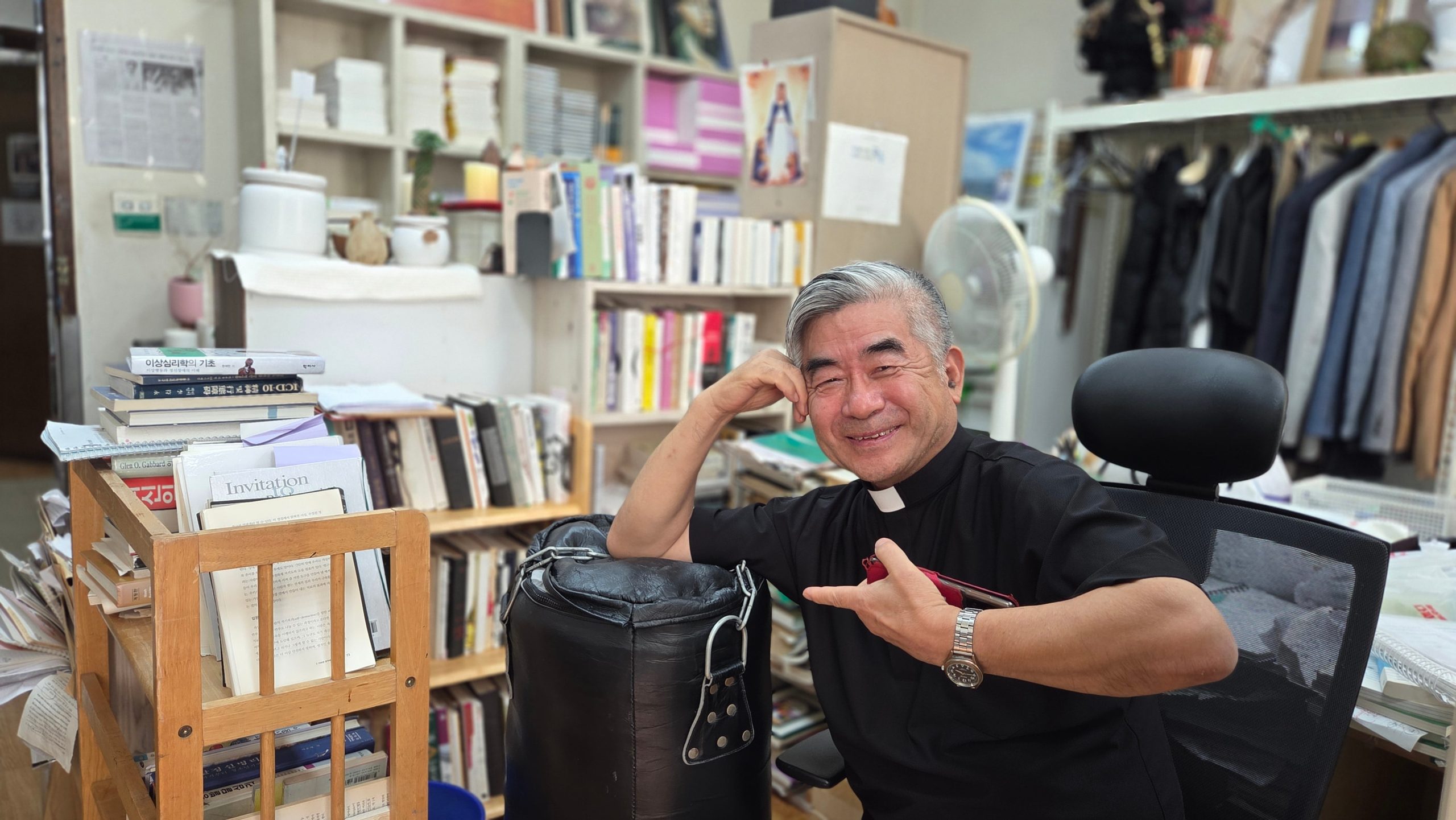
“Everyone is curious about the sandbag, huh? LOL”
This message came from Father Hong Seong-nam, director of the Catholic Spiritual Counseling Center, after I published an article about his new book Until the End, the Heart That Loves Me (Kim Young-sa). The article’s headline was “After Banishing the Psychological Tyrant Within… I Didn’t Hit the Sandbag, I Became Friends with It.” The accompanying photo showed Father Hong in his office, his arm resting on the sandbag and pointing at it with his finger. The focus on the sandbag seemed to have successfully conveyed the article’s message. If we consider intent, Father Hong’s message had properly passed through the journalist to the audience.
My connection with Father Hong began in 2019 with his book Stop Being a Good Person. He was already famous for bestsellers like Only by Shedding and If Angry, Get Angry; If Tired, Rest. His messages are often reflected in his book titles. Typically, religious figures advise, “Endure even when angry.” But Father Hong says, “Get angry when angry” and “Don’t suffer from the ‘good person complex,’ which is counterintuitive. These messages resonated, with many readers saying, “It’s refreshing” or “I feel less guilty.” Thus, Father Hong became a bestselling author, selling tens of thousands of copies with each book. Stop Being a Good Person was no exception.

After that interview, I met Father Hong once or twice a year. We discussed current events, and I often heard how he came to study counseling psychology. I had also heard in advance about his upcoming book. When I finally read it, however, I was shocked. It contained deeply personal stories he had never shared in his books or even during casual drinks. Some passages made me wonder, “Is it okay to reveal this much?” Due to space constraints, the article couldn’t detail these, but here are examples:
In elementary school, I loved drawing, and classmates praised my work. But the teacher didn’t hang my drawing on the classroom wall. Instead, she said, “Seong-nam’s drawing is too dark.”
As a child, I was neither skilled nor talented—just an unremarkable, invisible kid. I had frequent illnesses and spent my boyhood crushed by inferiority complexes. This is the opening episode of the book. I had never heard these stories about Father Hong’s kindergarten and elementary school days before.
Though his teacher didn’t acknowledge his talent, he truly loved drawing and dreamed of becoming a painter. But his father was strict. As a displaced person, his father believed “money is everything.” Thus, Father Hong erased “painter” from his life aspirations.
(pp. 20–21)
However, the gap between his “real self” and “ideal self” (who he wanted to be) led to self-loathing and religious schizophrenia, causing his monastic and seminary plans to collapse.
Before becoming a priest, he even considered becoming a boksu (a shamanic practitioner). I was surprised to read this. After military discharge, he tried various jobs to earn money. Then, introduced by his mother, he met a local shaman. The shaman examined him and declared, “You’re a natural-born shaman. You’ll become a famous fortune-teller at 35.” From that day, the shaman became his mentor. When sick, he avoided hospitals and followed the shaman’s advice to hang thorn branches around the house. Then, at dawn on Christmas Eve at age 26, he had a vision of Jesus—though he hadn’t been near a church at the time. This experience led him to theological college and the priesthood.
After such a turbulent path to priesthood, one might expect a smooth career. But that wasn’t the case. Light and shadow continued to alternate. His first assignment was Jamsil Church, where he received overwhelming love from parishioners, which seemed to purge his psychological impurities. However, at Myeongdong Cathedral, he faced confrontations with leftist activists, and subsequent assignments also brought difficult people and repeated hardships. He repeatedly wondered, “Did I become a priest for nothing?” and “Should I leave?”—struggles identical to those of ordinary working people.
(p. 28)
A priest confessing suicidal impulses—uncommon and difficult.
This was during his tenure as pastor of Gajwa Dong Church. The area was undergoing redevelopment, and the church was being rebuilt. Redevelopment projects are rarely smooth, and the fallout reached the church, making Father Hong’s time there extremely tough. During this period, he encountered counseling psychology. Through therapy, he realized he had been in a state of “psychological constipation” since childhood. By “enema-like” catharsis, he expelled long-accumulated wounds and was reborn.
This is where today’s protagonist, the sandbag, enters. Amid redevelopment, with residents gone and only the church remaining, Father Hong clashed with gangsters and suffered insomnia, skin diseases, and shingles due to stress. Someone hinted, “It might be hwa-byung (fire illness).”
He stopped suppressing his anger and began venting. At night, he roamed abandoned neighborhoods shouting, “You bastards!” and muttered to himself in the church. Parishioners, seeing him muttering alone, joked that he had received the “gift of tongues.” Either way, this helped. Around this time, passing a sports store, he spotted a sandbag and thought, “That’s it.” He bought one about waist-high and placed it between rooms in his residence—to kick or punch when passing by. He visualized faces he hated and kicked/punched the bag. Strangely, though, the sandbag soon faded from his awareness, even though it was deliberately placed in a visible spot. His layered anger had subsided.
The sandbag episode appears mid-book under the subtitle “Shout!” in a section on stress relief. When I read this, I mentally exclaimed, “That’s the photo!” Father Hong always emphasized, “Get angry when angry, hate when you hate,” and the sandbag was the perfect symbolic “prop” to visualize this.

I asked Father Hong about the sandbag’s current location. He said it’s at the Catholic Center in Myeongdong. Originally in his residence, he spent most days at the center, so he moved the sandbag there. Now, when annoyed, he kicks it or lifts it for exercise. I rushed to his office. The sandbag sat quietly next to his desk. A black leather cover featured a dragon design, which looked cute. For 15 years of use, it was surprisingly intact—no torn seams. Father Hong called it a “friend.” Whereas he once hit it while imagining hated faces, he now talks to it like a friend. Thus, the photo captured a hugging pose rather than a hitting one.
Father Hong explained that sharing his vulnerabilities in the book was a counseling technique: “If readers think, ‘Even this person is weak,’ they’ll feel comfortable sharing their own stories.” Many readers reportedly cried while reading Part 1, “Hong Seong-nam, My Story.”
Now we have an additional comfort: thinking of Father Hong and his sandbag. Let’s vent our inner wounds and get angry when angry. Even a priest, who seems to endure everything, hits a sandbag when angry, right?


