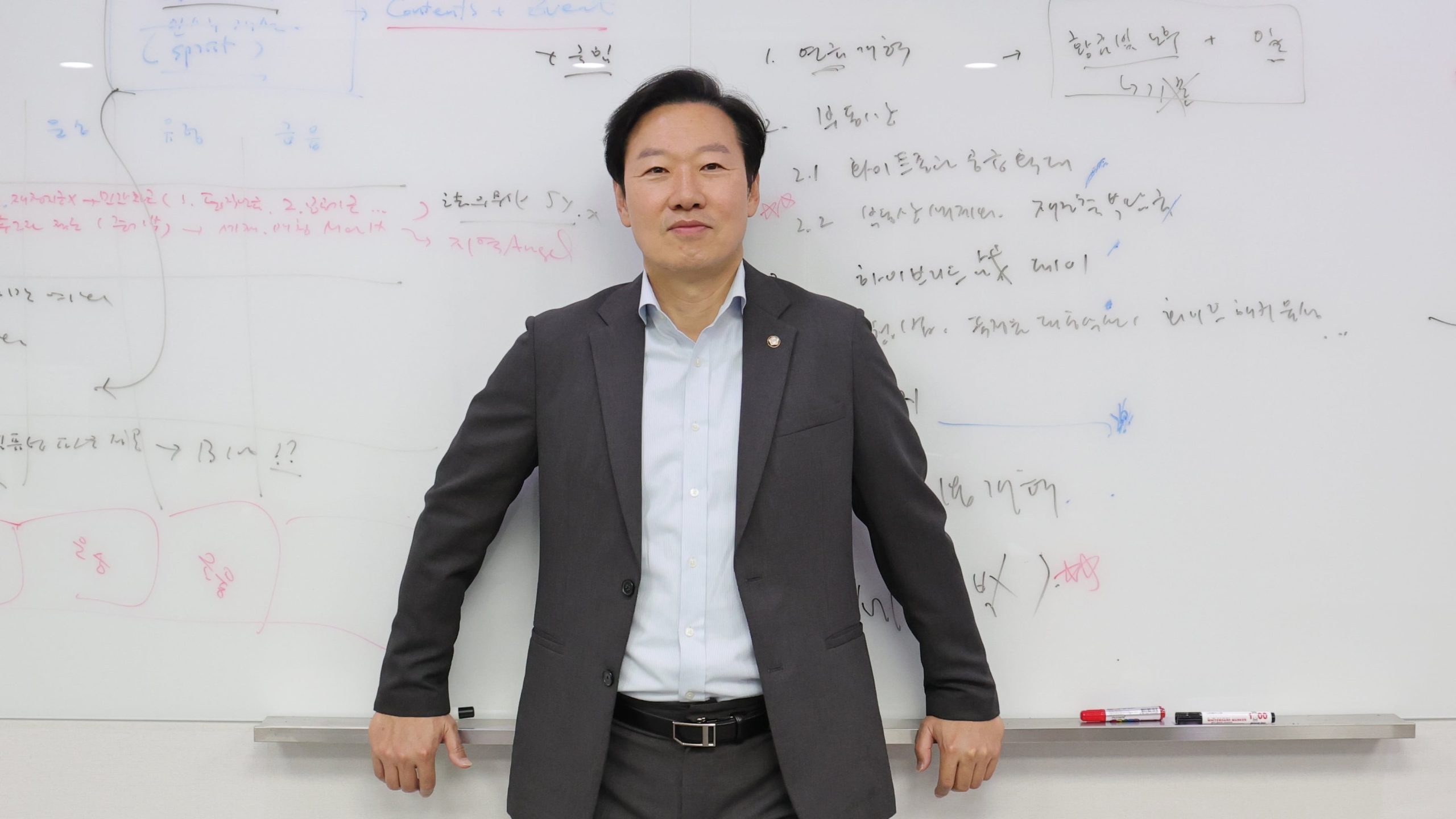

The Filibusterer’s Journey
Sixteen hours into a filibuster, the atmosphere in the National Assembly shifted from words of encouragement for visiting elementary students to tears. Park Soo-min, a first-term lawmaker, urged the children, “Listen to your parents and teachers only half the time. Fill the other half yourself.” He laughed, saying, “I disarm around children,” but the real reason behind his emotional display was different. “I was ashamed of adult politics. Politics is for future generations, yet we’re not even contributing a penny—we’re just fighting and obstructing.”
A former Ministry of Economy and Finance bureaucrat turned successful venture entrepreneur, Park entered politics through a talent recruitment system. He described the past year as “a time spent as a ‘Colosseum gladiator’ in Korean politics, where I must kill my opponent to survive.”
The Colosseum Gladiator
Many citizens first learned of Park Soo-min through his record-breaking filibuster. “I thought my previous record would make this one less newsworthy, but I’m grateful many watched and supported me.” His 15-hour-50-minute filibuster last year against the ‘Universal 250,000 Won Support Bill’ and this year’s 17-hour-12-minute filibuster against the ‘Government Organization Reform Bill’ drew attention. What’s his secret?
“Unity of self, topic, and content. Only then can I speak without noticing time pass (laughs). Both topics were areas I knew well as a former economic bureaucrat, and I had much to say.”
How did he manage bathroom breaks? “They let me go every four hours. I have to hurry back. Human rights are respected (laughs).” What about sleepiness? “5 a.m. is the toughest. That’s why I focus on what I want to say. When children appeared in the visitors’ gallery, I regained strength (laughs).”
He doesn’t drink water. “Water causes bloating and bathroom trips. So I bring crushed candies. Saliva keeps my vocal cords moist and pronunciation clear.” Was abolishing the Prosecutors’ Office the main issue with the government reorganization? “I’m a leading proponent of prosecutorial reform in my party. But you shouldn’t demolish the old house before building the new one.”
He also criticized the Climate and Energy Ministry. “Energy supply functions were placed under a regulatory body. The UK and Germany failed this way. If energy supply focuses on renewables and regulates nuclear power, electricity prices will double. Creating a ministry without public consensus is wrong.”

Jang Seok-ju’s ‘A Single Jujube’
He lamented the National Assembly’s lack of debate. “Changing 13 government organizations required almost no committee discussions. The ruling and opposition parties agreed to negotiate the Government Organization Reform Bill, but the ruling party unilaterally passed it under pressure from hardline supporters demanding a ‘Stronger Special Prosecutors Appointment Act.’”
The ruling party claims the opposition obstructs progress. “How can they obstruct when they haven’t even seen the starting line?” Filibusters can’t stop legislative dominance. Some mock it as a ‘lawmaker endurance test.’
“Filibusters are the last chance to spread better ideas. Like dandelion seeds, changing people’s words and thoughts can transform the world. Whether five minutes or 17 hours, lawmakers must use their time like gold.” He teared up during both filibusters. “Politics is for children. The world faces tariff and AI wars, yet we’re trapped in insurrectionary strife, unable to move forward. I felt ashamed and sorry.”
The National Assembly audit began and ended in shouting. A lawmaker who mocked the Chief Justice as ‘Toyotomi Hideyoshi’ and acted bizarrely received flood of donations. “This reflects excessive proportionality from hardline supporters. Lawmakers must resist YouTube temptations. Build recognition through work, not the other way around. The public is watching.”
Last year, during a filibuster against budget cuts, he passionately recited Jang Seok-ju’s poem ‘A Single Jujube,’ sparking attention. “A jujube contains thunder, lightning, and scorching sun from a year of farming. Similarly, the budget bill reflects complex interests and countless public officials’ efforts. After months of deliberation, the ruling party slashed it like bandits. Isn’t that what thugs do? Though the truth of the martial law hasn’t been revealed, the budget bill was likely the last drop that triggered it.”

The October 15 Real Estate Debacle
The controversy over Choi Min-hee’s wedding gift highlighted that lawmakers should serve, not seek livelihoods. “Absolutely. It also suggests public attention is shifting from the December 3 martial law. Issues like political corruption, judicial suppression, and the real estate crisis—overshadowed by insurrectionary strife—are gaining public scrutiny. Though the audit was chaotic, 107 PPP lawmakers comprehensively raised issues about the Lee Jae-myung administration’s failures, and the public is beginning to notice.”
During the Home Affairs Committee audit, he questioned the president’s ‘48 hours’ during the National Information Resources Service fire. “I didn’t accuse the president of having free time. I asked if he recognized the disaster and strictly supervised and supported the response, regardless of his location. Yet the presidential office’s spokesperson mentioned ‘legal action,’ framing it as political strife. The ruling party blamed the previous administration, but cutting the head of a former appointee won’t fix the system.”
In the Korean National Police Agency audit, he criticized the ‘planned arrest of Lee Jin-sook.’ “I’m not defending the conservative-appointed commissioner. I’m warning that anyone disliked by the regime could face illegal arrest, like this commissioner.”
During the Seoul Metropolitan Government audit, he called the October 15 real estate policy a ‘declaration of war by a leftist socialist worldview.’ “It’s like banning trading of blue-chip stocks. The real estate market began distorting under Roh Moo-hyun’s demand suppression and worsened under Moon Jae-in. The Lee Jae-myung administration, which should have learned from this, implemented the most extreme demand and loan suppression. South Korea has relied on market-driven real estate supply. Eliminating the market suggests a shift to socialism, where the public finances and distributes housing.”
Is there no solution? “Would imposing holding taxes on Samsung Electronics stock stabilize its price? Preventing excessive home price hikes requires steady supply and urban planning. Continuously creating alternative cities comparable to Gangnam will shift money to stock investments—a ‘money move.’”

Spring Water Under Ice
Why isn’t the People Power Party’s approval rating rising? “Disintegration is a condition for reconstruction, and winter is a time to await spring. I believe spring water flows under the ice.”
Local elections are near. “Winning is the goal, but we must also establish a 100-year vision to reorganize our path and nurture talent to avoid repeating mistakes.”
The support base is divided. “I believe hardline and moderate factions can coexist within constitutional values. Conservatives have unifying points: security and future generations.”
Will moderates accept Jeon Han-gil? “I sense his sincerity toward conservatism. Russell Kirk defined conservatism as norms, prudence, and restraint from passion and power. I hope for politics of tolerance and inclusion.”
Many worry about Jang Dong-hyeok’s leadership. “It’s too early to evaluate. However, a second-term young politician becoming leader itself is a major change and step forward. He’s making efforts to unite the right. I believe he’ll navigate this survival struggle well.”
A Better Capitalism
Why did he leave his promising Ministry of Economy and Finance career? “I hated how each new president didn’t ask, ‘How can the economy grow?’ but instead ordered, ‘Do this’ (laughs).”
He was in his early 40s. “I married late, and my children were born one after another. A civil servant’s salary wasn’t enough. I received offers from conglomerates but chose the ‘road without a map’ as corporate culture didn’t suit me.”
He succeeded in the biomedical field. “I ate many ‘teary breads.’ I often advise against inexperienced startups. I worked as a bureaucrat, handled overseas projects during Lee Myung-bak’s resource diplomacy, and studied biomedical fields thoroughly. Jumping into unfamiliar areas, no matter how praised, is risky.”
Which was hardest: bureaucrat, entrepreneur, or politician? “Politics, obviously. Bureaucrats need expertise and loyalty; entrepreneurs need perseverance and experience. Politics is a comprehensive art requiring all that and more—dealing with human desires and emotions (laughs).”
He has five children. “My mother’s belief was that raising two sons and one daughter felt too few. Thankfully, my wife and I work well together (laughs). It’s noisy but expensive.”
His family motto is ‘A Better Capitalism.’ “I don’t believe in ‘earn like a dog, spend like a minister’ capitalism. I trust a capitalism where everyone is happy.”
Is he considering the next general election? Will he run in a tough district? “Too soon to ask. My district, Gangnam, has severe polarization. I came to the National Assembly to break this trap. I wanted to create laws ensuring investment and capital gains are fairly distributed through pension and tax reforms, so growth benefits all. But the martial law and impeachment turmoil left no room. I’ll devote my remaining three years to finishing this task.”
To President Lee Jae-myung: “One of Kim Dae-jung’s strengths was avoiding political retaliation. Regimes relying on investigations always fail. It’s not too late.”
Park Soo-min
Born in 1967 in Seoul. Graduated from Soongmoong High School and Seoul National University’s College of Business Administration, then earned a master’s in business administration from the same university. In 1992, he passed the Grade 5 civil service exam in the tax administration track. During the Kim Dae-jung and Roh Moo-hyun administrations, he innovated national budgeting and fiscal systems at the Ministry of Planning and Budget. During Lee Myung-bak’s presidency, he was dispatched to the presidential office, handling K-nuclear projects like the Korea-UAE joint venture. After serving as a European Bank for Reconstruction and Development director, he founded a biomedical venture. He was elected to the National Assembly for Gangnam-gu in the 22nd general election.


