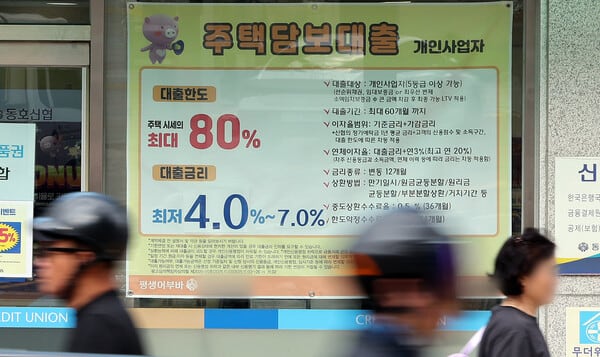
Financial authorities have decided to encourage banks to launch new long-term fixed-rate mortgages (fixed for over 10 years) within this year. The aim is to reduce the risk of a sharp increase in interest burdens for variable-rate borrowers during periods of rising rates. However, the 10-year cycle mortgage introduced in 2024 had higher interest rates than variable or 5-year cycle products, resulting in average monthly sales of less than 1 billion Korean won.
Analysts say the success or failure of this renewed attempt will depend on how much interest rates can be lowered. If banks fail to reduce long-term interest rate risks and funding costs, as seen in the US and Japan, the failure of two years ago could be repeated.
According to financial authorities on the 8th, the Financial Services Commission announced in a joint plan with related ministries titled *Measures to Support Vulnerable Borrowers in Preparation for Rising Interest Rates* that it would “encourage banks to launch their own pure long-term (over 10 years) fixed-rate mortgages in the second half of this year.”
Currently, most bank mortgages are either variable-rate loans where interest rates change at fixed intervals, hybrid products that fix rates for five years before switching to variable rates, or cycle-type loans where rates are reset every five years. Products with rates fixed until the maximum maturity of 50 years are limited to policy finance such as the *Bogeumjari Loan*.
◇Introduced two years ago but failed to reach 1 billion Korean won monthly
Long-term fixed-rate mortgages are not a new concept in South Korea. Shinhan Bank and the Industrial Bank of Korea launched a product with rates fixed for 10 years in 2024 and are still selling it. However, sales have reportedly averaged less than 1 billion Korean won per month.
The main reason was interest rates. Since the rates for 10-year fixed products are higher than other mortgage products, consumers chose options that save them interest now rather than avoiding future rate hikes. As of the 7th, Shinhan Bank’s 6-month variable-rate mortgage rate is 4.28–5.69% annually, while the 10-year fixed-rate product is 5.19–6.6% annually.
The higher rates for long-term fixed products stem from the increased funding burden on banks when rates are fixed. According to the Korea Financial Investment Association, as of the 7th, the rate for 6-month bank bonds (AAA) is 3.52%, while 5-year bonds are at 4.454% and 10-year bonds at 4.816%. Over the past two years, the rise in rates was also greater for 10-year bonds (1.457 percentage points) than for 6-month bonds (0.98 percentage points).
A banking sector official said, “While applying the same rate to customers for a long period, the bank’s funding costs may vary according to market rates, and that risk is reflected in the loan rates.”
The banking sector estimates that to fix rates for 40 years based on current market rates, the lower end of the rate would form in the early 6% range annually. With variable products’ lowest rates in the 4% range, analysts say it’s difficult to attract consumer choice.
◇Borrowers flock to ‘cheaper for now’ variable rates
Nevertheless, financial authorities are reviving long-term fixed products because borrowers are flocking to variable rates, which are currently lower. As of the 7th, variable-rate products from the five major banks—KB Kookmin, Shinhan, Hana, Woori, and NH Nonghyup—have rates 0.78 percentage points lower than fixed products at the upper end. In July, the proportion of new mortgages with variable rates reached 68.1%, the highest in 12 years and five months since February 2014.
The issue is that rate hikes are set to accelerate. While variable products save interest now, loan rates will also rise if market rates increase. The Bank of Korea raised the base rate in July for the first time in three years and six months, followed by another “back-to-back” hike in August. Major investment banks like JP Morgan predict the current 3% base rate could rise to 3.75%.
Switching to other products late is also difficult. The five major banks charge early repayment fees of 0.55–0.95%, and borrowers must endure at least three years of rate fluctuations to be exempt.
A source from the Financial Services Commission said, “If rates rise, variable-rate loans could increase borrowers’ repayment burdens, leading to delinquencies or defaults.” The aim is to broaden consumer options by launching products that fix rates for long periods to reduce interest rate risks.
◇US dominates with 30-year fixed rates… Banks don’t hold loans long
Overseas, structures where banks don’t bear all the interest rate risks of long-term mortgages support the spread of fixed rates. According to the International Monetary Fund (IMF), the share of fixed-rate mortgages (as of 2022) was 95.3% in the US, 99.6% in Mexico, compared to 34.9% in South Korea. Typical fixed-rate periods are 30 years in the US and Mexico, 20 years in the Czech Republic, 15 years in Colombia, and 10 years in Belgium and Japan.
In the US, banks don’t have to hold mortgages for 30 years. Housing finance agencies like Fannie Mae and Freddie Mac purchase mortgages from banks, securitize them into bonds, and sell them to investors. Banks can recover loaned funds for re-lending and avoid long-term interest rate risks.
Japan also operates the *Flat 35* product, a fixed-rate mortgage for up to 35 years, through government agencies purchasing or guaranteeing bank mortgages. In contrast, domestic banks often directly hold mortgages funded by deposits and bank bonds, making it relatively difficult to fix rates for over 10 years.
◇Ultimately, narrowing the rate gap is key… Reducing funding costs
Experts say the key to establishing long-term fixed products domestically is to lower banks’ funding costs and narrow the interest rate gap felt by consumers. Proposals include utilizing low-cost deposits, such as salary or checking accounts that maintain relatively stable balances even at low rates, and filling gaps with long-term funds like covered bonds.
Seo Ji-yong, a professor at Sangmyung University’s Business Administration Department, said, “Activating a mortgage-backed securities (MBS) market like the US could reduce both banks’ interest rate risks and consumer burdens.” He added, “There is a need to incentivize fixed-rate loans by providing benefits under the stress debt service ratio (DSR) for fixed-rate borrowers.”
- 월 5900원 멤버십, 신문 독자에게는 2900원, 조선멤버십
- 55000원 상당의 신문-잡지 8종 마음껏 보기, 조선멤버십
- 현금처럼 쓸 7000포인트 받아 알뜰한 쇼핑, 조선멤버십

Related posts:

Fiction park: He was the best in class. He still wasn’t good enough

Gagan Thapa takes oath as Congress president, vows to regain public trust

Inside knowledge that has locals gripped by fear after gran’s body found decomposing in cattle dip

New property purchase disclosure rule in Japan sparks fears it may curb foreign investment

Dino-mite treasures: inside Singapore’s Fort Knox storing playthings of ultra-rich