A New Stage for the Yellow Vests
France’s anti-government “yellow vest” protests, once a dominant force in public discourse, have faded from the headlines. However, a theater group in northern France is reviving the spirit of those protests, capturing the political tension, anger, and unity that defined the movement.
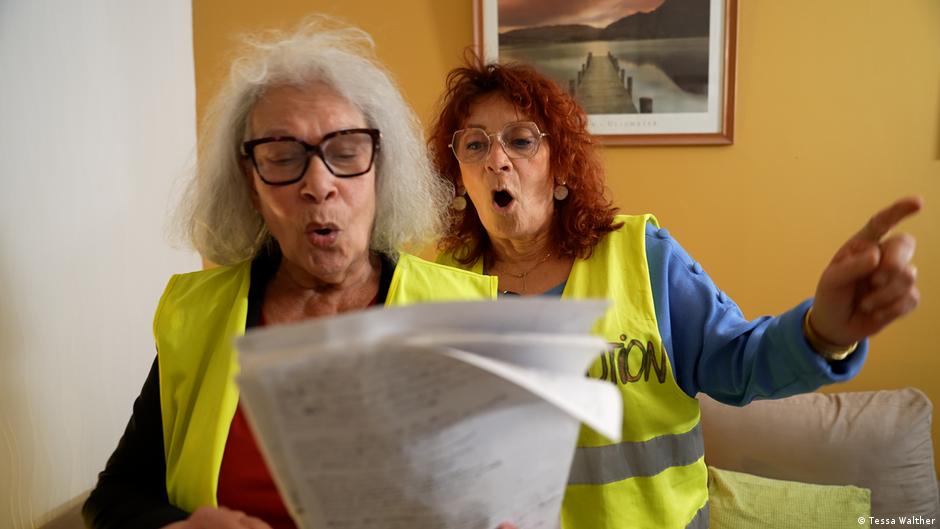
On a Sunday afternoon, ten individuals gather for a theater rehearsal in a community hall in Lille. These amateur actors didn’t meet through the arts scene; they came together during the yellow vests protests. The grassroots movement reached its peak in 2018 and 2019 when protesters wearing high-visibility yellow vests blocked streets across France in response to fuel tax hikes meant to support climate initiatives. Although the movement has since diminished, with smaller local actions still occurring, the larger demonstrations have largely ended.
Yet, many participants remain deeply affected by their experiences. One such individual is Marine Guilbert, a 66-year-old woman who arrives at the rehearsal with a shiny yellow vest visible beneath her backpack. On it, she has written “fiere d’etre un gilet jaune” — “proud to be a yellow vest” — accompanied by two butterflies she painted herself. Another actor jokes that she probably even wears the vest to bed.
A Movement That Still Resonates
At the height of the yellow vest movement, some protesters rallied peacefully, while others engaged in more aggressive acts, including throwing smoke bombs, looting shops, and burning barricades. French police responded with water cannons and tear gas, leading to accusations of excessive force. According to data from Mediapart, the clashes resulted in four deaths and hundreds of injuries.
Seven years later, Guilbert remains angry about the state of affairs in France. She earns less than €1,000 a month as a cleaner and relies on financial support from her son and charity food packages. She feels abandoned by the government, which is why she and her fellow actors are using theater to express their frustrations.
Guilbert can’t recall the last time she attended a play, noting that it was too expensive. Now, she says, she doesn’t need professional shows anymore. “We were born artists,” she confidently states.

The theater group was founded by Anne-Sophie Bastin, a lawyer and former yellow vest from Lille. “We witnessed so much violence and injustice by the police that we decided to reflect it on stage,” Bastin explains. She writes the scripts, directs the plays, and leads the group. The group first performed in 2019 with a play about the yellow vests themselves. Their new production, set to debut at the end of November in a 400-seat theater in Wasquehal, focuses on Bobby Sands, an Irishman and member of the Irish Republican Army who died on hunger strike in 1981.
Bastin sees Sands as an inspiring figure, despite his controversial status. She notes that the yellow vest movement was leaderless, and now she is the one in charge. During rehearsals, she intervenes when actors interpret the script differently, reminding them, “It is me who wrote this script.”
Initially, the group consisted solely of yellow vests, with around 40 members. As members left, the group expanded to include friends and family, now totaling 15 members.

France’s Ongoing Crisis
A new protest movement, “bloquons tout” or “let’s block everything,” has recently taken the spotlight as France continues to face multiple crises. A survey by Le Monde found that 96% of respondents were unhappy with the country’s state of affairs.
One of the theater group members, pensioner Yolaine Jean Pierre, composes protest songs in her free time. On the day of the rehearsal, she wears a badge featuring a yellow vest and a red heart. When she sings one of her songs, the others join in, creating a catchy tune that lingers in the ears. The lyrics consistently blame President Macron for France’s problems.
Political scientist Julien Talpin from the University of Lille points to structural issues within the French political system. “As the French political system is no longer able to address inequalities, anger is being expressed in other ways,” he explains.
Macron faces challenges in gaining parliamentary support for crucial reforms, and efforts to reduce the national debt have met with public backlash. A recent report by France’s Inequality Observatory highlights a 20-year rise in poverty rates.
Despite these challenges, change seems difficult to achieve. Experts suggest that replacing Macron could lead to the far-right National Rally party taking power.
Voices for Change
In the Lille community hall, most of the actors argue that Macron’s resignation is overdue. Jean Pierre doubts it will happen, quipping that Macron believes himself to be “God.” Another actor suggests that little would change regardless of who is in power, noting that Paris feels distant.
Guilbert channels her hopes for change into theater, expressing a desire for her voice to be heard both on the ground and on stage. Jean Pierre’s eyes light up when discussing the group, emphasizing the unity among its members. “We fight the same fight,” she says. “We think the same. There is unity.”


