The Global Water Crisis: A State of Bankruptcy
The concept of the boiling frog, where a frog is slowly cooked in water that is gradually heated, has become increasingly relevant to the global water crisis. What was once seen as a manageable issue has transformed into a shocking realization of irreversible depletion on a planetary scale. According to a recent report by the United Nations University (UNU), we have now entered a state of global water bankruptcy. This term refers to a situation beyond mere water scarcity—a term often used to describe limited availability of water—into a condition where local hydrological systems have reached a point of collapse, making it impossible for them to return to their previous state.
Decades of overuse and exploitation of water sources, coupled with erratic precipitation patterns and rising temperatures, have pushed hydrological cycles beyond their limits. As a result, the ability of rivers, lakes, groundwater reserves, soil moisture, and glaciers to replenish themselves has been significantly reduced.
Global Scenario
The report highlights that many rivers around the world no longer reach the sea for significant parts of the year. Over 30% of glaciers that contribute to river flow during the spring have vanished. Large lakes are also drying up, affecting a quarter of the global population that relies on them. At the same time, the soil’s capacity to hold water has declined due to unchecked erosion and land degradation.
To understand the scale of this issue, consider that the loss of terrestrial water from sources like soil moisture and groundwater between 2000 and 2016 amounts to about 40% of the combined ice melt from Greenland and Antarctica during the same period. The loss of terrestrial water is particularly concerning because it is not easily reversible. Replenishing it may require above-average precipitation for over a decade, which is unlikely given current climate trends.
In many regions, the term “water crisis” is no longer sufficient. While a water crisis can generally be addressed through effective policies and timely actions, the losses described in the UNU report cannot be reversed within our lifetime.
Nepal’s Context
Nepal has experienced drastic changes in rainfall patterns over the years. Instead of the traditional low-intensity continuous rain known as “jhari,” monsoons are now dominated by short, high-intensity localized rains, leading to increased debris flows and floods. These changes have also significantly reduced groundwater recharge.
Saune mool, or springs that appear in August at higher elevations when aquifers are replenished, have gradually disappeared over the last three decades. Consequently, streams and springs at lower elevations have started to dry up.
A 2022 national survey conducted by the government revealed alarming data about droughts and depleting water sources. Approximately 43% of households across the country reported that their streams and rivulets had completely dried up, with higher percentages in certain regions. For instance, 57% of households in the hills, 30% in the Tarai, and 77% in the hills of Sudurpaschim Province reported the same issue.
Natural springs serve as the primary water source for millions of people in mountainous areas. However, nearly 55% of surveyed households reported a decrease in spring and well discharge over the years. In some regions, such as Koshi, Karnali, and Sudurpaschim provinces, more than 75% of households reported complete drying up of these sources.
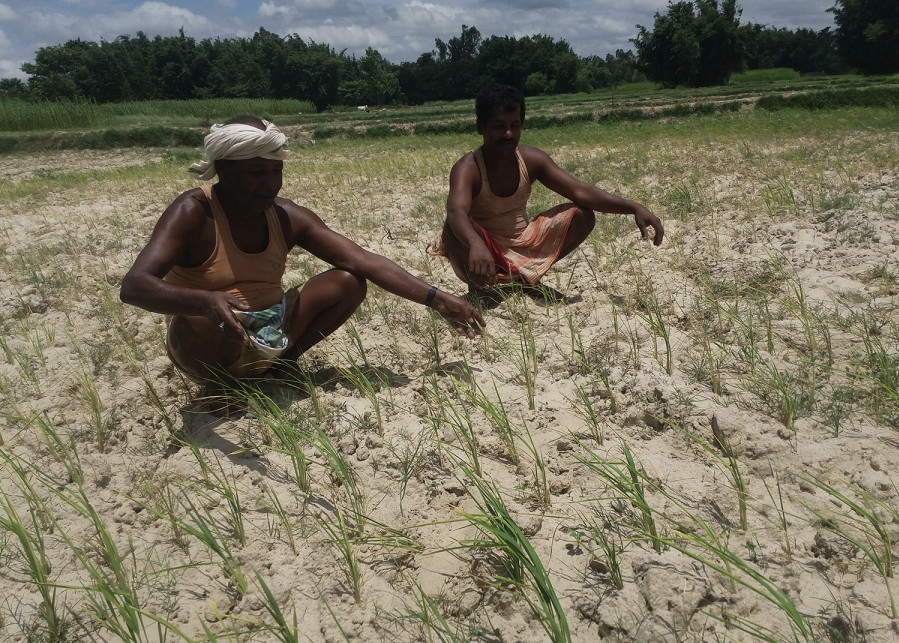
Groundwater remains the only reliable source in the Tarai region, but it is also depleting rapidly. A six-week delay in the monsoon in 2025 forced both federal and provincial governments to declare the area drought-stricken, as farmers could not plant paddy on time. People had to rely on distant sources for domestic use.
Dry winters have added to the challenge. Most parts of the country east of the Karnali Basin are experiencing their fifth consecutive dry winter. According to the Department of Hydrology and Meteorology (DHM), the likelihood of below-normal rainfall for the 2026 winter has increased to 65%, especially in the hills of Koshi and Sudurpaschim provinces.
Pressing Questions
The decline in local water sources raises critical questions. Can we revive lost springs using existing policies and knowledge? Can we replenish groundwater in the Tarai region, restoring it to a depth of 40 feet from its current level of 200-300 feet? Will the dried-up streams in the hills flow again? And, most importantly, can we stop existing water sources from further decline?
If we fail to address these issues, we risk following the path of countries like Iran, where water bankruptcy is already a reality. For many households in the hills and those in the Tarai region, water bankruptcy is not an impending threat—it is already here.
This situation serves as a lesson for all, especially political leaders aiming to bring change. Despite global efforts since the Earth Summit in 1992 and the emphasis on sustainable development goals, the ongoing water bankruptcy suggests that these initiatives have not been effective enough.
Our water policies must shift from reactive measures to proactive strategies that tackle the root causes of the problem. Water management must address both floods and droughts simultaneously, as failing to do so will only worsen these issues.
Addressing water concerns could help bridge divisions in national politics, offering a common ground that affects everyone. In this context, the looming water bankruptcy should become a shared agenda for all political actors in the upcoming elections. How urgently and effectively this happens will determine how we cope with the water bankruptcy we are slipping into.