The Dangers of Reckless Bets and Stunts
From weightlifting stunts with bags of cement that go horribly wrong, to drinking sprees that end in sudden collapse, many Nigerian youths are lured into dangerous, reckless bets and contests by the promise of quick cash, flashy phones, and attaining fleeting social media fame. These challenges often begin as harmless jokes but quickly escalate into life-threatening situations.
On Sunday morning, September 28, thousands of users were jolted by two disturbing video clips that quickly went viral. As the footage spread, it drew gasps, grimaces, and a flood of reactions from viewers who could hardly believe what they were watching.
In one of the clips, a shirtless young man in dark blue trousers, identified simply as Gbenga, was seen standing at the narrow gated entrance of a building with three other young men, in what appeared to be a high-stakes challenge. “Are you afraid of lifting the cement?” a snarky male voice speaking in Yoruba could be heard in the background as one of the men placed a bag of cement on Gbenga’s head. The young man staggered slightly as his friends added another bag. “He say he wan carry five bags of cement on his head, na there we dey so. The matter cast o,” the narrator behind the camera was heard saying in Pidgin English.
When a third bag was stacked on Gbenga’s head, he strained visibly under the load, swaying from side to side. His friends and the narrator responded with laughter. Moments later, after a fourth bag was carefully hoisted onto his head, the reckless contest turned tragic. Gbenga’s knees buckled, his body quivered under the crushing weight, and within seconds, he lost balance, crashing helplessly to the ground.
At first, the bystanders, believed to be his friends, burst into raucous laughter, treating the collapse as part of the spectacle. But the three-minute, 25-second video quickly took a disturbing turn. Gbenga writhed on the concrete floor, clutching at the air, his face contorted in visible agony as he struggled to breathe, unable to stand. “Bring water, let’s pour water on him,” one of the friends shouted in Yoruba, panic creeping into his voice. When a bystander tried to lift him, Gbenga’s arms flailed weakly, his movements uncoordinated, his body alarmingly limp.
Within moments, more people rushed into the scene, dragging him to a corner of the compound, frantically dousing him with water in a desperate attempt to revive him. In a second clip, also shared on X by the chairman of the Ray of Hope Prison Foundation, Sir Sean (@seanpepisky), Gbenga was seen sitting on the floor, unable to speak, while his friends mocked his failure to carry five cement bags.
Although Saturday PUNCH could not independently verify the exact location of the incident, the Yoruba dialect spoken in the video bore a striking resemblance to that commonly spoken in Owo, Ondo State.
Phones Promised as Reward
Providing more context, Sir Sean described the ill-fated double dare as a “careless moment” that began as a harmless joke on September 20, the day the incident occurred. “It started as a joke last Saturday, a simple dare among friends: ‘Who can carry four bags of cement?’ The prize? Their phones. Just phones. One bag of cement equals 50kg. Four bags equal 200kg. That’s almost three times the weight of an average man. Gbenga, full of energy and ego, stepped forward. He lifted, but his body couldn’t take it. In seconds, he collapsed; his spine and nerves gave up on him. They poured water on him. He tried to move, but he couldn’t. He tried to speak, but his words weren’t audible enough. He lay there even while they tried pulling him up. By Wednesday, Gbenga was gone. A mother lost her son. A family lost their future. Friends lost a brother. All for a bet; all for a moment of clout. Dear youths, this is not bravery. This is not entertainment. This is not masculinity. This is suicide in disguise,” he wrote.
Medical Experts React
Explaining what possibly happened to the victim, physiologist Ifeoluwa Ojo said the video suggested Gbenga’s neck suffered a fracture caused by the extreme weight. “From what could be seen in the video, the man was struggling to breathe due to a possible dislocation of the cervical vertebra. This may have caused compression of the phrenic nerve, which is responsible for lung expansion. I think he suffered respiratory failure at that moment, and what the bystanders should have done was lay him flat and put a neck collar to immobilise his neck, that is, if they had any medical personnel available. It’s sad that they stood there in the footage, laughing at him, and were even pouring water on his head, which does nothing to help his condition. If they had taken him to a hospital, they would first check Genga’s oxygen saturation and administer oxygen immediately. They would conduct scans to know what part of his body was affected,” he told Saturday PUNCH.
Also speaking, a senior medical officer, Dr Paul Anejodo, noted that carrying very heavy loads on the head poses serious risks. “This could lead to instability and falls, which carry a great risk of injury such as spinal damage, muscular injury, and fractures. Chronic heavy load carrying can also cause osteoarthritis and degenerative spine diseases. Some research shows it could even distort a child’s development in terms of height growth and intelligence,” he told Saturday PUNCH.
Extreme Bets
Findings by Saturday PUNCH revealed that the dangerous “cement bag challenge” attempted by Gbenga in the viral video was not an isolated stunt but one that had been flaunted by other social media users in the past. Using Yandex AI, our correspondent traced several images of Nigerian and Ghanaian labourers, as well as stunt performers, hoisting cement bags for the camera. While some of the images appeared authentic, others seemed to have been digitally altered to exaggerate the feats.
In one video posted on Facebook by Friyo Official on September 20, a manual labourer was captured offloading four heavy bags of cement from the back of a truck stacked to the brim. Another clip, shared by Oduri Chidera on August 15, showed a man using a piece of cloth tied together to haul several cement bags onto his back. The caption boldly declared: “The first man to carry seven bags of cement in Nigeria.”
Across generations and cultures, dares and wagers have long served as a way of testing bravery, strength, or luck, particularly among young men. But in the age of hyper-connectivity, where a viral clip can briefly turn anyone into an Internet sensation, the pressure to attempt dangerous stunts has escalated dramatically. For many, a single reckless challenge, framed as a bet and filmed for an audience, is no longer just entertainment but a test of pride. Refusing such dares risks being branded a coward.
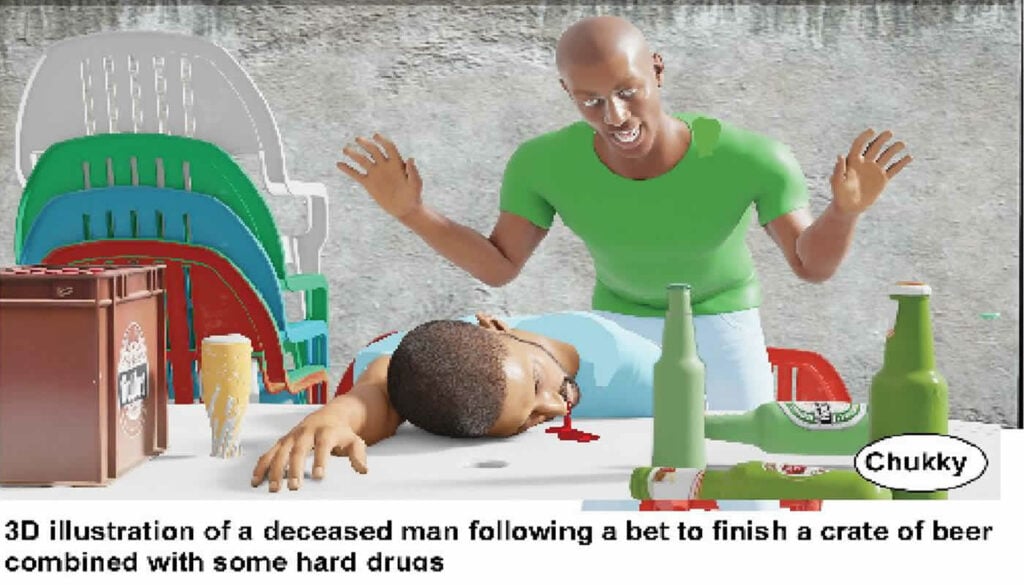
Driven by the thrill of admiration, peer respect, potential rewards, and fleeting online fame, these challenges often spiral into alarming extremes: young men gulping down bottles of alcohol in one sitting, labourers straining to lift weights far beyond their body’s capacity, or contestants choking themselves with food, all for cheers, claps, or clicks.
It was gathered that these stunts, often depicted as competitions, are normalised by their viral circulation on social media, which encourages others to attempt them.
Death by Alcohol
An engineer, who identified himself only as Peter, recalled a chilling incident in December 2022 at a private hospital in Port Harcourt. He said that while he was waiting at the emergency ward, an unconscious young man was rushed in. “He had made a reckless bet to finish an entire 70cl bottle of Red Label whiskey in one go,” Peter explained. “Eyewitnesses said he downed two heavy gulps in less than two minutes before collapsing. By the time his friends brought him to the hospital, he was already dead.”
For Peter, the most haunting part was not just the senselessness of the act but the thought of those who pushed him into it. “I am certain the same friends who dared him are alive today, going about their normal lives,” he added bitterly.
That tragedy was not an isolated case. On December 28, 2021, an X user, Joseph Barnabas, recounted how an alcohol-drinking competition in his Kaduna neighbourhood ended fatally. Contestants were urged to drink four bottles of gin, each with an alcohol concentration of between 36 and 50 per cent, in exchange for a cash prize. “You were dared to drink four bottles of gin and get N20,000,” Barnabas wrote. “One guy was on his fourth bottle when he slumped and died on the spot.”
Years earlier, in 2016, a father of two in Abeokuta, Ogun State, met a similar fate after accepting a dangerous challenge. The man, Prosper Oyinfade, joined friends in a neighbourhood celebration that quickly spiralled into a deadly wager. Oyinfade, a 34-year-old known for taking outrageous bets, was dared to finish 10 bottles of a herbal alcoholic beverage, each with an alcohol volume of 43 per cent. He and his challenger staked N10,000 each on the outcome. After consuming more than five bottles, his body began to give way; he collapsed three times before nightfall, vomiting violently until his face and clothes were soaked. By the next morning, despite his sister’s frantic efforts to save him, Oyinfade was dead. The drink that cost him his life was sold for just N350 per bottle.
Experts warn that such reckless binge drinking is a ticking time bomb. A medical expert, Dr Tobi Omoleye, explained that consuming large amounts of alcohol within a short period could trigger Holiday Heart Syndrome. “It is characterised by cardiac rhythm disturbances in people without prior heart problems,” Omoleye said. “It happens when excess ethanol and its metabolites overwhelm the body. While the condition is reversible once the drinking stops, its symptoms, which include palpitations, dizziness, and shortness of breath, can quickly escalate and, in some cases, prove fatal.”
Another medical officer, simply identified as Dr Anejodo, stressed that alcohol attacks the human body in multiple ways, damaging vital organs. “Too much alcohol at once can cause loss of consciousness, coma, and even death,” he warned. “It can impair sensation to the point where someone might step on nails or sharp objects without realising it. Beyond the immediate risks, alcohol corrodes the intestinal walls, causes bleeding ulcers, damages the liver, leading to liver cancer or failure, and destroys brain cells, which impairs memory, judgment, and decision-making. It even inflames the pancreas, sometimes leading to diabetes.”
From Kaduna to Port Harcourt, and Abeokuta to countless unnamed corners of Nigeria, stories like these highlight a grim reality: for the thrill of a dare or the promise of a small cash reward, lives are being cut short, families shattered, and caution thrown recklessly to the wind.
“It weakens the immune system, making individuals prone to infections, and interferes with bone development, leading to easy fractures and deformities. Alcohol also causes hypertension, an enlarged heart, and heart failure, and the list goes on. Whether consumed acutely or chronically, alcohol does more harm than good and should be strongly discouraged,” Dr Anejodo further warned.
Highway to the Grave
In August, tragedy struck in the Ipara area of Remo, Ogun State, when a car race wager ended in disaster, leaving five participants and two residents dead. A community source disclosed that suspected Internet fraudsters, popularly known as Yahoo boys, had organised the deadly race with a N30,000 prize for the winner. During the contest, one of the drivers reportedly lost control and rammed into a nearby shop, killing two bystanders instantly. The source added that the driver and two other occupants of the vehicle were trapped and sustained severe injuries before being rescued and taken to separate hospitals.
Confirming the incident, the spokesperson for the Ogun State Traffic Compliance and Enforcement Agency, Babatunde Akinbiyi, said the driver died on the spot, while the two surviving occupants were hospitalised with varying degrees of injuries.
In another bizarre twist of a bet gone wrong, in July 2022, a farmer in Dukku Local Government Area of Gombe State, simply identified as Abba, died after allegedly overdosing on drugs. He was said to have swallowed 50 tablets of Exol in a bet with unidentified individuals. Sources claimed the deceased had been a habitual substance abuser before the fatal dare. According to one account, Abba had approached the man who initiated the bet, asking for drugs before going to his farm. “When he was handed 50 tablets of Exol, he swallowed them all at once and proceeded to the farm. Not long after he began working, he started vomiting uncontrollably. He was rushed to a clinic, where he was pronounced dead,” a source recounted.
Online Validation Fuelling Deadly Bets
Speaking with Saturday PUNCH, a certified psychotherapist, Adebisi Jacob, noted that a craving for validation and belonging is driving young Nigerians into extreme and life-threatening bets. “Many young people live in a highly competitive environment where social media shapes identity. The applause, likes, or quick recognition they get for daring acts often feels like a shortcut to relevance,” he explained. “For some, these extreme risks are not about money but about being seen, acknowledged, and celebrated. Add to that the economic desperation and hopelessness around, and it becomes clearer. When legitimate opportunities feel scarce, dangerous stunts, gambling, internet fraud, or risky bets seem like the only way to ‘blow.’ The thinking is: if one dangerous act can bring quick cash or instant fame, it feels worth more than years of grinding without recognition, especially in a society where wealth and material success define self-worth.”
Jacob further highlighted the role of peer pressure and group psychology, noting that many youths are often goaded into such stunts by friends or online audiences. “The fear of looking weak, timid, or ‘broke-minded’ pushes them to override basic instincts for self-preservation. In psychology, we call this risk normalisation. The more they see others doing it, the less dangerous it seems, until tragedy strikes. There’s also the issue of limited coping skills for stress and frustration,” Jacob added. “Many young people are wrestling with unemployment, family pressures, and the harsh realities of daily survival. Without healthier outlets such as sports, creativity, or community engagement, they channel their restlessness into dangerous activities that promise excitement and quick relief. So, it is not just about ‘youths behaving recklessly’; it is the collision of psychological needs (validation and belonging), social dynamics (peer pressure and online applause), and systemic issues (poverty, unemployment, and lack of opportunities). If we are to address it, interventions must go beyond mere preaching,” the certified physiotherapist stated.
He also urged the government and stakeholders to provide “community-driven mental health awareness, mentorship programmes, and platforms where young Nigerians can gain recognition, purpose, and even income in safer, healthier ways.”
The Executive Director of Lighted Pearl Africa Foundation, Moses Okenla, also called on relevant stakeholders to expand youth access to technical and vocational skills as part of efforts to enhance employability across key sectors. “There is no denying the fact that Nigerian youths are zealous, hardworking, and eager to take on new challenges. This drive should be channelled into healthy pursuits. Youths need skills to enable them to contribute meaningfully to the economy. Both the private and public sectors must work together in developing these skills. Working in isolation will only bring minimal impact in the fight against youth unemployment. The resilience of Nigerian youths, often displayed through social media wagers and stunts, shows that many simply need the right vocational and digital skills, and proper sensitisation, so they do not risk their lives for money, phones, or fleeting online fame,” Okenla said.


