The Struggle for Transparency and Aid in the Aftermath of Protests
Two months after the start of various fundraising campaigns aimed at supporting victims of the Gen Z protests, many individuals and families affected by the events are still waiting for assistance. Despite efforts from numerous individuals and organizations, particularly those based abroad, the lack of transparency in these crowdfunding initiatives has raised concerns about how funds are being collected and distributed.
Crowdfunding platforms have become a primary tool for raising money, with over 100 active fundraisers identified. These campaigns are primarily led by Nepalis living overseas, non-resident associations, student groups, and clubs. However, the lack of clear information on the amounts raised, the organizers, and the distribution of funds has left many questioning the effectiveness of these efforts.
Among the 107 fundraiser accounts created after the protests, 57 set a total target of Rs102.8 million, with Rs25.87 million raised so far. The remaining 50 accounts show no contributions. These campaigns are being run from countries such as Australia, the US, Belgium, and Canada.
Some of the most notable campaigns include:
- A GoFundMe campaign targeting 441,700 Australian dollars, which has raised 187,690 so far.
- A campaign aiming for $318,101, with $51,785 collected to date.
- Another targeting 41,700 pound sterlings, having raised 5,653.70.
- A campaign seeking 34,800 euros, with only 1,658.77 Euro collected.
- A Canadian dollar-based initiative aiming for 55,000, but having received only 3,452.09 Canadian dollars.
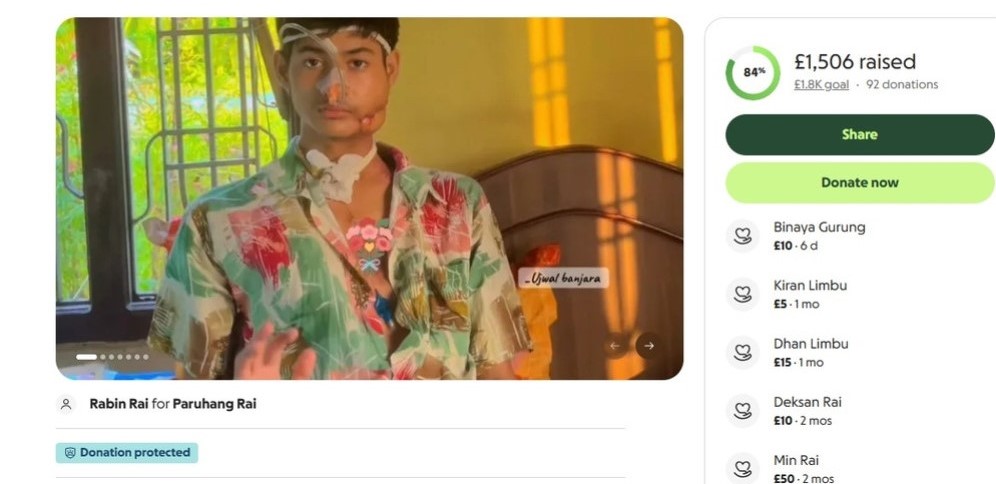
Despite these efforts, some families have not received any support, even when their names were used without their knowledge. For instance, the name of Santanu Dhakal was used by Rabin Rai and Paruhang Rai on GoFundMe to raise 1,800 pounds (Rs335,181). While Rs280,435 has been collected, Santanu has not received any of it. His brother, Elish, stated that they had avoided collecting funds themselves to prevent misuse.
Similarly, a fundraiser for Gaurav Joshi, who died during the protests, aimed to collect $1,000 but has raised only $100, which the family has yet to receive. Gaurav’s maternal uncle, Jagdish Prasad Bhatta, said the organizers have been unresponsive.
Challenges in Distribution and Transparency
Delays in the distribution of funds have been attributed to pending review processes. Khanal, Abhas Bamjan, and Manjil Lamichhane, all raising funds via GoFundMe, said delays in distribution are due to legal and technical procedures. “The families’ concern is valid. They have the right to know when and how they will receive the funds. But we are bound by legal and technical procedures,” they said in an email.
Khanal stated that the GoFundMe Trust and Safety team agent is reviewing all documents and evidence. “The details of the deceased have been verified, and verification of the injured is ongoing. All work is being conducted transparently and in accordance with the law,” he said.
However, not all recipients have been fortunate. Yuvaraj Upadhyaya from Kailali, injured in the stomach and arm, said he has received no funds via GoFundMe. “I haven’t received any aid. Even though the hospital covered treatment and medicines, managing daily living expenses is difficult,” he said.
In contrast, some injured individuals have received funds. Abhishek Shrestha has received funds raised under his name. “My relative, Shyam Shrestha, organised it on GoFundMe, and I have received all the collected money,” he said. A target of 6,500 Australian dollars has so far raised 789 Australian dollars.
Coordination and Government Involvement
Government agencies have also played a role in coordinating relief efforts. The Finance Ministry spokesperson Tanka Prasad Pandey mentioned the establishment of a Physical Infrastructure Reconstruction Fund for systematic collection and distribution of aid. “The fund has an account with Rastriya Banijya Bank and allows voluntary contributions. So far, Rs62.5 million have been deposited. Even if someone collects funds individually, we request them to deposit here for treatment and relief,” he said.
The National Disaster Risk Reduction and Management Authority (NDMRA) has implemented a one-window system to ensure structured relief distribution. However, the authority has not monitored funds collected via social media or GoFundMe. Calls have grown for clearer policies and practical guidelines to ensure proper use of such donations.
Despite the challenges, some organizations have managed to distribute funds effectively. A group of Nepali student organisations in the US aimed to raise $35,000 and has so far collected $27,500, or 79 percent of the target. The fundraiser was coordinated by Rashika Chamlagai of the University of North Carolina. According to Chamlagai, 40 to 50 percent of the collected funds have already been distributed in the first phase.
Conclusion
While the efforts of individuals and organizations to raise funds for the victims of the Gen Z protests have shown promise, the lack of transparency and coordination remains a significant challenge. As the situation continues to evolve, the need for clear policies and effective mechanisms to ensure that aid reaches those in need becomes increasingly urgent.


